THE HAGUE: The International Criminal Court said Thursday it had jurisdiction to probe the forced deportation of Rohingya Muslims by Myanmar’s military as a possible crime against humanity.
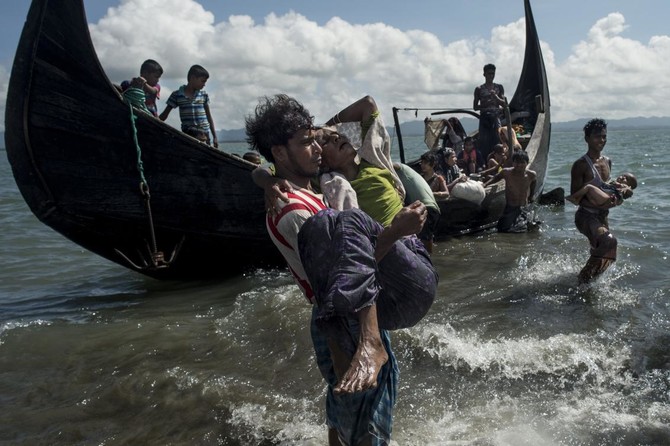
Some 700,000 people from the stateless Muslim minority have fled Myanmar’s northern Rakhine state into neighboring Bangladesh since August last year to escape a bloody military crackdown.
The ICC’s “pre-trial chamber... decided by majority the court may exercise jurisdiction over the alleged deportations of the Rohingya people from Myanmar to Bangladesh,” the Hague-based tribunal said in a statement.
The Myanmar government on Thursday declined to comment on the announcement when contacted by AFP.
The move comes days after UN investigators called for an international investigation and prosecution of Myanmar’s army chief and five other top military commanders for genocide, crimes against humanity and war crimes against the Rohingya.
The violence has left a trail of torched villages in its wake, amid allegations of murder and rape at the hands of troops and vigilantes.
In an unprecedented move in April, the ICC’s chief prosecutor Fatou Bensouda asked judges to rule whether she can investigate the deportations as a crime against humanity.
It is a legally complicated request, as Myanmar is not a signatory and member of the Rome Statute which underpins the ICC.
The Southeast Asian nation voiced “serious concern” over the prosecutor’s move, saying that the ICC’s charter in fact did not state that it had jurisdiction to investigate a country that had not signed up to the Rome Statute that governs the court.
Bangladesh, however, is a signatory and the judges said that because the deportations involve a cross-border crime, that gives the court jurisdiction to investigate the plight of the Rohingya.
Bensouda had likened deportation to “a cross-border shooting,” arguing the crime “is not completed until the bullet (fired in one state) strikes and kills the victim (standing in another state).”

Judges rule ICC has jurisdiction over Rohingya deportations
Ukraine sanctions Belarus leader for supporting Russian invasion
- Ukraine on Wednesday sanctioned Belarus’s long-time leader Alexander Lukashenko for providing material assistance to Russia in its invasion and enabling the “killing of Ukrainians.”
KYIV: Ukraine on Wednesday sanctioned Belarus’s long-time leader Alexander Lukashenko for providing material assistance to Russia in its invasion and enabling the “killing of Ukrainians.”
Lukashenko is one of Russian President Vladimir Putin’s closest allies and allowed his country to be used as a springboard for Moscow’s February 2022 attack.
Russia has also deployed various military equipment to the country, Ukraine alleges, including relay stations that connect to Russian attack drones, fired in their hundreds every night at Ukrainian cities.
“Today Ukraine applied a package of sanctions against Alexander Lukashenko, and we will significantly intensify countermeasures against all forms of his assistance in the killing of Ukrainians,” President Volodymyr Zelensky said in a statement.
Russia has also said it is stationing Oreshnik missiles in Belarus, a feared hypersonic ballistic weapon that Putin has claimed is impervious to air defenses. It has twice been fired on Ukraine during the war — launched from bases in Russia — though caused minimal damage as experts said it was likely fitted with dummy warheads both times.
Zelensky also accused Lukashenko of helping Moscow avoid Western sanctions.
The measures are likely to have little practical effect, but sanctioning a head of state is a highly symbolic move.
Ukraine and several Western states sanctioned Putin at the very start of the war.
Lukashenko has at times tried to present himself as a possible intermediary between Kyiv and Moscow.
Initial talks on ending Russia’s invasion in the first days of the war were held in the country.
But Kyiv and its Western backers have largely dismissed his attempts to mediate, seeing him as little more than a mouthpiece for the Kremlin.
Lukashenko is one of Russian President Vladimir Putin’s closest allies and allowed his country to be used as a springboard for Moscow’s February 2022 attack.
Russia has also deployed various military equipment to the country, Ukraine alleges, including relay stations that connect to Russian attack drones, fired in their hundreds every night at Ukrainian cities.
“Today Ukraine applied a package of sanctions against Alexander Lukashenko, and we will significantly intensify countermeasures against all forms of his assistance in the killing of Ukrainians,” President Volodymyr Zelensky said in a statement.
Russia has also said it is stationing Oreshnik missiles in Belarus, a feared hypersonic ballistic weapon that Putin has claimed is impervious to air defenses. It has twice been fired on Ukraine during the war — launched from bases in Russia — though caused minimal damage as experts said it was likely fitted with dummy warheads both times.
Zelensky also accused Lukashenko of helping Moscow avoid Western sanctions.
The measures are likely to have little practical effect, but sanctioning a head of state is a highly symbolic move.
Ukraine and several Western states sanctioned Putin at the very start of the war.
Lukashenko has at times tried to present himself as a possible intermediary between Kyiv and Moscow.
Initial talks on ending Russia’s invasion in the first days of the war were held in the country.
But Kyiv and its Western backers have largely dismissed his attempts to mediate, seeing him as little more than a mouthpiece for the Kremlin.
© 2026 SAUDI RESEARCH & PUBLISHING COMPANY, All Rights Reserved And subject to Terms of Use Agreement.


