Pakistan-Saudi trade ties to scale new heights

1 / 5
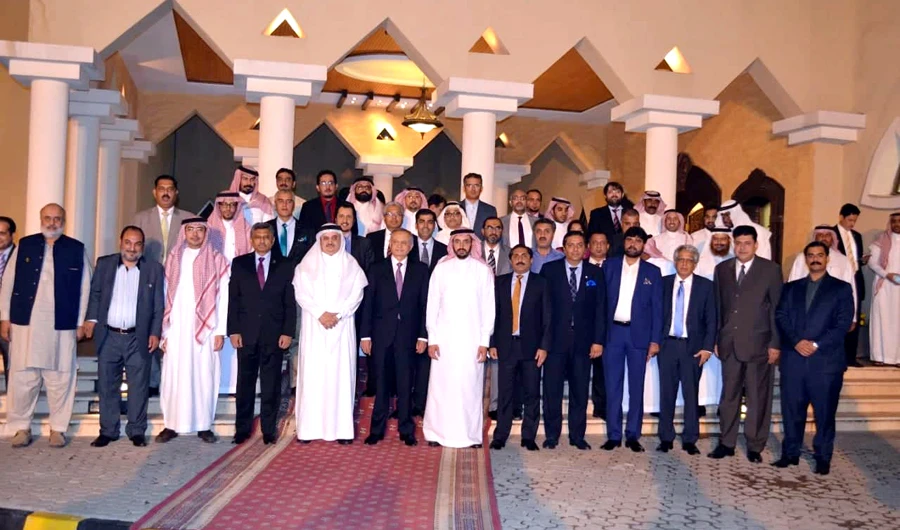
The Saudi trade delegation with Saudi Arabia Ambassador to Pakistan Nawaf Al-Malki and Commerce Secretary Mohammed Younus Dagha during a dinner. (AN photo)
2 / 5
From right, Saudi Arabia’s Deputy Minister for Foreign Trade Abdul Rahman Al-Harbi, Saudi Ambassador to Pakistan Nawaz Al-Malki (center) and Commerce Secretary Mohammed Younus Dagha exchange views. (AN photo)
3 / 5
From right, Saudi Arabia’s Deputy Minister for Foreign Trade Abdul Rahman Al-Harbi, Saudi Ambassador to Pakistan Nawaz Al-Malki (center) and Commerce Secretary Mohammed Younus Dagha exchange views. (AN photo)
4 / 5
Officials attend an informal meeting as Saudi Arabia trade delegation visits Pakistan. (AN photo)
5 / 5
From right, Saudi Arabia’s Deputy Minister for Foreign Trade Abdul Rahman Al-Harbi, Saudi Ambassador to Pakistan Nawaz Al-Malki (center) and Commerce Secretary Mohammed Younus Dagha exchange views. (AN photo)
Updated 07 September 2018
Follow

Pakistan-Saudi trade ties to scale new heights

  • Delegation identifies key areas of development in Islamabad
  • Riyadh says it looks forward to cement relationship with newly-formed government

ISLAMABAD: Following on the heels of a high-powered business meeting between Islamabad and Riyadh, Saudi Arabia's Deputy Minister for Foreign Trade Abdul Rahman Al-Harbi pledged an increase in bilateral trade volume with a focus on expansion in the oil, gas and petrochemical sectors.

“Current bilateral trade relationship is now around $3.2 billion and it is not meeting expectations… I think there is a great room for improvement [in the existing trade volume],” Al-Harbi told Arab News, on the sidelines of a dinner hosted by Saudi Arabia’s Ambassador to Pakistan, Nawaf bin Said Al-Malki, on Wednesday.

Al-Malki said relations between Pakistan and Saudi are deep-rooted, with both countries looking to expand in major sectors. “We will further cement our strong ties with the new government,” Al-Malki said.

Pakistani officials from the ministry of trade and commerce were also present at the meeting, including the Secretary of Commerce Mohammed Younus Dagha. 

Dagha, on his part, said that result-oriented meetings have been held between the two sides and the response from “Saudi Arabia side was very very positive.” “We want a very large investment from Saudi Arabia. And we are talking in [terms of] several million dollars … [specifically] in the petrochemical sector,” he said.

Referring to the role of the private sector in enhancing bilateral trade ties, Al-Harbi said they had held meetings with representatives from SABIC, Maaden and Aramco which helped identify “many areas of cooperation”.

“Personally, I’m very optimistic and I think it (bilateral trade) has a great potential and it is in the right direction now. We [just have to] make sure that the private sectors get access to those opportunities,” he said.

Dagha said Pakistan has huge investment potential, especially in the agricultural sector, and Saudi Arabia would be extended all help to advance in the field. “We are willing to give Saudi large areas of land. They can come and develop [their resources],” Dagha said.
Pakistan launches $136 million Ramadan relief package for 12.1 million families

Updated 8 sec ago
Follow

Pakistan launches $136 million Ramadan relief package for 12.1 million families

  • Rs13,000 per family to be transferred via bank accounts, mobile wallets under cashless system
  • Pakistan’s national space agency says the Muslim fasting month is likely to begin from Feb. 19

ISLAMABAD: Prime Minister Shehbaz Sharif on Saturday launched a Rs38 billion ($136 million) Ramadan relief package, pledging direct digital cash transfers of Rs13,000 ($47) each to 12.1 million low-income families across Pakistan.

Pakistan’s national space agency announced a day earlier the Ramadan crescent would likely be visible on Feb. 18, with the first fast expected to fall on Feb. 19, subject to official confirmation.

The government will distribute the relief package through bank accounts and regulated mobile wallet platforms, fully replacing the previous utility store-based subsidy model with a digital payment mechanism overseen by the State Bank of Pakistan.

“This year, Rs38 billion have been allocated ... that will not only be distributed to the rightful people in all four provinces, but also to Gilgit-Baltistan and Azad Kashmir through these wallets and digital bank accounts,” the prime minister said during a ceremony in the federal capital, adding that 12.1 million families would benefit.

The allocation marks a sharp increase from last year’s Rs 20 billion ($72 million) Ramadan program, as the government expands coverage and deepens its shift toward cash-based targeted subsidies.

Officials said Rs28 billion ($101 million) has been earmarked for families not currently receiving support under any federal income assistance program, while an additional Rs10 billion ($36 million) will go to those already registered under existing social protection schemes.

Syed Imran Shah, federal minister for poverty alleviation and social security, said the digital framework would allow transfers to be made in a “safe, effective and easy way,” reducing leakages and preserving beneficiaries’ dignity by eliminating long queues and physical distribution centers.

Amir Ali Ahmed, secretary of the Benazir Income Support Program (BISP), said the 2026 rollout builds on last year’s digital transition, when around two million beneficiaries received payments electronically.

A third-party validation report issued in December 2025 confirmed the transparency and operational effectiveness of the system, he added.

The prime minister said he would personally oversee periodic reviews of the program to ensure timely disbursement.

The government had scrapped the Utility Store-based Ramadan subsidy system last year, arguing that it led to quality concerns, long queues and administrative inefficiencies.

The digital transfer model aims to move toward a targeted subsidy regime aligned with broader efforts to expand financial inclusion and reduce cash-based leakages.