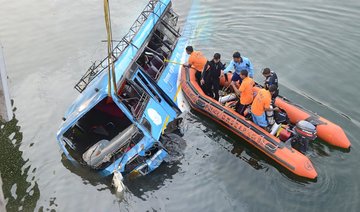
DUBAI: Poor maintenance has been blamed for a bridge collapse that has killed at least five people in south Calcutta, in the state of West Bengal in eastern India.
Images of the Majerhat road bridge show a broken section of the 40-year old highway that appears to be roughly 30 meters long.
Speaking to the Arab News, a Calcutta resident who did not wish to be identified said: “There is total pandemonium in the area with distraught bystanders present and rescue teams trying to manage the situation. This is hampering rescue operations.”
He added that the death toll was expected to rise, as rescue workers struggled to rescue any survivors.
“There is speculation that the maintenance work on many bridges in the city of Calcutta has not been regular,” he added. “The onus falls on the authorities. The Majerhat bridge is a case in point. The volume of heavy and light traffic over the bridge has increased over the years since it connects two parts of the city. This traffic has not been regulated or controlled. The number of cars plying over it has obviously increased and thousands commute daily over the bridge.”
Chief Minister Mamata Banerjee said the first priority was to rescue the injured and those who were trapped, according to a Press Trust of India report.
The bridge, that collapsed at around midday on Tuesday, was built in the late 70s, according to Calcutta resident Jason Pote.
“At that time, the area was not developed since the city had not witnessed the construction and residential boom then. This bridge was built for low-volume traffic. The gradual increase in traffic occurred with the construction of a free port area nearby. Port containers and other heavy cargo then began to move across this bridge at nights to be offloaded at other parts of the city. The lack of maintenance therefore made it an accident waiting to happen.”
Pote added that the crash “would affect a lot of people. The Majerhat bridge and a parallel bridge, the Durgapur Bridge, carry people from the developed areas to the central business districts of Calcutta.
“People will now find it tough to reach their destinations. There are very little options. The local police will be under pressure to regulate alternative traffic routes in a city which is renowned for traffic jams.
“There are six schools on the main road itself. So, from 8 a.m. - 8.30 a.m. there will be mayhem since it is school times. Each school has probably around 2,000 students and this is a conservative number. This means 10,000 passengers travelling daily in over 2,500-3,000 vehicles looking for alternative routes which will be affected.”
Arab News tried to contact Derek O’Brien, a member of Parliament and spokesman for the All-India Trinamool Congress, the ruling party in West Bengal, but was unable to get a comment.

Poor maintenance blamed for deadly Calcutta bridge collapse
- Dramatic footage captured on a security camera shows how a busy Calcutta street turned into carnage
- Chief Minister Mamata Banerjee said the first priority was to rescue the injured and those who were trapped
Uganda’s presidential election experiences hours of delays at some polling stations
- Some polling stations remained closed for up to four hours after the scheduled 7 a.m. start time due to “technical challenges“
- The East African country of roughly 45 million people has 21.6 million registered voters
KAMPALA, Uganda: Uganda’s presidential election was plagued by widespread delays Thursday in addition to a days-long Internet shutdown that has been criticized as an anti-democratic tactic in a country where the president has held office since 1986.
Some polling stations remained closed for up to four hours after the scheduled 7 a.m. start time due to “technical challenges,” according to the nation’s electoral commission, which asked polling officers to use paper registration records to ensure the difficulties did not “disenfranchise any voter.”
President Yoweri Museveni, 81, faces seven other candidates, including Robert Kyagulanyi, a musician-turned-politician best known as Bobi Wine, who is calling for political change.
The East African country of roughly 45 million people has 21.6 million registered voters. Polls are expected to close at 4 p.m. Thursday, according to the electoral commission. Results are constitutionally required to be announced in 48 hours.
Impatient crowds gathered outside polling stations expressing concerns over the delays Thursday morning. Umaru Mutyaba, a polling agent for a parliamentary candidate, said it was “frustrating” to be waiting outside a station in the capital Kampala.
“We can’t be standing here waiting to vote as if we have nothing else to do,” he said.
Wine alleged there was electoral fraud occurring, noting that biometric voter identification machines were not working at polling places and claiming there was “ballot stuffing.”
“Our leaders, including Deputy President for Western Region, arrested. Many of our polling agents and supervisors abducted, and others chased off polling stations,” Wine wrote in a post on social media platform X.
Museveni told journalists he was notfied biometric machines were inoperable at some stations and he supported the electoral body’s decision to revert to paper registration records. He did not comment on the allegation of fraud.
Ssemujju Nganda, a prominent opposition figure and lawmaker seeking reelection in Kira municipality, told The Associated Press he had been waiting in line to vote for three hours.
Nganda also noted biometric machines were malfunctioning, in addition to the late arrival of balloting materials, and predicted the delays likely would lead to apathy and low turnout in urban areas where the opposition has substantial support.
“It’s going to be chaos,” he said Thursday morning.
Nicholas Sengoba, an independent analyst and newspaper columnist, said delays to the start of voting in urban, opposition areas favored the ruling party.
Museveni serving Africa’s third-longest presidential term
Uganda has not witnessed a peaceful transfer of presidential power since independence from British colonial rule six decades ago.
Museveni has served the third-longest term of any African leader and is seeking to extend his rule into a fifth decade. Some critics say removing him through elections remains difficult, but the aging president’s authority has become increasingly dependent on the military led by his son, Muhoozi Kainerugaba.
Museveni and Wine are reprising their rivalry from the previous election in 2021, when Wine appealed to mostly young people in urban areas. With voter turnout of 59 percent, Wine secured 35 percent of the ballots against Museveni’s 58 percent, the president’s smallest vote share since his first electoral campaign three decades ago.
The lead-up to Thursday’s election produced concerns about transparency, the possibility of hereditary rule, military interference and opposition strategies to prevent vote tampering at polling stations.
Uganda’s Internet was shut down Tuesday by the government communications agency, which cited misinformation, electoral fraud and incitement of violence. The shutdown has affected the public and disrupted critical sectors such as banking.
Heavy security deployed
There has been heavy security leading up to voting, including military units deployed on the streets this week.
Amnesty International said security forces are engaging in a “brutal campaign of repression,” citing a Nov. 28 opposition rally in eastern Uganda where the military blocked exits and opened fire on supporters, killing one person.
Museveni urged voters to come out in large numbers during his final rally Tuesday.
“You go and vote, anybody who tries to interfere with your freedom will be crushed. I am telling you this. We are ready to put an end to this indiscipline,” he said.
The national electoral commission chairperson, Simon Byabakama, urged tolerance among Ugandans as they vote.
“Let us keep the peace that we have,” Byabakama said late Wednesday. “Let us be civil. Let us be courteous. Let’s be tolerant. Even if you know that this person does not support (your) candidate, please give him or her room or opportunity to go and exercise his or her constitutional right.”
Authorities also suspended the activities of several civic groups during the campaign season. That Group, a prominent media watchdog, closed its office Wednesday after the interior ministry alleged in a letter that the group was involved in activities “prejudicial to the security and laws of Uganda.”
Veteran opposition figure Kizza Besigye, a four-time presidential candidate, remains in prison after he was charged with treason in February 2025.