

Pakistan, UAE hold talks on migratory birds

In this file photo, a houbara bustard flies during a falconry competition in Hameem, 150km west of Abu Dhabi, on Dec. 9, 2014. (AFP)
Updated 01 September 2018
Follow

Pakistan, UAE hold talks on migratory birds

  • Discuss issues of Houbara Bustard hunting and impact of climate change on the environment
  • Several wildlife sanctuaries already in place in Sindh

ISLAMABAD: UAE’s deputy head of mission Abdul Aziz Al-Neiyadi on Friday said that the UAE was ready to sign an MOU with Pakistan following discussions on climate change and the hunting of the Houbara Bustard.
In the meeting with Malik Amin Aslam, Pakistan’s adviser on climate change, Al-Neiyadi stressed upon areas of “mutual cooperation between Pakistan and UAE including [the hunting of the] Houbara Bustard and the environment”, while appreciating the pro-environmental initiatives undertaken by the current government, a statement released by the ministry read.
“We are ready to sign an MOU in this regard,” he said, adding that the UAE extended its invaluable support to Pakistan to utilize the huge economic potential in the area.
Aslam, on his part, reiterated the fact that Pakistan “attaches high value to its friendly relations with the UAE and wishes to take them to new heights, especially in the area of environment”.
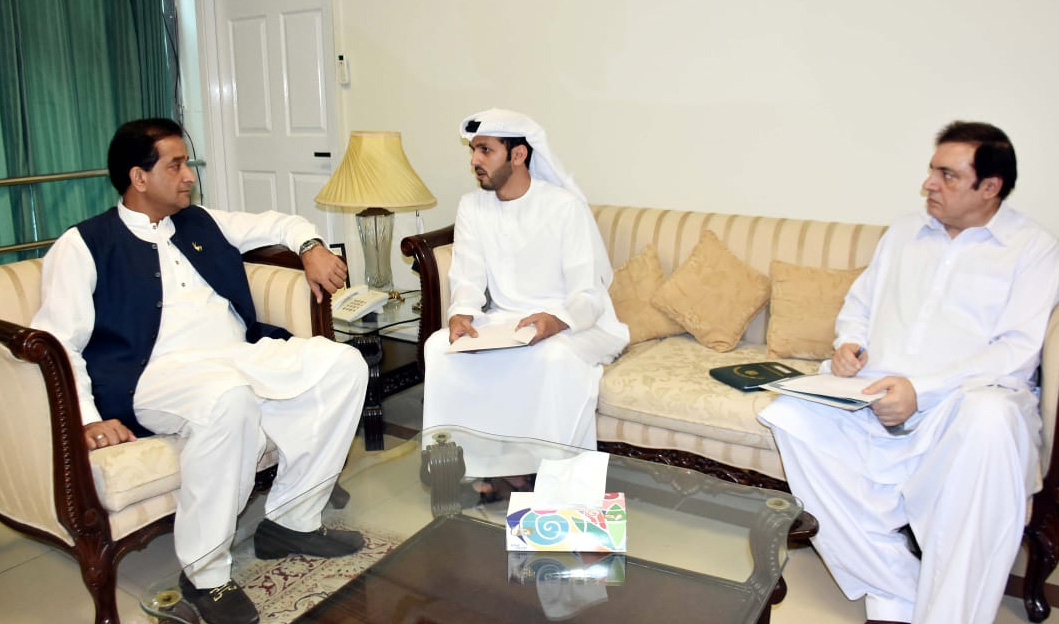


UAE Deputy head of mission Abdul Aziz Al-Neiyadi met with Prime Minister Imran Khan’s Advisor on climate change Malik Amin Aslam (Photo courtesy: Ministry of Climate Change)

There are several wildlife sanctuaries in place for the migratory birds in Pakistan’s eastern province of Sindh.
In December last year, Sindh’s provincial wildlife department registered a case against a member of the Qatari royal family for hunting without proper permission.
In 2015, environment authorities in Pakistan’s northwestern province of Khyber Pakhtunkhwa also fined a Qatari prince for hunting the rare birds without a permit.
The International Union for Conservation of Nature has classified the Houbara Bustard as a vulnerable species. “Pakistan is located along the Central Asian Flyway (CAF) connecting central Asia to the Indian Ocean. The CAF falls in the Indus Plains and is frequented by a number of birds from central Asia and the subcontinent during their migration period,” Mohammad Saleem, Deputy Director of Media and Communications at the ministry of climate change, told Arab News.
Every year, Royal Arab hunting expeditions travel to Pakistan during the winter season in pursuit of the Houbara Bustard with Pakistan’s authorities issuing special permits for the same.


Pakistan, China to sign multiple MoUs at major agriculture investment conference today

Updated 11 sec ago
Follow

Pakistan, China to sign multiple MoUs at major agriculture investment conference today

  • Hundreds of Chinese and Pakistani firms to attend Islamabad event
  • Conference seen as part of expanding CPEC ties into agriculture, trade

KARACHI: Islamabad and Beijing are set to sign multiple memorandums of understanding (MoUs) to boost agricultural investment and cooperation at a major conference taking place in the capital tomorrow, Monday, with hundreds of Chinese and Pakistani companies expected to participate.

The conference is being billed by Pakistan’s Ministry of National Food Security and Research as a platform for deepening bilateral agricultural ties and supporting broader economic engagement between the two countries.

“Multiple memorandums of understanding will be signed at the Pakistan–China Agricultural Conference,” the Ministry of National Food Security said in a statement. “115 Chinese and 165 Pakistani companies will participate.”

The conference reflects a growing emphasis on expanding Pakistan-China economic cooperation beyond the transport and energy foundations of the flagship China-Pakistan Economic Corridor (CPEC) into agriculture, industry and technology.

Under its first phase launched in 2015, CPEC, a core component of China’s Belt and Road Initiative, focused primarily on transportation infrastructure, energy generation and connectivity projects linking western China to the Arabian Sea via Pakistan. That phase included motorways, power plants and the development of the Gwadar Port in the country's southwest, aimed at helping Pakistan address chronic power shortages and enhance transport connectivity.

In recent years, both governments have formally moved toward a “CPEC 2.0” phase aimed at diversifying the corridor’s impact into areas such as special economic zones, innovation, digital cooperation and agriculture. Second-phase discussions have highlighted Pakistan’s goal of modernizing its agricultural sector, attracting Chinese technology and investment, and boosting export potential, with high-level talks taking place between planning officials and investors in Beijing.

Agri-sector cooperation has also seen practical collaboration, with joint initiatives examining technology transfer, export protocols and value-chain development, including partnerships in livestock, mechanization and horticulture.

Organizers say the Islamabad conference will bring together government policymakers, private sector investors, industry associations and multinational agribusiness firms from both nations. Discussions will center on investment opportunities, technology adoption, export expansion and building linkages with global buyers within the framework of Pakistan-China economic cooperation.