

Iranian minister visits Pakistan but support from Islamabad likely to be limited

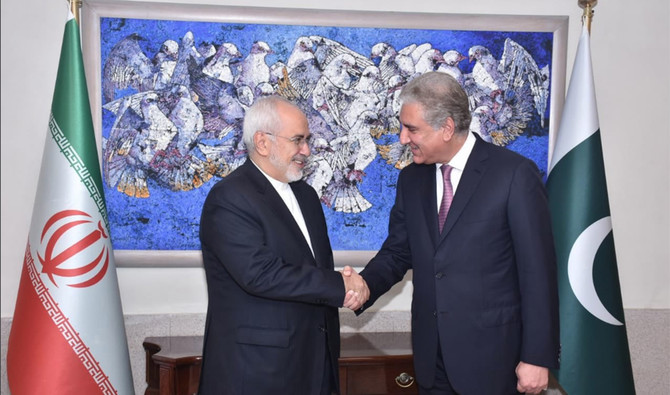
Foreign Minister of Pakistan Shah Mahmoud Quraishi greets his Iranian counterpart Jawad Zarif in Islamabad. Zarif’s visit came days before the expected arrival of US Secretary of State Michael Pompeo in Pakistan. (Ministry of Foreign Affairs in Islamabad)
Updated 31 August 2018
Follow

Iranian minister visits Pakistan but support from Islamabad likely to be limited

  • Foreign Minister Javad Zarif is first foreign dignitary to visit Pakistan since new government took over
  • His trip comes days before the US secretary of state is due to arrive in Pakistan, on Sept. 5

ISLAMABAD: Iranian Foreign Minister Javad Zarif concluded a two-day official visit to Islamabad on Friday. While Pakistan’s Foreign Minister Shah Mehmood Qureshi publicly declared the country support for Iran’s “principled stance” over the 2015 nuclear deal, after the withdrawal of the US from the agreement, analysts said that Islamabad might not be in a position to provide Tehran with the support it has promised.

In addition to Qureshi, Zarif, the first foreign dignitary to visit Pakistan since the new government took over, also met Prime Minister Imran Khan, National Assembly speaker Asad Qaiser and army chief Gen. Qamar Javed Bajwa.

“Welcoming his Iranian counterpart, Foreign Minister Shah Mahmood Qureshi noted the potential for strengthening the already strong bilateral relationship,” said the Ministry of Foreign Affairs.

Referring to the 2015 Joint Comprehensive Plan of Action nuclear deal between Iran, the P5+1 countries (China, France, Russia, the United Kingdom, the US and Germany) and the EU, which was signed in 2015, Qureshi said that Pakistan supports “Iran’s principled stance.”

US President Donald Trump withdrew the US from the agreement this year and announced the re-imposition of economic sanctions that had been lifted as part of the deal. However, experts believe that Pakistan might be unable to support Iran as it has promised.

“Islamabad does not have that political clout, and Pakistan’s own relations with the US are hanging with a fragile thread that could break any moment,” said geopolitical analyst, Qamar Cheema.

During his meetings, “Zarif discussed the expansion of cooperation with Pakistan in different fields of common interest, including economy and social relations,” the Foreign Office said. In addition, security collaboration along the troubled Pakistan-Iran border, military cooperation and counterterrorism were among the key issues he discussed with the Gen. Bajwa.

Zarif’s visit came days before the expected arrival of US Secretary of State Michael Pompeo in Pakistan on Sept. 5. US-Pakistan relations remain frosty due to a deep and longstanding trust deficit, but mindful of the country’s alleged influence over the Taliban, the US has not imposed sanctions and continues to engage with its estranged ally despite the strained relations.

However, the administration in Washington has kept Islamabad under mounting pressure, in an attempt to force it to comply with its demand for action against the militants who have consistently thwarted American peace efforts in Afghanistan.


What is Trump’s ‘Board of Peace’?

Updated 6 sec ago
Follow

What is Trump’s ‘Board of Peace’?

  • The Board of Peace’s charter does not appear to limit its role to the occupied Palestinian territory of Gaza
  • Trump will be chairman but also “separately serve as inaugural representative of the United States of America”

BRUSSELS: US President Donald Trump’s government has asked countries to pay $1 billion for a permanent spot on his “Board of Peace” aimed at resolving conflicts, according to its charter seen by AFP.
The board was originally conceived to oversee the rebuilding of war-torn Gaza, but the charter does not appear to limit its role to the occupied Palestinian territory.
What exactly will it do? And who has been invited?

- To what end? -

The Board of Peace will be chaired by Trump, according to its founding charter.
It is “an international organization that seeks to promote stability, restore dependable and lawful governance, and secure enduring peace in areas affected or threatened by conflict,” reads the preamble of the charter sent to countries invited to participate.
It will “undertake such peace-building functions in accordance with international law,” it adds.

- Who’s boss? -

Trump will be chairman but also “separately serve as inaugural representative of the United States of America.”
“The Chairman shall have exclusive authority to create, modify, or dissolve subsidiary entities as necessary or appropriate to fulfill the Board of Peace’s mission,” the document states.
He will pick members of an Executive Board to be “leaders of global stature” to “serve two-year terms, subject to removal by the Chairman.”
He may also, “acting on behalf of the Board of Peace,” “adopt resolutions or other directives.”
The chairman can be replaced only in case of “voluntary resignation or as a result of incapacity.”

- Who can be a member? -

Member states have to be invited by the US president, and will be represented by their head of state or government.
Each member “shall serve a term of no more than three years,” the charter says.
But “the three-year membership term shall not apply to Member States that contribute more than USD $1,000,000,000 in cash funds to the Board of Peace within the first year of the Charter’s entry into force,” it adds.
The board will “convene voting meetings at least annually,” and “each member State shall have one vote.”
But while all decisions require “a majority of Member States present and voting,” they will also be “subject to the approval of the Chairman, who may also cast a vote in his capacity as Chairman in the event of a tie.”

- Who’s already in? -

The White House has said its members will include:
US President Donald Trump, chair
US Secretary of State Marco Rubio
Steve Witkoff, Trump’s special negotiator
Jared Kushner, Trump’s son-in-law
Tony Blair, former UK prime minister
Marc Rowan, billionaire US financier
Ajay Banga, World Bank president
Robert Gabriel, loyal Trump aide on the National Security Council

- Who’s been invited? -

The list of countries and leaders who say they have been invited include, but are not limited to:
Russia’s President Vladimir Putin
Canada’s Prime Minister Mark Carney
Egypt’s President Abdel Fattah El-Sisi
Argentina’s President Javier Milei
Jordan
Brazil
Paraguay
India
Pakistan
Germany
France
Italy
Hungary
Romania
Uzbekistan
Belarus
Greece
Morocco
Slovenia
Poland

- When does it start? -

The charter says it enters into force “upon expression of consent to be bound by three States.”