

UK minister to discuss Iran’s destabilizing activities in Syria, Yemen

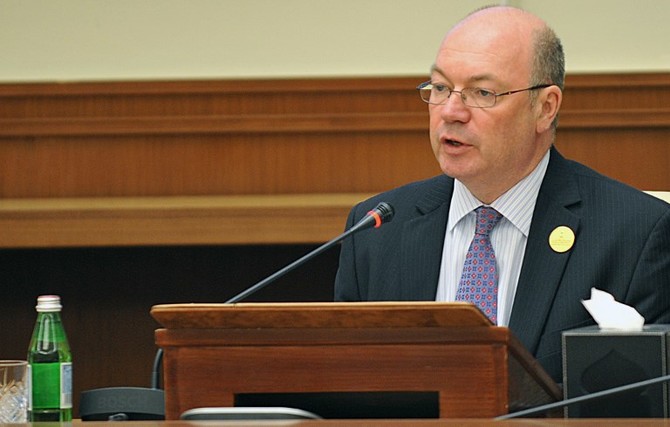
Junior Foreign Minister Alistair Burt arrived in Tehran on Friday. (AFP/File Photo)
Updated 31 August 2018
Follow

UK minister to discuss Iran’s destabilizing activities in Syria, Yemen

  • Burt will discuss Iran’s “destabilizing role” in the ongoing conflicts in Syria and Yemen, as well as the plight of dual nationals detained in Iran
  • His visit comes as the EU tries to keep the deal alive

JEDDAH: Junior Foreign Minister Alistair Burt arrived in Tehran on Friday to discuss the future of Iran’s international nuclear deal, in the first visit to the country by a British minister to Iran since US President Donald Trump withdrew from the 2015 agreement.

His visit comes as the EU tries to keep the deal alive.

Burt will also discuss Iran’s “destabilizing role” in the ongoing conflicts in Syria and Yemen, as well as the plight of dual nationals detained in Iran.

In a statement ahead of the visit, Burt said: “During my visit … I will stress that Iran’s ballistic missile program and its destabilizing activities in the Middle East must be addressed. I will also use the opportunity of my visit to push for the resolution we all want to see in the cases of the British dual nationals detained in Iran.”

Britain is seeking the release of Nazanin Zaghari-Ratcliffe, a project manager with the Thomson Reuters Foundation. She was arrested in April 2016 at Tehran’s airport as she was heading back to Britain with her daughter, now aged four, after a family visit.

Burt will meet Iranian ministers, including his counterpart Abbas Araghchi, and NGOs during his two-day visit.

“As long as Iran meets its commitments under the deal, we remain committed to it as we believe it is the best way to ensure a safe, secure future for the region,” said Burt.


France to rally aid for Lebanon as it warns truce gains remain fragile

Updated 3 sec ago
Follow

France to rally aid for Lebanon as it warns truce gains remain fragile

France said on Friday that Lebanon’s recovery remains precarious despite positive signs following a ceasefire and government transition, and it stood ready to support ​the country’s reconstruction if it continues with reforms.
French Minister for Europe and Foreign Affairs Jean-Noel Barrot, addressing reporters after meetings in Beirut with Lebanese President Joseph Aoun and other top officials, said France was prepared to host a dedicated conference in Paris on reconstruction, but only if reforms continue, legislation is passed ‌and decisions ‌are implemented.
While Lebanon has adopted ‌banking ⁠secrecy ​and ‌bank resolution laws, it must still complete restructuring, reach an IMF agreement and pass a loss-sharing law, Barrot said. He also urged swift action on Hezbollah disarmament and national reconciliation.
Barrot said Lebanon had reached a crucial juncture in implementing the November 2024 truce with Israel, as well as restoring ⁠state authority over weapons and stabilising a shattered financial system.
France, the ‌country’s former colonial power, plans ‍to mobilize international backing for ‍the Lebanese armed forces and internal security forces at ‍a separate conference scheduled for March 5 in Paris.
“Lebanon must work to restore confidence — that of its citizens, businesses, depositors, and the diaspora,” Barrot said.
France’s immediate focus was ensuring respect ​for the ceasefire, which he emphasized “implies that Israel withdraws from Lebanese territory, in accordance with its ⁠commitments, and that civilians are protected from strikes,” alongside implementation by Lebanese authorities of an agreed-upon arms monopoly plan.
Lebanon has pledged to bring all arms in the country under state control, in line with the 2024 agreement that ended a devastating war between Hezbollah and Israel, and has asserted control over areas of the country closest to the border with Israel. But Hezbollah has warned the government that pressing on with efforts to disarm ‌the group throughout the country would trigger chaos and possibly civil war.