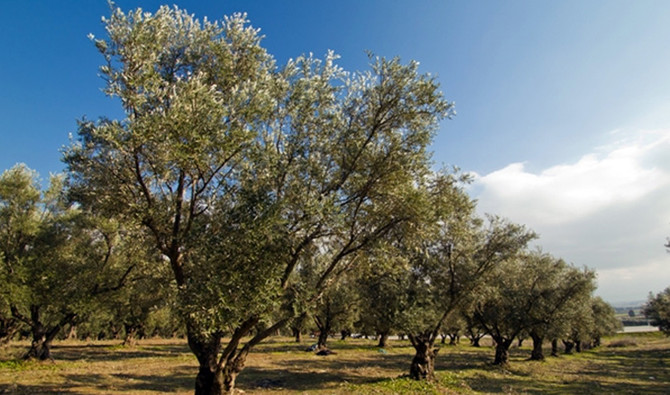

KARACHI: A “silent revolution” is taking over Pakistan, one olive tree at a time.
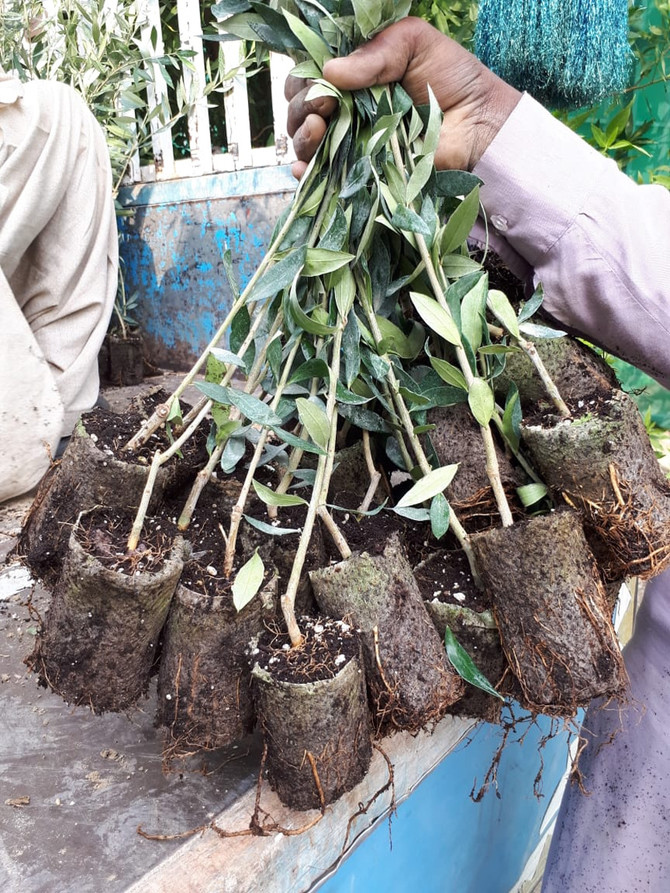
And if all branches are extended properly, the Punjab government will soon provide free olive saplings to nearly 600 farmers, as part of a plantation project, in an area now known as the Olive Valley.
“Spread across 9,000 acres of land in Rawalpindi, Chakwal, Jhelum and Attock districts of the Potohar region – along with Mianwali and Khushab – the Olive Valley currently has 833,400 trees,” Tariq Azeem, the project’s director, told Arab News.
With help from the Barani Agriculture Research Institute in Chakwal, the Punjab Agriculture Department has so far planted more than one million olive tree saplings in the Potohar region.
The project aims to enhance local production and curtail the country's import of olive oil, currently billed at 5,000 metric tons.
“The returns are promising. Last year we sold olive oil for Rs3,500 (Dh104.46, $28.44) per liter, which was much lower than the international price of $95 per litre,” Basit Shakeel Hashmi, an olive farmer, said.
Hashmi says farming in the valley has helped him produce “the world’s best extra virgin olive oil”.
Thus far, he has planted more than 20,000 olive trees on his farm and is anticipating a profitable yield by mid-September. “The average yield is 25 kilograms. We are determined to increase the yield so that the country can reduce its dependence on imported olive oil,” he said.
“Initially we used to import saplings, but are now developing local varieties of the plant. We sell these to the government for Rs150 rupees per sapling [earlier sold at Rs350]. They are then distributed to new farmers free of cost,” Hashmi said.
As part of the project, which is divided into three phases, the government will also provide technical assistance to farmers along with special subsidies, Azeem, the project’s director, said.
“We want to plant two million saplings over an area of 15,000 acres in the first phase,” he said, adding that the project “is expected to generate 25,000 to 30,000 employment opportunities”. “Apart from job creation, the project has also significantly increased the monetary value of the land,” he said.
In 2017, 25 tons of olives were transported to an oil extraction facility, located in the Chakwal district.
“We estimate that an equal amount of the plant was also utilised for [making] pickles and for other purposes. Our oil extraction facility is equipped with state-of-the-art Italian machinery with a capacity of generating 600 kilograms per hour,” he added.
According to estimates provided by Azeem, “Potohar is the place where the world’s best extra virgin oil is being extracted and sold for Rs2,000 and Rs4,000 per liter. It is a silent revolution in the arid zone of the plateau”.
The Olive Valley project has also helped increase the take away income for farmers, encouraging older and more experienced agronomists to help their younger counterparts.
In the past 27 years, Pakistan has developed nearly 70 varieties of olives. These, in turn, helped produce 16 of the best varieties of the plant from across the country. “We are now focusing on farming only four varieties of olives that have proven to be the best in the world,” Azeem said.
Currently, the major consumption of edible oil in Pakistan is of the soybean and palm oil variety.
According to the Federal Bureau of Statistics, the country imported 156,718 metric tons of soybean oil during the last fiscal year while the import of palm oil stood at 2,843,350 metric tons for the same period.
With recent breakthroughs in olive farming, Azeem says he is confident that “the country will attain at least 50 per cent self-sufficiency in olive oil production in the next decade, a step that would save reasonable amount of much- needed foreign exchange.”
Farmers can apply to be a part of the project until August 31.