White Helmets documentary crew heads to Oscars for ‘Last Men in Aleppo’

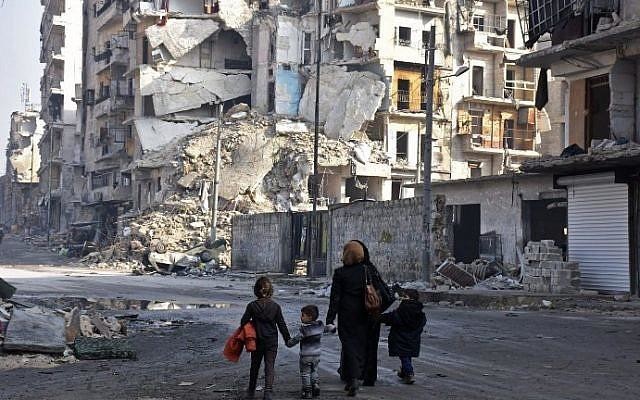
Syrians walk along a damaged street in Aleppo's Tareeq Al-Bab neighborhood on January 18, 2017, a month after government forces retook the northern Syrian city from rebel fighters. (AFP)
Updated 04 March 2018
Follow

White Helmets documentary crew heads to Oscars for ‘Last Men in Aleppo’

CAIRO: Members of the the White Helmets are heading to the Oscars to be held on Sunday, where Syrian film ‘Last Men in Aleppo’ has been nominated in the Best Feature Documentary category.
The film documents the efforts of the Syrian White Helmets volunteer civil defense group that operates in rebel-held parts of Syria.
Described by its director Firas Fayyad as “a big shout out to justice” that lays bare the horrors of the war in his native country.
The movie describes the daily war atrocities through the eyes of volunteer rescue workers.
“We were very happy to be nominated,” Khaled Khatib, a member of the volunteer emergency response group and one of the film’s producers, told CBC News in a Skype call from Istanbul earlier this week.
A British documentary called ‘White Helmets’ aired on Netflix and scooped an Oscar last year in the Best Short Documentary category. It earned the online streaming service its first Academy Award.
Due to complications with their travel visas amid the Donald Trump travel ban, Khatib and others on the crew were barred form entering the US, and therefore would not have been able to attend.
However last-minute visas have been approved and they will attend the ceremony at the Dolby Theatre in Los Angeles.


Riyadh to install 25 new public artworks after conclusion of Tuwaiq Sculpture symposium

Updated 09 March 2026
Follow

Riyadh to install 25 new public artworks after conclusion of Tuwaiq Sculpture symposium

  • Move will extend the impact of the annual art event beyond its conclusion, bringing large-scale contemporary artworks into the city’s streets and parks
  • Artworks produced during the symposium will now become part of Riyadh Art’s permanent collection

RIYADH: Some 25 sculptures created during the seventh edition of the Tuwaiq Sculpture symposium and exhibition will soon be installed across public spaces in Riyadh.

The move will extend the impact of the annual art event beyond its conclusion, organizers said, bringing large-scale contemporary artworks into the city’s streets and parks.

Organized by the Royal Commission for Riyadh City through the Riyadh Art Program, the 2026 edition has ended after nearly two months of live sculpting, exhibitions and public programming.

The artworks produced during the symposium will now become part of Riyadh Art’s permanent collection and will appear across the capital as part of a broader effort to integrate art into everyday urban life.

This year’s symposium began in January and took place along Prince Mohammed bin Abdulaziz Road, widely known as Tahlia Street.

The site was transformed into an open-air studio in which visitors could observe artists carving, welding and assembling sculptures.

The live sculpting phase, which was held between Jan. 10 and Feb. 5, brought together leading Saudi and international artists to produce 25 large-scale works.

The sculptures were created using locally sourced granite and reclaimed metal, highlighting both the region’s natural materials and the creative reuse of industrial elements.

Visitors were able to follow the process of each artwork’s development, from raw materials to finished sculptures, while also interacting with the artists and learning about their techniques and concepts.

The event also featured a wide-ranging community engagement program designed to deepen public understanding of contemporary art.

The program included 10 panel discussions, 105 training workshops and 15 masterclasses exploring sculptural techniques, materials and the role of public art in cities.

Educational outreach formed another key component of the symposium. Organizers hosted 25 educational visits for more than 600 students, while daily guided tours enabled visitors to explore the artworks and gain insight into the creative processes behind them.

After the live sculpting phase, the completed sculptures remained on-site until March 8, giving visitors the opportunity to experience the works in their original setting before their distribution across Riyadh.

The symposium was curated by Lulwah Al-Homoud, Sarah Staton, and Rut Blees Luxemburg, who guided the artistic direction around the theme “Traces of What Will Be,” exploring how sculpture can reflect future possibilities while responding to the city’s evolving identity.