


DHAKA: Exiled Rohingya refugees forced to flee their homes in Myanmar one year ago have revealed their greatest fear — losing their identity.
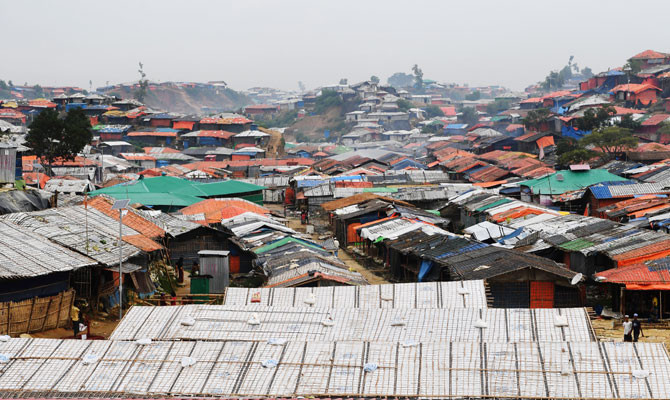
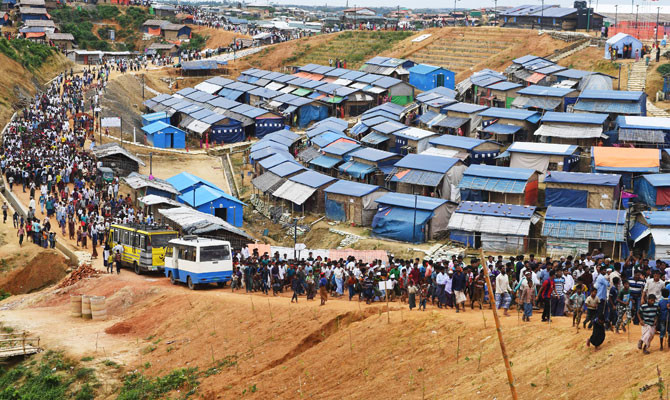
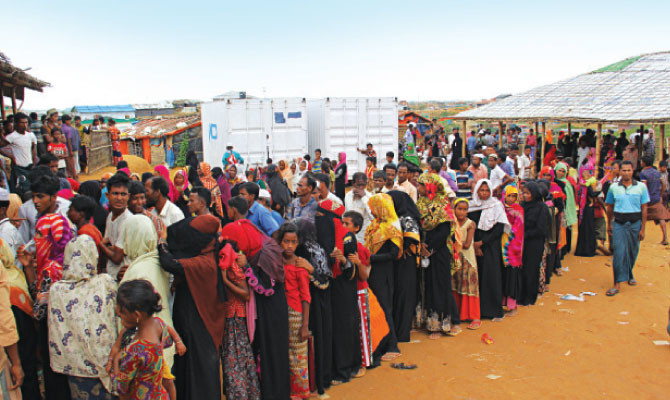
More than 700,000 Rohingya have fled the destruction, violence and persecution in Myanmar’s northern Rakhine province since August 2017, with many settling in refugee camps at Cox’s Bazaar in neighboring Bangladesh.
The Rohingyas’ plight — described as a “journey of pain” — has developed into the world’s worst refugee crisis, according to the UN.
Recent talk of an agreement between Bangladesh and Myanmar to allow repatriation of the Rohingya has done little to ease refugees’ fears.
“Before repatriation we need to be recognized as Rohingya and as citizens of Myanmar,” Mohammed Nurul Islam, 50, a refugee in Balukhali since last September, said.
“I have heard about the repatriation plans, but they do not make me feel safe.”
 Rohingya community leaders have also rejected an agreement between the UN and Myanmar for the return of the refugees.
Leaders said the deal failed to address their concerns and they would not help in the repatriation process.
“The agreement is on the issue of return of the Rohingya to their homes. Strangely, they did not bother to consult the Rohingya community. There is no commitment from the Burmese government to fulfil our key demands as a precondition for our safe return. It is against the interest of the Rohingya,” a Rohingya spokesman said.
One year has passed since this crisis began, but the refugee influx from Myanmar has yet to stop. Bangladeshi authorities said that since January this year, as many as 12,000 Rohingyas crossed the border into Bangladesh.
“Refugees are still coming, but irregularly and in small numbers,” Abul Kalam, Bangladesh’s refugee, relief and repatriation commissioner, told Arab News.
The Bangladesh government said it has no precise understanding with Myanmar authorities on when and how the repatriation will take place.
“We have taken all the necessary steps demanded by Myanmar. Now it’s Myanmar’s role to create a conducive environment for the repatriation of the Rohingya,” said Delwar Hossain, director-general of the Bangladesh foreign ministry.
Bangladesh signed an agreement with Myanmar to finalize repatriation plans last November. According to the deal, repatriation was expected to get begin within two months.
Bangladesh later handed a list of about 8,000 Rohingyas to the Myanmar authority, but Myanmar said it lacked proof of a voluntary return by the refugees.
A series of meetings between both countries has failed to end the impasse.
“We don’t understand what the (Myanmar) view is in terms of Rohingya repatriation. During our recent visit to Myanmar (Aug. 9–11), Myanmar authorities told us that they wanted to start the repatriation, but things still are not moving forward,” Hossain said.
Amid the uncertainty, the UN children’s fund UNICEF has warned of a “lost generation” of Rohingya who lack the life skills they will need in future.
Half a million youngsters were at risk of “falling prey to despair,” said Simon Ingram, a UNICEF senior communication adviser.
“Now they are starting to wonder, ‘What next?’” he said. “They are starting to ask what sort of future they really have, and that is where a new level of anxiety and fear starts to come in.”
Inside Cox’s Bazaar, 1,200 centers provide education for 140,000 children, although there are few learning opportunities for those above 14 years of age.
“If we don’t make the investment in education now, we face the real danger of seeing a lost generation of Rohingya children,” said Adde Edouard Beigbeder, UNICEF’s Bangladesh representative.
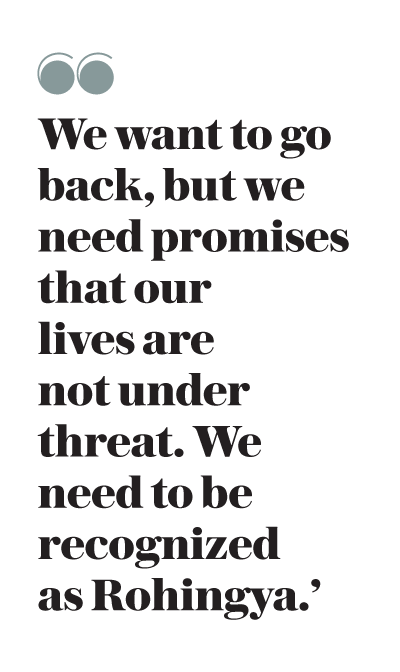
Meanwhile, Asma Begum, a Rohingyan refugee in Kutupalang camp, said refugees needed to be recognized as Rohingya before repatriation. “We need guarantees that our lives are not under threat.
“We need to go back to Rakhine, but can the UN give us protection?” Asma asked.
On Friday, Antonio Guterres, UN secretary-general, said: “The horrific stories of suffering I have heard remain vivid in my memory. A year has passed; we must act globally to stop this crisis.”
‘Ethnic cleansing’ author demands justice for exiles
The world has failed Myanmar’s Rohingya Muslims, according to the author of a book on their plight, a year after the attacks that led to almost a million refugees fleeing their homes and seeking sanctuary in Bangladesh. “The international community has done nothing to repatriate more than 700,000 Rohingyas who were forcibly removed by the Myanmar military,” Azeem Ibrahim, author of “The Rohingyas: Inside Myanmar’s Hidden Genocide,” told Arab News on Saturday.
“No efforts were made to apprehend or bring the perpetrators of the genocide to justice, and the international community has again failed the Rohingya in catastrophic fashion,” Ibrahim (pictured) said. The violence against the minority Myanmar Rohingya began on Aug. 25, 2017, after a series of attacks on Myanmar police stations by a small Rohingya militant group killed a dozen security personnel. In retaliation, the country’s military and Buddhist mobs launched waves of attacks, killing people and emptying villages in what many in the international community see as a calculated attempt to drive the Rohingya from the country. Many doubt they will ever be able to return despite extended talks between Myanmar, Bangladesh, the UN and international aid agencies. Speaking from the US before attending a rally to commemorate the “black day” in the Rohingyas’ minority history, Ibrahim said he hopes to draw attention to the plight of the Rohingya trapped in refugee camps. “The ethnic cleansing of the Rohingya was not an isolated event,” he said. “The Myanmar military, as is common for all perpetrators of genocides and crimes against humanity, undertook a test run of their planned major atrocities in October 2016, when armed Buddhist militia supported by Myanmar military expelled more than 140,000 Rohingya from their villages and towns with hardly any reaction from the international community apart from listing a few generals on an international travel ban list.”
When confronted with the violence perpetrated against the Rohingya, Myanmar prime minister Aung San Suu Kyi sided with her generals and refused to acknowledge the crimes, he said. “The Rohingya have lost faith in the international system and are calling for their case to be taken up by the International Criminal Court
so that the perpetrators of genocide can be brought to justice,” Ibrahim said. The author said that the Myanmar Citizens Act of 1982 paved the way for “ethnic and religiously motivated violence, and the final removal of all Rohingya from Myanmar.”
According to the author, the root of the Buddhist-Muslim clashes in Myanmar has its roots in the Japanese invasion of the country during World War II, when the Buddhist majority population sided with the Japanese. “Only the minority Muslim Rohingya stayed loyal to the British rulers of the time and have been since persecuted at various intervals.”
Mohamed Chebaro


