ThePlace: Mina, the valley of the Pilgrims

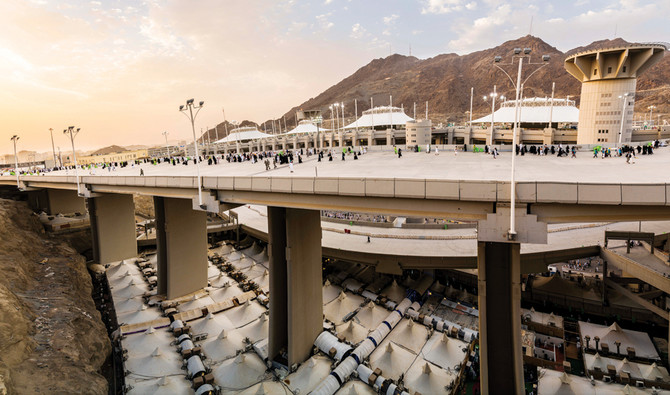
The valley of Mina plays an important role during Hajj season. (AN photo by Ziyad Alarfaj)
Updated 16 October 2018
Follow

ThePlace: Mina, the valley of the Pilgrims

Mina is located 6 kilometers to the east of Makkah, covering a 16.8 kilometer area starting from Makkah’s city center to Muzdalifa. It is known as the Tent City, as it can accommodate more than 3 million people in more than 100,000 air-conditioned tents. It remains uninhabited for the duration of the year, except during Hajj season.
It is one of the largest projects implemented by King Salman to accommodate pilgrims in accordance with safety and security measures that allow it to absorb more than 2.6 million pilgrims annually, making it the largest tent city in the world. The tents are made of glass fabrics covered with Teflon, which is known for its high resistance to flammability and non-toxic gases; the tents are also air-conditioned and climate resistant.
Each tent is equipped with water sprayers that operate automatically as soon as their heat sensors pick up a rise in temperature, and once the sprinkles release water, alarms will sound and alert pilgrims to danger.
The valley of Mina plays an important role during the annual spiritual Hajj journey and contains the location where pilgrims perform the stoning of the devil in its valley, where the Jamarat Bridge is.
The new Jamarat Bridge project, facilitated by the government, is 950 meters long and consists of five floors with a height of 12 meters per floor. It has 12 entranceways, 12 exit roads from the four directions, emergency outlets on the basis of 300,000 pilgrims per hour, and an air-conditioning system with water sprinklers to cool the atmosphere and reduce the area’s temperature to 29 degrees Celsius.
On the fifth level, umbrellas cover the large site of the three Jamarat, to enhance the comfort of pilgrims and protect them from sun strokes.
Pilgrims perform the stoning in the hours between sunrise and sunset on the final day of Hajj, throwing seven small pebbles at three walls known as the Jamarat, beginning with the smallest (Jamarat Al-Ula) and going on to the middle (Jamarat Al-Wusta), then the largest (Jamarat Al-Aqaba).


Minzal brings Saudi traditions to life in Diriyah

Updated 07 January 2026
Follow

Minzal brings Saudi traditions to life in Diriyah

  • From leather crafts and archery to Saudi coffee, Minzal offers a lesson in ‘Sloum Al-Arab’

RIYADH: This season of Minzal places social norms and traditional etiquette at its center, with tents set up to teach what is locally known as “Sloum Al-Arab” alongside gatherings for coffee, dinner and stargazing around campfires.

“Sloum Al-Arab” refers to the unwritten customers and values that have shaped Arab and Bedouin society for centuries, including generosity, coffee preparation, courage and archery. 

In Saudi Arabia, these traditions are closely ties to cultural identity and religious belief. 

Leather products and the making of leather goods is one of the crafts featured at Minzal this year and is one of the oldest crafts still practiced in the kingdom.

“The most difficult thing I faced to work on was camel leather because it is a little tough,” Nada Samman, a leather trainer and craftsman at Minzal, told Arab News. 

Minzal continues to evolve with each season, offering activities that highlight Bedouin values, traditional skills and sports. (AN photo by Haifa Alshammari)

“The work on leather is wonderful whether it is goat leather, cow leather, Sawakni sheep, and of course, camel leather. At Minzal, we are offering multiple handicraft workshops, most specifically the leather handicrafts. We want visitors to spend time at something useful and fun."

Samman explained the workshops allowed participants to preserve heritage while engaging in meaning, hands on activities. 

Faisal Al-Khaled, a visual artist and craftsman specializing in Saudi designs at Minzal, shared a similar goal: “I want people to have, by the end of this experience, a unique and traditional art piece created by them, and that I know I helped them to preserve this craft.”

Minzal, which has been organized for several years now, continues to evolve with each season, offering activities that highlight Bedouin values, traditional skills and sports. Archery is a key feature, reflecting its deep roots in Arab and Islamic history.

Mohammed Al-Sharif, a certified archery player and coach with the Saudi Archery Federation since 2028, said the sport was closely connected to Saudi culture. It was encouraged by the Prophet Muhammad, which led people to learn and teach it through generations.

“Our traditional bow is considered one of the most important and widely used bows in Arab culture,” Al-Sharif said. “We have several styles, and professional archers specializing in traditional bow shooting … There are various types of archery, such as horseback archery and standing archery, where bow sizes vary according to specific needs, such as types used for hunting and others used during warfare.”

He explained that archery was historically part of daily life, used for protection and hunting. 

Saudi coffee also plays a significant role in the Minzal experience, with live demonstrations. One of the most frequently consumed beverages in the Kingdom, it is a symbol of hospitality and generosity.

Ahmed Al-Shuaibi explained how it was prepared at the Sloum tent, first by roasting the beans and then allowing them to cool. The beans are ground with spices in a Nigr.

“Coffee is passed from our grandparents,” he added. “In significant majlis, you see them offering our local coffee and not other types of coffee. We organized this corner so that young generations can visit and learn this.”