Italy clashes with EU over migrants stranded on rescue boat

1 / 5
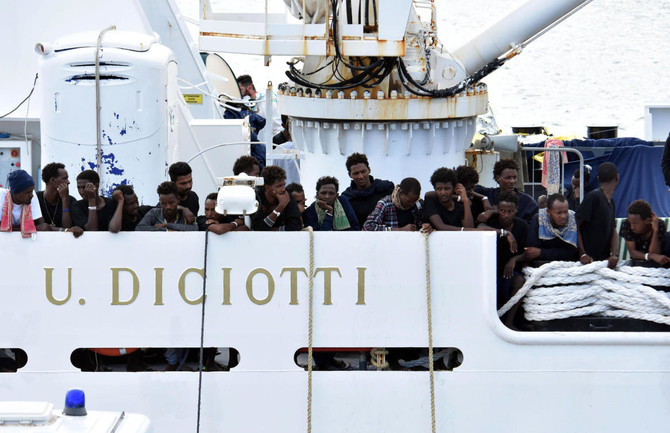
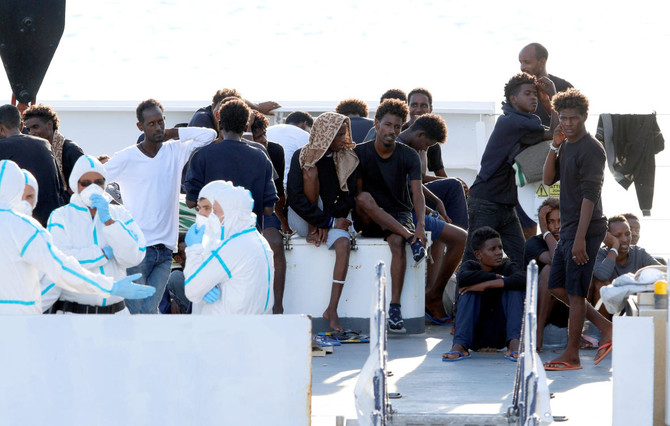
Migrants aboard the Italian Coast Guard ship Diciotti gather on the deck as they await decisions in the port of Catania, Italy, Friday, Aug. 24 2018. (AP)
2 / 5
Migrants aboard the Italian Coast Guard ship Diciotti gather as they await decisions in the port of Catania, Italy, Friday, Aug. 24 2018. (AP)
3 / 5
Migrants wait to disembark from the Italian coast guard vessel “Diciotti” at the port of Catania, Italy, August 22, 2018. (Reuters)
4 / 5
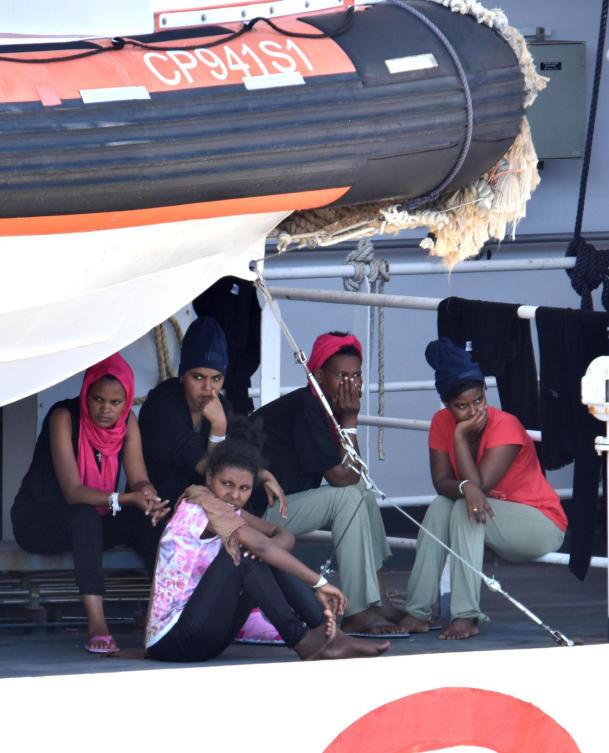
Migrants aboard the Italian Coast Guard ship Diciotti sit as they await decisions in the port of Catania, Italy, Friday, Aug. 24 2018. (AP)
5 / 5
Migrants aboard the Italian Coast Guard ship Diciotti talk as they await decisions in the port of Catania, Italy, Friday, Aug. 24 2018. (AP)
Updated 24 August 2018
Follow

Italy clashes with EU over migrants stranded on rescue boat

  • Italian coast guard vessel Diciotti has been docked in the port of Catania, Sicily for days
  • Many of the 150 migrants stranded aboard the ship for a ninth day began a hunger strike out of frustration

ROME/BRUSSELS: Italy’s populist government said on Friday it would cut funds for the EU unless other states take in boat migrants stranded in an Italian port, earning a rebuke from Brussels for making unacceptable “threats.”
Diplomatic sources told Reuters a meeting of EU state envoys in Brussels found no agreement on how to deal with the 150 mostly Eritrean migrants on board the Diciotti, an Italian coast guard ship docked in Catania since Monday.
More than 650,000 people have reached Italian shores since 2014 and Rome has begun to take a rigidly anti-immigration line, saying it will not let any more rescue ships dock unless other EU states agree to take the people in.
“There has not been a deal on Diciotti,” one diplomat said after the Brussels talks.
Interior Minister Matteo Salvini, who heads the anti-immigrant League party, has said they will not be allowed ashore until other EU states agree to take them in — prompting a criminal investigation into whether the migrants are being held against their will.
Salvini’s government ally, Deputy Prime Minister Luigi Di Maio, who leads the 5-Star Movement, has said his party will not approve next year’s European Union funding if there is no action soon.
“The soft line does not work, the hard line will be to withhold funds if they don’t listen to us,” Di Maio said.
Rejecting the Italian threats as unacceptable, the EU’s executive European Commission said a solution to the Diciotti case was its “main priority.”
“Unconstructive comments, let alone threats ... will not get us any closer to a solution,” spokesman Alexander Winterstein told a news conference on Friday.
The issue of how to handle migrants has bitterly split the EU, although arrivals are down dramatically from their 2015 peak of more than a million.
Southern EU states like Italy and Greece feel overrun and the bloc’s eastern members refuse to host any of the new arrivals.
The easterners, who face cuts in EU development aid over their refusal to help on migration, did not attend the Brussels meeting on Friday. Malta, Italy, Spain, Greece, Luxembourg, Belgium, Germany, France, Ireland and the Netherlands were present.
CURTAILING ARRIVALS
In Italy, a campaign promise to further curtail arrivals helped propel the 5-Star and the League into office last June.
Deals were reached in June and July to distribute people from ships that carried rescued migrants to Italy and Malta.
But Salvini this week said countries were failing to keep their promises.
Opposition politicians who visited the Diciotti this week condemned Salvini and Di Maio.
“The worst thing is that (the migrants) are being held hostage as a way of blackmailing Europe,” said Laura Boldrini, a lawmaker for the left-wing Free and Equal party.
The migrants appeared to have started a hunger strike on Friday, Davide Faraone, a lawmaker in the opposition Democratic Party, said on Twitter.
Another opposition lawmaker, Riccardo Magi, said most on board could qualify for asylum.
Magi petitioned the Catania prosecutor to open a criminal investigation into whether the migrants were being held against their will. Agrigento’s chief prosecutor has opened a probe against “unknown” persons for holding them.
On Friday, Salvini remained defiant in the face of the investigation and said it was his job to protect the country.
“If someone is thinking about arresting me, they’re mistaken, because the Italian people are asking for order, rules, respect and controlled immigration,” he said.


Italian police fire tear gas as protesters clash near Winter Olympics hockey venue

Updated 08 February 2026
Follow

Italian police fire tear gas as protesters clash near Winter Olympics hockey venue

  • Police vans behind a temporary metal fence secured the road to the athletes’ village, but the protest veered away, continuing on a trajectory toward the Santagiulia venue

MILAN: Italian police fired tear gas and a water cannon at dozens of protesters who threw firecrackers and tried to access a highway near a Winter Olympics venue on Saturday.
The brief confrontation came at the end of a peaceful march by thousands against the environmental impact of the Games and the presence of US agents in Italy.
Police held off the violent demonstrators, who appeared to be trying to reach the Santagiulia Olympic ice hockey rink, after the skirmish. By then, the larger peaceful protest, including families with small children and students, had dispersed.
Earlier, a group of masked protesters had set off smoke bombs and firecrackers on a bridge overlooking a construction site about 800 meters (a half-mile) from the Olympic Village that’s housing around 1,500 athletes.
Police vans behind a temporary metal fence secured the road to the athletes’ village, but the protest veered away, continuing on a trajectory toward the Santagiulia venue. A heavy police presence guarded the entire route.
There was no indication that the protest and resulting road closure interfered with athletes’ transfers to their events, all on the outskirts of Milan.
The demonstration coincided with US Vice President JD Vance’s visit to Milan as head of the American delegation that attended the opening ceremony on Friday.
He and his family visited Leonardo da Vinci’s “The Last Supper” closer to the city center, far from the protest, which also was against the deployment of US Immigration and Customs Enforcement agents to provide security to the US delegation.
US Homeland Security Investigations, an ICE unit that focuses on cross-border crimes, frequently sends its officers to overseas events like the Olympics to assist with security. The ICE arm at the forefront of the immigration crackdown in the US is known as Enforcement and Removal Operations, and there is no indication its officers are being sent to Italy.
At the larger, peaceful demonstration, which police said numbered 10,000, people carried cardboard cutouts to represent trees felled to build the new bobsled run in Cortina. A group of dancers performed to beating drums. Music blasted from a truck leading the march, one a profanity-laced anti-ICE anthem.
“Let’s take back the cities and free the mountains,” read a banner by a group calling itself the Unsustainable Olympic Committee. Another group called the Association of Proletariat Excursionists organized the cutout trees.
“They bypassed the laws that usually are needed for major infrastructure project, citing urgency for the Games,” said protester Guido Maffioli, who expressed concern that the private entity organizing the Games would eventually pass on debt to Italian taxpayers.
Homemade signs read “Get out of the Games: Genocide States, Fascist Police and Polluting Sponsors,” the final one a reference to fossil fuel companies that are sponsors of the Games. One woman carried an artificial tree on her back decorated with the sign: “Infernal Olympics.”
The demonstration followed another last week when hundreds protested the deployment of ICE agents.
Like last week, demonstrators Saturday said they were opposed to ICE agents’ presence, despite official statements that a small number of agents from an investigative arm would be present in US diplomatic territory, and not operational on the streets.