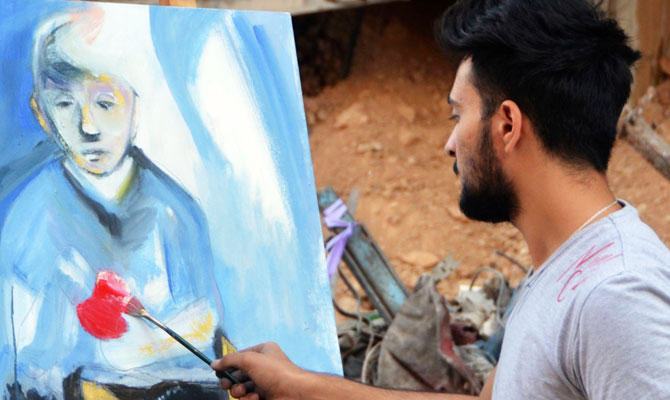
YARMUK, Syria: Not far from his destroyed home in Syria’s Yarmuk camp for Palestinian refugees, 21-year-old Abdallah Al-Harith dabs bright red paint onto a canvas standing amid the grey ruins.
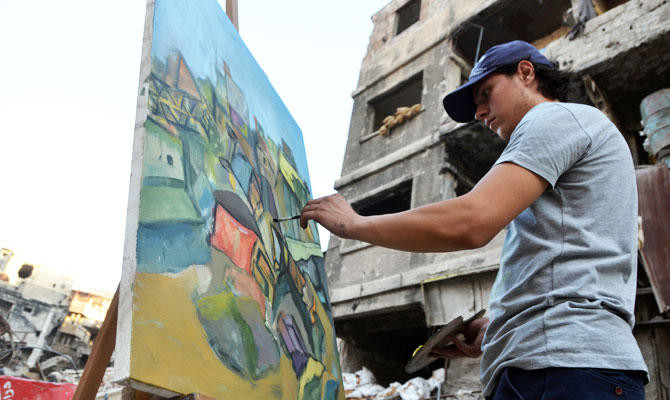
Last week, he was among 12 young artists to set up their easels in the once-crowded camp turned Damascus suburb, now largely abandoned after seven years of civil war.
Equipped with paint brushes and pencils, they set out to translate suffering into art in a neighborhood ravaged by years of bombardment and siege.
“We’re bringing back life to a dark place,” said Harith, who fled Yarmuk several years ago, but returned after the regime ousted Daesh group jihadists in May.
“I had such a lump in my throat when I first came back to the camp. At first I couldn’t draw anything,” said the fine arts student.
“But then I realized that any glimpse of life amid all this death was a victory,” he said, gesturing toward the battered buildings around him.
He and his peers stood sweeping paint across their canvases while the gentle melody of an oud — a Middle Eastern lute — was broadcast across the smashed concrete. Harith painted an image of a small boy emerging from the ground, holding a bright red apple.
“It’s supposed to represent new life,” Harith said. 
“I actually saw something like this once: children with apples playing again on what had been fighting ground.”
Before the war, Yarmuk was home to around 160,000 people, the United Nations says.
Set up in 1957 to house Palestinian refugees, over the decades it became a crowded district that was eventually swallowed up by Damascus.
But today it lies almost abandoned. Around 140,000 residents fled clashes between the regime and rebels in 2012, leaving the rest to face severe food shortages under government encirclement. In 2014, a harrowing photograph of gaunt-looking residents massing between ravaged buildings to receive handouts caused global outrage.
Earlier this year, fighting between loyalists and jihadists displaced most of the remaining residents, according to the United Nations’ agency for Palestinian refugees, UNRWA.
President Bashar Assad’s troops retook control in May, ousting IS fighters from their last urban stronghold on the outskirts of the capital.
In late May, UNRWA said an immediate return of residents was unlikely due to extensive damage to key infrastructure such as the water and power networks.
Visiting the camp last month, UNRWA commissioner-general Pierre Krahenbuhl said he had rarely seen such damage.
“The scale of the destruction in Yarmuk compares to very little else that I have seen in many years of humanitarian work in conflict zones,” he said.
On Saturday, the work of the young artists was displayed at the entrance of the Yarmuk camp, with a small crowd making the trip to see it.
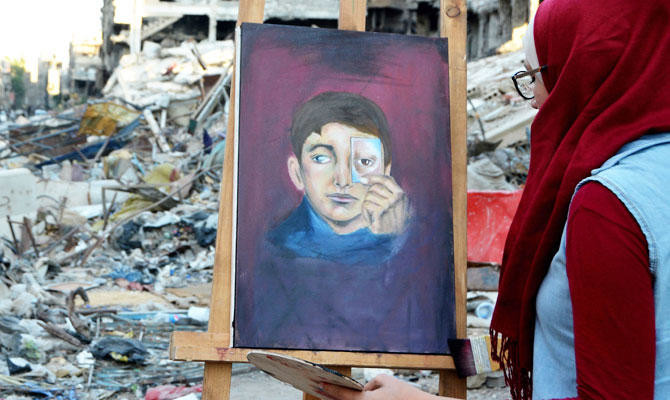
Painter Hinaya Kebabi depicted a young boy with a missing eye, holding up a drawing of another eye to conceal his wound, the 22-year-old explained.
“One day, I hope people will come back here to color, not rubble,” she said.
One painting depicted streams of red running down a dark building.
In another, an emaciated man was curled up naked in the foetal position.
After the images were shared online, several Internet users slammed the project as provocative.
“The camp is neither romantic nor a place for drawing,” 28-year-old Abeer Abassiyeh said, as most former residents remain unable to return to their homes.
But Mohammed Jalbout, one of the organizers who hails from the Palestinian camp, defended the project.
“We all have homes here. I haven’t been back to mine or been able to inspect it,” he said.
But, he said, “at least through art, we’re trying to breathe a little life back into this place.”


![]()
![]()
![]()
![]()
![]()

In Syria’s Yarmuk, artists paint amid the ruins


In Syria’s Yarmuk, artists paint amid the ruins
- Around 140,000 residents fled clashes between the regime and rebels in 2012, leaving the rest to face severe food shortages under government encirclement
- Set up in 1957 to house Palestinian refugees, over the decades it became a crowded district that was eventually swallowed up by Damascus


Latest updates


© 2026 SAUDI RESEARCH & PUBLISHING COMPANY, All Rights Reserved And subject to Terms of Use Agreement.