DUBAI: Stylistically, “Divine Intervention” might be painted in distinctly international art-house hues, but it’s a movie that could only have been made in Palestine.
Upon its release in 2002, its bristling brand of black comedy was recognized with serious cinema’s greatest honors: a Palme d’Or nomination – and Jury Prize win – at the Cannes Film Festival. But when Hollywood’s awards season rolled around later that year, the film’s beguiling Kafkaesque roadblocks came off the screen and onto the ballot form, with Oscar judges reportedly ruling the first entry from the then-unrecognized state as ineligible.
This sorry tale alone might have secured a certain notoriety, but cannot alone explain the canonical renown of director/star Elia Suleiman’s best-known picture. When in 2013 the Dubai International Film Festival polled nearly 500 film critics, writers and scholars to compile a definitive list of the 100 most important Arabic-language films ever made, “Divine Intervention” was the only movie from this century to make the top 10 – and one of only three post-2000 entries in the top 30 (the third of which was Suleiman’s 2009 picture “The Time That Remains.”)
Tellingly, today “Divine Intervention” is among just a handful of the anointed list’s entries readily available on DVD with English subtitles. It’s a largely plotless, absurdist portrait of life under occupation in his native Nazareth, and Suleiman’s studious cinematic referencing and ironic wit feel tailor-made for the liberal international intelligentsia.
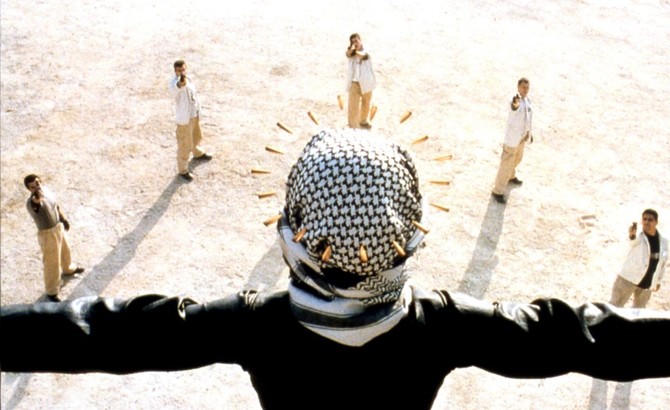
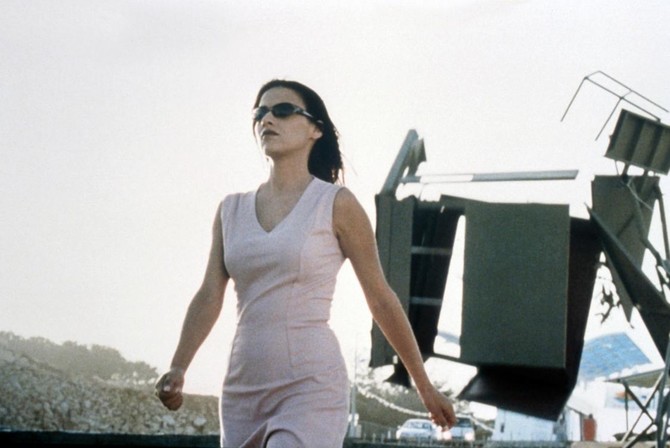
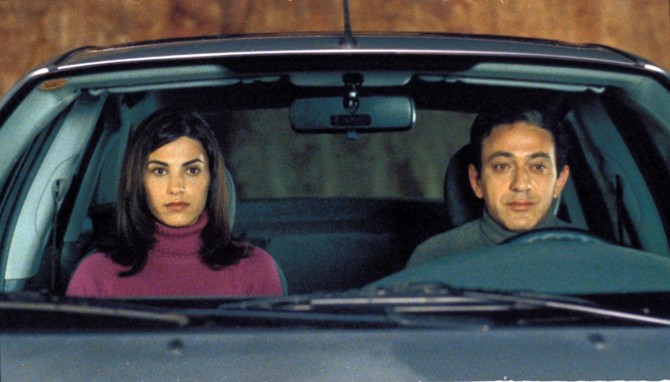
Like a tone poem or meditative montage, bleakly comic set pieces unfold with stoic detachment: A villager lines up glass bottles ready to throw at police. Santa Claus is stabbed to death. Thwarted lovers meet to furtively hold hands at a border checkpoint. A female Arab ninja takes down a crew of gun-toting commandos.
Comparisons abound to Jacques Tati and Jim Jarmusch and, like the latter, Suleiman has a keen sense of juxtaposing incongruous images with existing music – the soundtrack of “Divine Intervention” namechecks Arab talents from vintage legend Mohammed Abdel Wahab to contemporary superstar Amr Diab and indie heroes Soapkills.
Dialogue is in short supply: Suleiman’s character ES – surely a nod to Kafka’s K – utters not a single line. Instead, his actions speak loudest when releasing a helium balloon bearing Yasser Arafat’s face to float over Jerusalem – which dumbstruck Israeli soldiers farcically debate shooting down.


‘Divine Intervention’ one of the best Arabic-language films ever made

‘Divine Intervention’ one of the best Arabic-language films ever made

OPINION: Saudi Arabia’s cultural continuum: from heritage to contemporary AlUla
- The director of arts & creative industries at the Royal Commission for AlUla writes about the Kingdom’s cultural growth
AlUla: Saudi Arabia’s relationship with culture isa long and rich. It doesn’t begin with modern museums or contemporary installations, but in the woven textiles of nomadic encampments, traditional jewellery and ceramics, and of course palm‑frond weaving traditions. For centuries, Saudi artisans have worked with materials drawn directly from their environment creating objects that are functional, but also expressions of identity and artistry.
Many of these traditions have been recognised internationally, with crafts such as Al-Sadu weaving inscribed on UNESCO’s Intangible Cultural Heritage list.

This grounding in landscapes, resources, and collective history means Saudi Arabia’s current cultural momentum is not sudden, but the natural result of decades — even centuries — of groundwork. From the preservation of heritage sites and, areas, some of which have been transformed into world-renowned art districts, to, the creation of institutions devoted to craft, the stage has been set for a moment where contemporary creativity can move forward with confidence, because it is deeply rooted.
AlUla, with its 7,000 years of human history, offers one of the clearest views into this continuum. Millennia-old inscriptions at Dadan and Jabal Ikmah stand alongside restored mudbrick homes in Old Town and UNESCO-listed Hegra. In the present, initiatives like Madrasat Addeera carry forward AlUla’s craft traditions through design residencies and material research. And, each winter, the AlUla Arts Festival knots these threads together, creating a season in which heritage and contemporary practice meet.

This year, that dialogue began in the open desert with Desert X AlUla 2026. Now in its fourth edition, the exhibition feels like the pinnacle of the current moment where contemporary art, heritage, and forward-thinking meet without boundaries. The theme of Desert X AlUla 2026 was “Space Without Measure,” inspired by the work of Lebanese-American artist and writer Kahlil Gibran[HA1] [MJ2] . The theme invited artists to respond to the horizons of AlUla’s landscape and interpret its wonder through their perspective.
Works by Saudi and international figures converse directly with nature: Mohammed Al-Saleem’s modernist sculptures bring in celestial-inspired geometry; Maria Magdalena Campos-Pons translates the colour of AlUla’s sunsets; Agnes Denes “Living Pyramid” turns the oasis into a vertical landscape of indigenous plants, . The 11 artists of this year’s edition were able to capture AlUla’s essence while creating monumental works that speak directly to our relationship with the environment.

In AlJadidah Arts District, “Material Witness: Celebrating Design From Within,” features heritage craft and material research from Madrasat Addeera alongside work by regional and international designers, showing how they translate heritage materials into contemporary forms.[HA3] [MJ4]
Music adds another element of vitality, filling the streets of AlJadidah Arts District, with performances supported by AlUla Music Hub, featuring local musicians.
The opening of “Arduna,” the first exhibition presented byof the AlUla Contemporary Art Museum, co-curated with France’s Centre Pompidou, adds another layer to this conversation. Featuring Saudi, regional, and international artists, from Picasso and Kandinsky to Etel Adnan, Ayman Zedani and Manal AlDowayan, the [HA5] [MJ6] exhibition signals the emergence of a global institution rooted in the heritage and environment of AlUla, placing local voices in context with world masters.
Each activation in this year’s AlUla Arts Festival is part of the same Saudi cultural continuum, . This is why the Kingdom’s cultural rise feels different from rapid developments elsewhere. The scale of cultural infrastructure investment is extraordinary, but its deeper strength lies in how that investment connects to living traditions and landscapes.
The journey is only accelerating. Rooted in heritage yet open to the world, the Kingdom’s cultural future is being shaped not by sudden inspiration, but by our traditions and history meeting the imagination and creative voices of our present.


