

Food trucks serve in holy places for first time

1 / 2
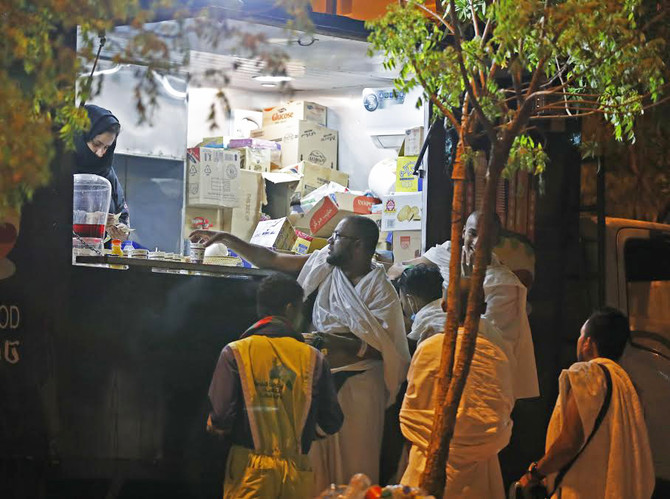
A Saudi woman serves pilgrims and workers from one of the food trucks roaming the streets in Arafat and Mina for the duration of the Hajj season. (AN photo by Bashir Saleh)
2 / 2
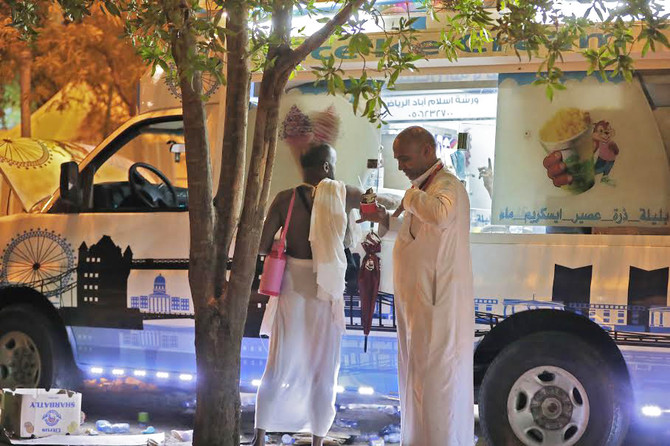
Pilgrims by ice cream from one of the food trucks roaming the streets in Arafat and Mina for the duration of the Hajj season. (AN photo by Bashir Saleh)
Updated 21 August 2018
Follow

Food trucks serve in holy places for first time

  • About 45 food trucks were given permit to roam the holy places to offer food, drinks and desserts to pilgrims
  • Only Saudi citizens are allowed to work in these food trucks


MINA: Food trucks run by Saudi men and women have begun for the first time to serve food and drinks in the holy places.

This was after Deputy Makkah Gov. Prince Abdullah bin Bandar directed the Secretariat of the Holy Capital to allow local entrepreneurs to provide their services inside the holy places during the current Hajj season.

Unlike the old fixed food stalls, about 45 food trucks have begun roaming the holy places to offer food, drinks and desserts to pilgrims. They also serve ice cream to help people cope with the heat, as well as different kinds of sandwiches.

The Secretariat of the Holy Capital confirmed that all food trucks in Arafat comply with health requirements, with every food truck manager carrying health certificates that allow them to carry out their activities.

The Secretariat highlighted that only Saudi citizens are allowed to work in these food trucks.

Afaf Abdul Aziz, one of the women serving hot drinks, said that she was pleased that the governor of Makkah had allowed women to work in the holy places.

She added: “The job is hard but truly fun. I wanted to prove that Saudi women can work in all occupations and contribute to serving pilgrims.”

She said that most of her customers were Saudis or from Arabian Gulf countries, most of whom worked in providing Hajj services.

“I have seen many Saudi women working in hospitals, health care centers, and Tawafa establishments, which makes me content,” she said.

Arif Obaid said that he worked in a food truck and served hot drinks, especially coffee, highlighting that many security men visited his truck for all kinds of coffee, especially Arabic coffee, which is in high demand. “Most of our goods go to charity work targeting pilgrims,” he said.

The Secretariat of the Holy Capital has announced accepting applications from Saudi men and women who wish to practice this activity in the holy places during the current Hajj season according to a set of standards and controls. 

The most important of these is ensuring the safety of nourishments served to pilgrims and that the applicant has a health certificate proving that she/he is free of contagious or infectious diseases.


Saudi Arabia announces new financial support to the Yemeni government

Updated 16 January 2026
Follow

Saudi Arabia announces new financial support to the Yemeni government

RIYADH: Saudi Ambassador to Yemen and Supervisor of the Saudi Program for the Development and Reconstruction of Yemen Mohammed Al-Jaber announced that the Kingdom, under the directives of its leadership, has provided new support to the Yemeni government's budget, aimed at paying the salaries of state employees in all sectors.

In a post on X, Al-Jaber stated that this support complements a package of development projects and initiatives, amounting to SR1.9 billion, announced on Wednesday. The package includes provision of necessary petroleum derivatives to operate power plants, which will contribute to improving the living standards of people in Yemen and alleviating daily burdens on them.

Al-Jaber’s post emphasized, in particular, that all salaries of military and security forces linked to the the higher military committee linked to the Saudi led Coalition will be paid as of Sunday. 


The post is likely relate to Several Media reports which have suggested that disgraced former Southern Transitional Council (STC) chief Aidaroos Al Zubaidi — who has now fled Yemen — was taking advantage of military personnel and withholding salaries as means of pressure. Al-Zubaidi is wanted by the Yemeni government for acts of high treason and corruption. 

The ambassador emphasized that these steps come within the framework of supporting the Yemeni government's efforts to implement the economic reform program, which aims to achieve financial and economic stability and enhance the state's ability to meet its basic obligations.
