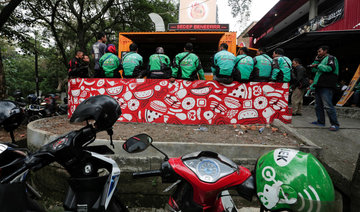
JAKARTA: Go-Jek, Indonesia’s first billion-dollar startup, is “extremely close” to achieving profitability in all its segments, except transportation, its founder and CEO Nadiem Makarim told Reuters.
Launched in 2011 in Jakarta, Go-Jek — a play on the local word for motorbike taxis — has evolved from a ride-hailing service to a one-stop app allowing clients in Southeast Asia’s largest economy to make online payments and order everything from food, groceries to massages.
“We’re seeing enormous online to offline traction for all of our businesses and are close to being profitable, outside of transportation,” said the 34-year old CEO.
The startup is expected to be fully profitable “probably” within the next few years, Makarim added.
Already a market leader in Indonesia, where it processes more than 100 million transactions for its 20-25 million monthly users, Go-Jek is now looking to expand in Southeast Asia.
Ride hailing services in Southeast Asia are expected to surge to $20.1 billion in gross merchandise value by 2025 from $5.1 billion in 2017, according to a Google-Temasek report.
Go-Jek said in May it would invest $500 million to enter Vietnam, Singapore, Thailand and the Philippines, after Uber struck a deal to sell its Southeast Asian operations to Grab — the bigger player in the region.
Go-Jek is seeing strong funding interest from its backers as it targets an aggressive expansion, Makarim said.
“Since its Aug. 1 launch, the app has already grabbed 15 percent of market share in Ho Chi Minh,” Makarim said. The firm this week opened recruitment for motorcycle drivers in Thailand.
The startup expects anti-monopoly concerns swirling around the Grab-Uber deal, which Singapore said had substantially hurt competition, to help clear a path for its expansion.
“We’re bringing back choice. The Singapore government is particularly eager to bring back competition,” Makarim said, adding that the order of overseas rollouts had not been set.
Go-Jek’s offshore push comes at a time when Singapore-based Grab is stepping up funding to expand in Indonesia and transform itself into a consumer technology company, starting with a partnership with online grocer HappyFresh.
“Mimicking Go-Jek’s strategy is the highest form of flattery,” laughed Makarim.
Grab told Reuters in a statement, “The super app strategy has been around for a while now and no Southeast Asian player can claim to have pioneered it.” The company also said Grab has not lost market share in Ho Chi Minh since August, but declined to provide market share data.
Makarim believes Go-Jek’s understanding of food merchants will give it an edge over Grab, which counts investors such as Chinese ride-hailing firm Didi Chuxing and Japan’s SoftBank Group Corp. among its backers.
Makarim, who sees food delivery as Go-Jek’s core business, said he was not concerned about funding, without giving details.
Go-Jek was reported in June as being in talks to raise $1.5 billion in a new funding round and was valued at about $5 billion in a prior fundraising, sources have told Reuters. The firm had said in March it was considering a domestic IPO.
Makarim noted Go-Jek’s backers were sharing both capital and expertise. The company is collaborating with Alphabet Inc’s Google on platform mobility, Tencent on payments strategy, JD.com on logistics operations, and Meituan Dianping on merchant transactions and deliveries.
Go-Jek has set up a venture capital arm, Go-Ventures, to invest in startups in Southeast Asia “with strategic importance to our business,” the CEO said.