

How Hajj volunteers help pilgrims realize their lifelong dream

1 / 7
A young scout helps a pilgrim at King Abdul Aziz International Airport in Jeddah. (Twitter)
2 / 7
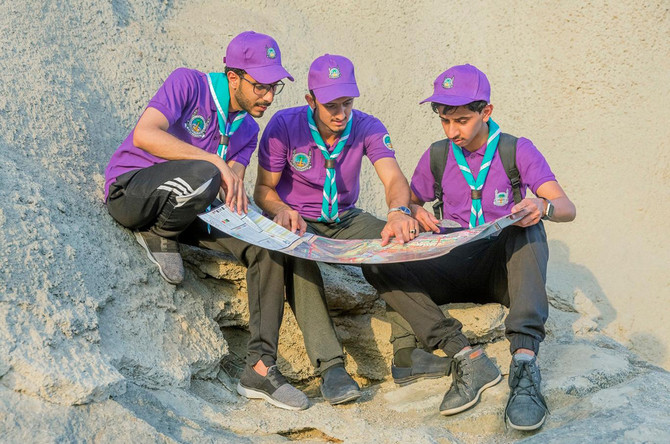
Young Saudi scouts go familiarize themselves with their designated work area in Makkah. (SPA)
3 / 7
Volunteer first aiders assist an aging pilgrim in Makkah. (SPA)
4 / 7
A volunteer serves water to an infirm pilgrim. (SPA)
5 / 7
A Saudi volunteer serves pilgrims with tea. (SPA)
6 / 7
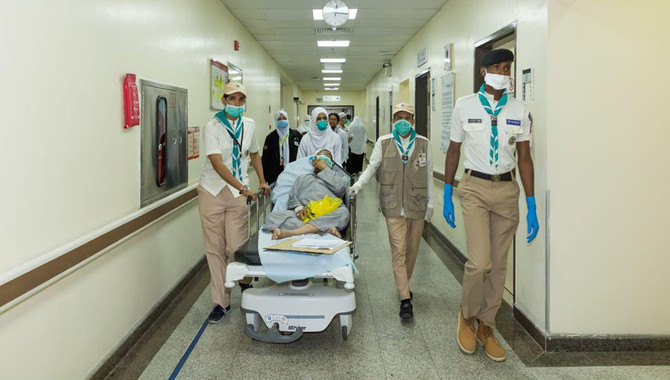
Boy Scouts take a sick pilgrim to a field hospital. (SPA)
7 / 7
A scout gives directions to a pilgrim. (SPA)
Updated 16 August 2018
Follow

How Hajj volunteers help pilgrims realize their lifelong dream

  • Volunteers are being encouraged to join the program Kun Awnan, or “Be Helpful,” to serve pilgrims
  • The program assigns volunteers to different locations based on their skills, experience and, in some cases, their place of residence

JEDDAH: Every year, Saudis — many of them young people — gather from all over the Kingdom to help their Muslim brothers and sisters fulfill their lifetime dream of visiting Makkah to perform Hajj, the fifth pillar of Islam.

With the support and the supervision of the Ministry of Hajj and Umrah, volunteers participate in all different kind of activities to ensure pilgrims’ comfort, receiving them with hospitality and generosity at the country’s ports.

All governmental and private bodies, including Scouts, join self-motivated volunteers to provide services such as traffic control, health care, guidance and support to various public sector agencies participating in the massive pilgrimage operation.

In 2017, the ministry approved the launch of the volunteering program Kun Awnan, or “Be Helpful,” to serve pilgrims. 

“This program is in line with the Kingdom’s Vision 2030 to rally one million volunteers per year,” Hani Abu Alsaud, the program’s CEO, told Arab News.
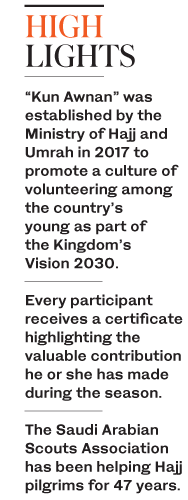
Through this program, the ministry aims to promote a culture of volunteering, while providing young people with a chance to use their expertise and skills to assist pilgrims while doing everything they can to make the experience of God’s guests smoother and more secure.

The program assigns volunteers to different locations based on their skills, experience and, in some cases, their place of residence. 

Volunteering points or camps include the holy mosques of both Makkah and Madinah, King Abdulaziz International Airport in Jeddah, Prince Mohammad Bin Abdulaziz International Airport in Madinah and the holy sites in Makkah.

“Last year, we received more than 3,000 volunteering applications through our newly launched website and we could accept only 12 percent of the total applicants,” Abu Alsaud said.

“Most of our volunteers are college and university students from all over the country ... (who) come to participate in the pride of serving God’s guests, and every one of them will receive a certificate of participation,” he said.

Kun Awnan activities include receiving pilgrims at airports, providing translations in a wide range of languages, doing all possible to make the Hajj experience go smoothly, as well as guiding activities and ceremonies after the season is over.

Scout camp activities were also launched to serve pilgrims during this year’s Hajj season under the Saudi Arabian Scouts Association. 

More than 4,500 Saudi Scouts and Guides were deployed in the public service camps for pilgrims in Makkah and its holy sites to assist pilgrims in cooperation with the ministry.

Zaiad Qadeer, director of the scout activities at the department of education in Makkah, said: “Scouts come from several cities across Saudi Arabia and are trained to speak multiple languages. This comes as a big help for pilgrims who arrive from all over the world. 

“Our main role would be assisting pilgrims who might lose their way around the holy sites in Makkah during the Hajj performance.”

As part of their efforts to provide the best possible services, six scout camps have been established in Makkah and its holy sites. 

“Scouts have been active members of the volunteering activities for years, deployed in almost all locations and working side by side with other teams and agencies to provide assistance to pilgrims and receive them with hospitality and generosity,” Qadeer explained. 

“We also help the Ministry of Health to treat sick pilgrims, complementing a number of voluntary humanitarian services for pilgrims.”

The General Directorate of Civil Defense plays a major role in volunteer work in the Kingdom. 

Operations General Hamoud bin Suleiman Al-Faraj told local media that the civil defense hoped to increase volunteer work under its umbrella, and had witnessed a large increase in the number of volunteers participating in the Hajj within a year — 1,485 volunteers this year compared with 816 volunteers in 2017.


Japan consulate in Jeddah celebrates cinema with Red Sea Film Festival guests

Updated 13 sec ago
Follow

Japan consulate in Jeddah celebrates cinema with Red Sea Film Festival guests

JEDDAH: As part of the celebrations marking 70 years of diplomatic relations between Japan and Saudi Arabia, the Consulate General of Japan in Jeddah hosted a special reception on Sunday evening for guests of the Red Sea International Film Festival.

The gathering, held at the consul general’s residence, highlighted the strengthening cultural ties between the two nations and Japan’s growing presence at the festival.

Speaking to Arab News on the sidelines of the event, Daisuke Yamamoto, consul general of Japan in Jeddah, said: “We are happy to have a gathering today. This is the first time Japan has held this kind of event related to the Red Sea Film Festival. Although it is the festival’s fifth edition, Japanese representation in previous years was limited. I encouraged our film industry to engage more, and I am happy that five Japanese films are being screened this year.”

While noting the absence of Japanese actors at the festival, he said the presence of producers and directors marks an important step forward. “There are already discussions about potential collaborations, and this reception is an excellent opportunity to build on the proposal we received from the Red Sea organizers.”

Yamamoto highlighted the longstanding partnership between Japan and Saudi Arabia in key sectors such as petrochemicals and the automotive industry, and expressed hope that cinema will become a new bridge for cooperation.

“I have known Saudi Arabia for many years and have seen remarkable, positive changes. We hope the Japanese film industry can be part of this dynamic transformation as well,” he added.

The event, organized in cooperation with the Red Sea Film Foundation, brought together about 50 attendees, including government officials, several consuls general, representatives from the Jeddah Historic District Program, festival guests and Saudi cultural figures.

Welcoming the guests, Yamamoto expressed his appreciation to the Ministry of Culture, the Jeddah Historic District authorities, and the Red Sea Film Foundation for their close cooperation throughout the year.

He noted the increasing cultural engagement between the two countries, including the hosting of several Japanese cultural programs in the historic district.

“Cinema is a noble art and a global cultural window that connects peoples and fosters cultural exchange, thus promoting openness to cultural diversity,” Yamamoto said in his address.

This aligns with the goals of Saudi Vision 2030, he added. “Our two friendly countries are collaborating to achieve this vision through the ‘Saudi-Japanese Vision 2030’ Committee, and the Ministry of Culture, through its Jeddah Historical District, is implementing it with insightful and open leadership to the fullest extent.”

Well-known Saudi actor, writer and producer Abdullah Al-Sadhan, who attended the reception, praised both the festival and the Japanese Consulate for their hospitality.

“It’s always a pleasure to return to the Red Sea International Film Festival and see how it continues to grow,” he said, adding: “This gathering by the Japanese consulate reflects a genuine interest in building bridges with our film community. Events like this open the door for stronger cooperation between Saudi and Japanese creators, which can only enrich the industry on both sides.”

Maiyada Mahdaly, secretary of the consul general, said: “Through this event, we celebrated the vibrant spirit of cinema and the growing cultural connection between our countries. We also welcomed talents from Saudi Arabia, Japan and beyond to honor creativity, collaboration and the power of storytelling that transcends borders.”