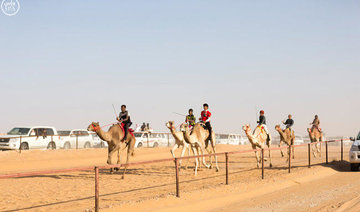
RIYADH: Camel racing is among the most famous traditional sports in the Arab world, which even dates back to the pre-Islamic era, when tribes organized the races to show off the strong camels they owned.
The races continued during the subsequent Islamic era, promoting the practicing of equestrian sports and bravery.
Prophet Muhammad’s companions were known for camel racing.
The camels that take part in races are known as “thaluls” in Arabic, or riding camels.
Among the most famous ones are: Thalul Al-Hurra (aka The Free Camel), as well as those from central and northern the Arabian Peninsula, such as Aseela, from the Thalul Al-Hurra breed, and the Omani Thaluls, known for being a graceful, slim and noble type of camels.
And the Sudanese Thaluls, which are known for the strength and patience and adapting to the challenging desert conditions.
The camels are known for their tolerance to thirst and traveling longer distances than horses.
Though camels are slightly slower than horses, some types of camels have traveled distances on speed that exceeds those of horses, as good camels can travel 40 kilometers continuously in one hour.
Good racing camels are known for specific characteristics that distinguish them from other camels, such as light weight, small palms, large chest size, long legs and long tail.
Racing camels undergo a special diet to help them get rid of excess fats, and the most important foods they feed on are dates, milk, honey, dry grass and corn.

Camel racing: An Arabian sport loved by the region’s people
- Camel racing is among the most famous traditional sports in the Arab world
- The camels that take part in races are known as “Thaluls” in Arabic
In the light of Andalusia: Luis Olaso’s new body of work
- Luis Olaso transforms Andalusian landscapes and light into abstract art, creating canvases that reflect culture, nature, and the artist’s inner state
- Each work in ‘Photosynthesis’ acts as a sensory and meditative portrait — an immersion into the Andalusian experience and the artist’s emotional universe
DUBAI: Spanish artist Luis Olaso is presenting “Photosynthesis,” his new exhibition, until March 9 at the JD Malat Gallery in Downtown Dubai. The series marks a turning point in his career, born from his recent move to Cadiz, in Andalusia, where the sun, light, and Mediterranean landscapes have profoundly transformed his practice.
For Olaso, relocating to southern Spain was not merely a change of scenery but an immersion into a culture and environment that nourishes his art at every moment.
“It’s very important for me because this is the first exhibition I have created in my new studio … I built it in the middle of the garden, surrounded by nature, fruit trees and olive trees, with a fantastic landscape. The influence of Andalusia and the colors of that place are the driving force behind my work,” said Olaso.
Located at the heart of an estate surrounded by olive, almond, and orange trees, his studio is designed to allow nature to enter the creative process both physically and psychologically. Yet, rather than depicting these elements directly, Olaso absorbs them as a sensory catalyst: Each color, texture, and gesture becomes the expression of a lived moment.
“Even when I work with plants or flowers, I’m not aiming for literal representation; they are vehicles to express abstract metaphors of myself and the moment I’m living while creating the work,” he said.
His artistic process is both spontaneous and meditative. Olaso often works on several canvases simultaneously to free himself from the pressure of the “perfect painting,” allowing intuition to guide his brush. Music — the Spanish band Triana and 1970s psychedelic flamenco — plays a central role in his focus and inner connection.
“Painting, for me, is similar to meditation. I need to be in that precise moment and feel connected with myself,” said Olaso.
“Photosynthesis” also reflects a profound cultural and artistic dialogue. The artist’s work draws from Spanish tradition— with references to Antoni Tapies and Manolo Millares — as well as major international abstract movements, including American gestural abstraction and the San Francisco Bay Area Figurative Movement.
This meeting point between abstraction, culture, and emotion transforms each canvas into a portrait of a lived instant and the artist’s inner state.
After Dubai, Olaso is expected to present a solo exhibition in Madrid in March 2026, followed by another solo exhibition in Helsinki in April. An art fair is scheduled for September, with additional fairs planned throughout the year, notably with the JD Malat Gallery.
These milestones illustrate his universal approach to art, deeply rooted in a specific cultural context: the light, color, and sensory memory of Andalusia. With “Photosynthesis,” the artist offers viewers an experience in which painting becomes a mirror of the self, an emotional journey, and an encounter with a singular place.