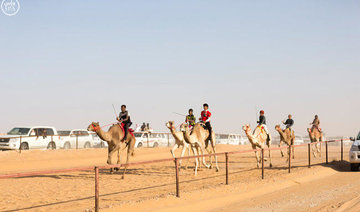
RIYADH: Camel racing is among the most famous traditional sports in the Arab world, which even dates back to the pre-Islamic era, when tribes organized the races to show off the strong camels they owned.
The races continued during the subsequent Islamic era, promoting the practicing of equestrian sports and bravery.
Prophet Muhammad’s companions were known for camel racing.
The camels that take part in races are known as “thaluls” in Arabic, or riding camels.
Among the most famous ones are: Thalul Al-Hurra (aka The Free Camel), as well as those from central and northern the Arabian Peninsula, such as Aseela, from the Thalul Al-Hurra breed, and the Omani Thaluls, known for being a graceful, slim and noble type of camels.
And the Sudanese Thaluls, which are known for the strength and patience and adapting to the challenging desert conditions.
The camels are known for their tolerance to thirst and traveling longer distances than horses.
Though camels are slightly slower than horses, some types of camels have traveled distances on speed that exceeds those of horses, as good camels can travel 40 kilometers continuously in one hour.
Good racing camels are known for specific characteristics that distinguish them from other camels, such as light weight, small palms, large chest size, long legs and long tail.
Racing camels undergo a special diet to help them get rid of excess fats, and the most important foods they feed on are dates, milk, honey, dry grass and corn.


Camel racing: An Arabian sport loved by the region’s people


Camel racing: An Arabian sport loved by the region’s people
- Camel racing is among the most famous traditional sports in the Arab world
- The camels that take part in races are known as “Thaluls” in Arabic


Berlinale responds to backlash over Gaza-related comments
The Berlin International Film Festival has issued a statement after what organisers described as a growing “media storm” linked to comments about the war in Gaza and the broader role of politics in cinema.
Festival director Tricia Tuttle released a lengthy note late Saturday following criticism directed at several high-profile guests. The controversy began during the opening day press conference when jury president Wim Wenders was asked about the conflict in Gaza. He responded: “We have to stay out of politics because if we make movies that are dedicatedly political, we enter the field of politics,” a remark that sparked swift backlash online.
Indian author Arundhati Roy later withdrew from the festival, reportedly angered by the remarks.
Other prominent figures, including Michelle Yeoh and Neil Patrick Harris, also faced online criticism after responding cautiously to questions about politics. Harris stated that he was interested in “doing things that were ‘apolitical,’” a comment that further fuelled debate.
In her statement, Tuttle defended the festival and its participants, stressing the importance of artistic freedom. “People have called for free speech at the Berlinale. Free speech is happening at the Berlinale. But increasingly, filmmakers are expected to answer any question put to them. They are criticised if they do not answer. They are criticised if they answer and we do not like what they say. They are criticised if they cannot compress complex thoughts into a brief sound bite when a microphone is placed in front of them when they thought they were speaking about something else,” she said.
She added: “It is hard to see the Berlinale and so many hundreds of filmmakers and people who work on this festival distilled into something we do not always recognise in the online and media discourse… It is a large, complex festival.”
“Artists are free to exercise their right of free speech in whatever way they choose… nor should they be expected to speak on every political issue raised to them unless they want to,” Tuttle said.