PESHAWAR: Fifty vehicles set off from Peshawar for the picturesque Hazara division on August 13. They are taking part in the Azadi March to celebrate Pakistan’s Independence Day. The rally was inaugurated by KP ministers Atif Khan and Shahram Khan as it set off from the motorway interchange. Twenty mountain bikes joined the convoy at Hassanabdal.
Shahram Khan said that KP has many tourist attractions and the new government, led by Pakistan Tehreek-e-Insaf, would try to develop as many as possible to increase the income generated from them.
“KP is an ideal location for tourism,” he said. “We want people from all over Pakistan and other countries to visit KP and enjoy its natural beauty.”
Atif Khan added that young people make up almost 60 percent of the country’s population, and so an important focus of the PTI-led provincial government would be youth affairs and tourism.
The participants in the rally, organized by the Frontier 4x4 Club and sponsored by the Tourism Corporation Khyber Pakhtunkhwa, spent the night in Mansehra district and were due to reach Haripur in time to celebrate Independence Day at a ceremony on August 14. TCKP general manager Sajjad Hameed said Mansehra was selected for the overnight stay to promote tourism in the picturesque area.
Babar Khan Yousafzai, president of the Frontier 4x4 Club, said that the vehicles in the rally are mostly from Peshawar and Abbottabad, while the mountain bikers are from the and Hikers group from Islamabad.
“The Frontier 4x4 Club and Bikers and Hikers have signed a memorandum of understanding and we jointly arrange such events,” added Yousafzai, who has finished first in the Gomal Zam rally in South Waziristan, the Sarfaranga Cold Desert Rally in Skardu and the Gwadar Rally.
Haripur Deputy Commissioner Zahid Pervez said that the Independence Day ceremony would include a number of events, including the arrival of the Azadi March, a football match, and a boxing competition at Chakai Park.

Azadi March convoy leaves Peshawar for Hazara
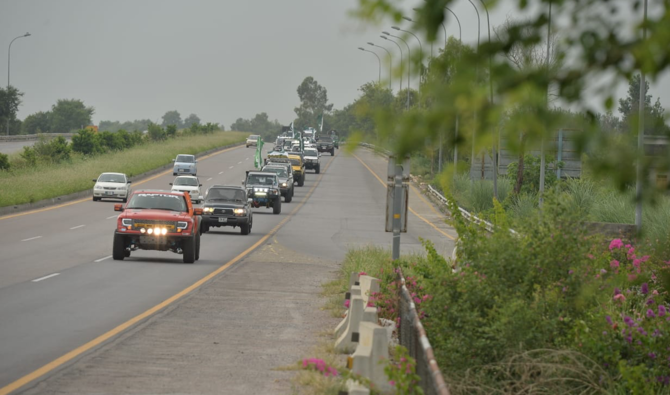
- 52 vehicles and 20 mountain bikes are participating in the event, will reach Haripur in time for the Independence Day ceremony on August 14
- KP government, wants to promote tourism, and generate more funds for the province by organising this Azadi march convoy
Pakistan terms climate change, demographic pressures as ‘pressing existential risks’
- Pakistan has suffered frequent climate change-induced disasters, including floods this year that killed over 1,000
- Pakistan finmin highlights stabilization measures at Doha Forum, discusses economic cooperation with Qatar
ISLAMABAD: Pakistan’s Finance Minister Muhammad Aurangzeb on Saturday described climate change and demographic pressures as “pressing existential risks” facing the country, calling for urgent climate financing.
The finance minister was speaking as a member of a high-level panel at the 23rd edition of the Doha Forum, which is being held from Dec. 6–7 in the Qatari capital. Aurangzeb was invited as a speaker on the discussion titled: ‘Global Trade Tensions: Economic Impact and Policy Responses in MENA.’
“He reaffirmed that while Pakistan remained vigilant in the face of geopolitical uncertainty, the more pressing existential risks were climate change and demographic pressures,” the Finance Division said.
Pakistan has suffered repeated climate disasters in recent years, most notably the 2022 super-floods that submerged one-third of the country, displaced millions and caused an estimated $30 billion in losses.
This year’s floods killed over 1,000 people and caused at least $2.9 billion in damages to agriculture and infrastructure. Scientists say Pakistan remains among the world’s most climate-vulnerable nations despite contributing less than 1 percent of global greenhouse-gas emissions.
Aurangzeb has previously said climate change and Pakistan’s fast-rising population are the only two factors that can hinder the South Asian country’s efforts to become a $3 trillion economy in the future.
The finance minister noted that this year’s floods in Pakistan had shaved at least 0.5 percent off GDP growth, calling for urgent climate financing and investment in resilient infrastructure.
When asked about Pakistan’s fiscal resilience and capability to absorb external shocks, Aurangzeb said Islamabad had rebuilt fiscal buffers. He pointed out that both the primary fiscal balance and current account had returned to surplus, supported significantly by strong remittance inflows of $18–20 billion annually from the Middle East and North Africa (MENA) and Gulf Cooperation Council (GCC) regions.
Separately, Aurangzeb met his Qatari counterpart Ali Bin Ahmed Al Kuwari to discuss bilateral cooperation.
“Both sides reaffirmed their commitment to strengthening economic ties, particularly by maximizing opportunities created through the newly concluded GCC–Pakistan Free Trade Agreement, expanding trade flows, and deepening energy cooperation, including long-term LNG collaboration,” the finance ministry said.
The two also discussed collaboration on digital infrastructure, skills development and regulatory reform. They agreed to establish structured mechanisms to continue joint work in trade diversification, technology, climate resilience, and investment facilitation, the finance ministry said.


