Pakistan, India change gates at Wahga-Attari border on Independence Days

1 / 7
Pakistan Rangers performing ‘Retreat Parade’ at the Wahga-Attari border, which links Pakistani and Indian Punjab, where the two countries are installing new gates on the occasion of their Independence Days. (AN photo by Malik Shafiq)
2 / 7
Friendship Coach (Dosti Bus) passing through the gates at the Wahga-Attari border. (AN photo by Malik Shafiq)
3 / 7
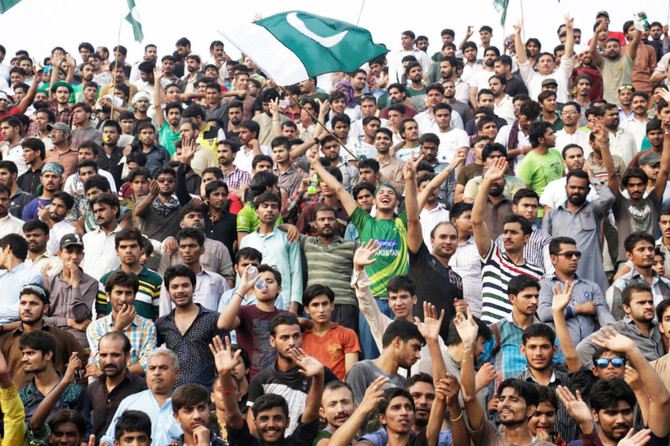
Several hundred people from the two sides observe the parade every day at dusk as the paramilitary forces of Pakistan and India perform a flag-lowering ceremony before closing their gates. (AN photo by Malik Shafiq)
4 / 7
Pakistan Rangers performing ‘Retreat Parade’ at the Wahga-Attari border, which links Pakistani and Indian Punjab, where the two countries are installing new gates on the occasion of their Independence days. (AN photo by Malik Shafiq)
5 / 7
Several hundred people from the two sides observe the parade every day at dusk as the paramilitary forces of Pakistan and India perform a flag-lowering ceremony before closing their gates. (AN photo by Malik Shafiq)
6 / 7
Several hundred people from the two sides observe the parade every day at dusk as the paramilitary forces of Pakistan and India perform a flag-lowering ceremony before closing their gates. (AN photo by Malik Shafiq)
7 / 7
Friendship Coach (Dosti Bus) passing through the gates at the Wahga-Attari border. (AN photo by Malik Shafiq)
Updated 13 August 2018
Follow

Pakistan, India change gates at Wahga-Attari border on Independence Days

  • The aim of changing gates is to provide the people on both sides with a clearer view of the “Retreat Ceremony”
  • The Wahga-Attari border is one of the three places where several hundred people from the two countries — Pakistan and India — witness the lowering of flags every day

LAHORE, Pakistan: Nuclear neighbors and rivals Pakistan and India will be replacing the gates on the Zero Line between the bordering towns of Wahga and Attari on their independence days on Aug. 14 and 15.
The days mark the transfer of power to the two countries as separate dominions with a gap of 24 hours in between.
The Wahga-Attari border, which links Pakistani Punjab’s city of Lahore and Indian Punjab’s city of Amritsar, is one of the three places where several hundred people from the two sides witness the lowering of flags every day.
The security forces from the two countries — the Border Security Force (BSF) of India and Pakistan Rangers — have jointly performed the military drill in the evening while lowering their national flags since 1959.
The other two points where similar parades are held daily are Mahavir/ Sadqi (in India) — Fazilka (in Pakistan), and Hussainiwala (in Ferozpur, India) — Ganda Singh Wala (in Kasur, Pakistan). The gates were installed between the two countries after the separation in 1947.
The exercise is known as the “Beating Retreat drill.” The paramilitary forces of the two countries, the BSF and the Rangers, shut the heavy gates for the night at the joint check post amid a synchronized display of aggression.
The drill is a symbol of the two countries’ rivalry, as well as brotherhood and cooperation with each other.
The Wahga-Attari border is the most active land point for transportation of goods between the two countries and citizens with visas cross the border on foot, using this path to enter each other’s country.
The “Friendship Bus” (Dosti Bus), which connects Lahore with the Indian capital, Delhi, also crosses into the neighboring country using this gate for two round trips every week.
The parade is a permanent feature of the border activity and has continued despite security threats — on Nov. 2, 2014, 60 people were killed and another 110 injured in a suicide attack on the Pakistan side of the Wagah border. The Indian side denied the public attendance on the evenings between Sept. 29 and Oct. 8, 2016 owing to the India–Pakistan military confrontation on Sept. 29, 2016.
The gates on the two sides are being changed with the mutual consultation of the two countries with the aim of providing a good view of the parade and seeing the audience sitting on the opposite sides.
The process of removing the old gates and installing the new ones has begun on the two sides and Pakistan will complete it by tomorrow (Aug. 14, Tuesday).
According to media reports the Indian security officials have confirmed the replacement of gates on Wagah Border, saying the countries have agreed on installing similar gates.
The Indian media reported that the new gates will have a similar design on both sides and the earlier gates were unnecessarily big with thick pillars, which hindered the view of spectators from either side to look beyond the Zero line.
Nand Lal Chauhan, former superintending engineer, Central Public Works Department, said the gate was designed by a renowned architect. “We had handed over the design to the BSF. After a discussion with the Pakistan Rangers, some modifications were introduced before final approval from both sides,” he said. The weight of the gate is 5.5 quintals. It is 51ft wide and 11ft high.
JS Oberoi, DIG, BSF, Amritsar sector, said: “It was mutually decided to let the people on both sides have a clearer view of the Retreat Ceremony.”
The officials in Pakistan have confirmed that the inauguration of a new gate on their side will take place on Aug. 14, as a part of Independence Day celebrations.


Russian minister visits Cuba as Trump ramps up pressure on Havana

Updated 6 sec ago
Follow

Russian minister visits Cuba as Trump ramps up pressure on Havana

  • The Russian embassy in Havana said the minister would “hold a series of bilateral meetings” while in Cuba

HAVANA: Russia’s interior minister began a visit to ally Cuba on Tuesday, a show of solidarity after US President Donald Trump warned that the island’s longtime communist government “is ready to fall.”
Trump this month warned Havana to “make a deal,” the nature of which he did not divulge, or pay a price similar to Venezuela, whose leader Nicolas Maduro was ousted by US forces in a January 3 bombing raid that killed dozens of people.
Venezuela was a key ally of Cuba and a critical supplier of oil and money, which Trump has vowed to cut off.
“We in Russia regard this as an act of unprovoked armed aggression against Venezuela,” Russia’s Interior Minister Vladimir Kolokoltsev told Russian state TV Rossiya-1 of the US actions after landing in Cuba.
“This act cannot be justified in any way and once again proves the need to increase vigilance and consolidate all efforts to counter external factors,” he added.
The Russian embassy in Havana said the minister would “hold a series of bilateral meetings” while in Cuba.
Russia and Cuba, both under Western sanctions, have intensified their relations since 2022, with an isolated Moscow seeking new friends and trading partners since its invasion of Ukraine.
Cuba needs all the help it can get as it grapples with its worst economic crisis in decades and now added pressure from Washington.
Trump has warned that acting President Delcy Rodriguez will pay “a very big price” if she does not toe Washington’s line — specifically on access to Venezuela’s oil and loosening ties with US foes Cuba, Russia, China and Iran.
On Tuesday, Russia’s ambassador to Havana, Victor Koronelli, wrote on X that Kolokoltsev was in Cuba “to strengthen bilateral cooperation and the fight against crime.”
The US chief of mission in Cuba, Mike Hammer, meanwhile, met the head of the US Southern Command in Miami on Tuesday “to discuss the situation in Cuba and the Caribbean,” the embassy said on X.
The command is responsible for American forces operating in Central and South America that have carried out seizures of tankers transporting Venezuelan oil and strikes on alleged drug-trafficking boats.

- Soldiers killed -

Cuba has been a thorn in the side of the United States since the revolution that swept communist Fidel Castro to power in 1959.
Havana and Moscow were close communist allies during the Cold War, but that cooperation was abruptly halted in 1991 with the dissolution of the Soviet bloc.
The deployment of Soviet nuclear missile sites on the island triggered the Cuban Missile Crisis of 1962, when Washington and Moscow came close to war.
During his first presidential term, Trump walked back a detente with Cuba launched by his predecessor Barack Obama.
Thirty-two Cuban soldiers, some of them assigned to Maduro’s security detail, were killed in the US strikes that saw the Venezuelan strongman whisked away in cuffs to stand trial in New York.
Kolokoltsev attended a memorial for the fallen men on Tuesday.