Husain Haqqani: Pakistan should accept my right to dissent

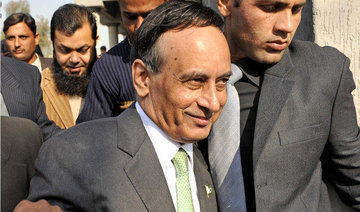
Husain Haqqani. (AFP/file)
Updated 12 August 2018
Follow

Husain Haqqani: Pakistan should accept my right to dissent

  • Pakistan’s Supreme Court directed FIA to bring Haqqani back to the country
  • Ex-ambassador to US rejects allegations of embezzlement and abuse of power in “Memogate” case

ISLAMABAD: Pakistan’s former ambassador to the US, Husain Haqqani, said on Sunday that Pakistani authorities should accept that he cannot be forced to return to Pakistan to face the charges that have been brought against him, claiming there is insufficient evidence against him to justify extradition. 

“My comments on yesterday’s #Pakistan SC (Supreme Court) proceedings and the failed attempts to force my return. Time for authorities to accept my right to dissent and stop wasting time and energy,” Haqqani tweeted.
In reponse to another tweet, Haqqani stated “If there is a real case against anyone, courts of other countries would extradite him upon presentation of evidence.”
On August 9, Ahmer Bilal Sufi — an expert on international law — told a three-member bench of the Supreme Court that Haqqani should be repatriated to Pakistan to face criminal charges including breach of trust, misappropriation, cheating and embezzlement.
Sufi is assisting the country’s top court in the famous “Memogate” case.
In June this year, Pakistan’s Supreme Court directed the Federal Investigation Agency (FIA) to bring Haqqani back to Pakistan.
Haqqani was forced to resign from his post in 2011 after being accused of seeking American help against Pakistan’s armed forces, a request he allegedly shared with US officials in a written memorandum, hence the “Memogate” tag. That controversy came to light just days after US Navy SEALs killed Al-Qaeda leader Osama bin Laden in Abbottabad.
In March this year, the FIA lodged a “first information report” accusing Haqqani of embezzlement and abuse of power during his time as Pakistan’s ambassador in Washington from 2008 to 2011.


Pakistan deputy PM to attend OIC meeting tomorrow on Israel’s West Bank measures

Updated 6 sec ago
Follow

Pakistan deputy PM to attend OIC meeting tomorrow on Israel’s West Bank measures

  • OIC ministerial meeting on Feb. 26 in Jeddah to discuss Israel’s recent measures at expanding control over West Bank
  • Deputy Prime Minister Ishaq Dar to visit Saudi Arabia from Feb. 26-28, meet counterparts from OIC member states 

ISLAMABAD: Pakistan’s Deputy Prime Minister Ishaq Dar will attend an emergency meeting of the Organization of Islamic Cooperation (OIC) in Jeddah on Thursday to discuss Israel’s recent measures to expand control over the West Bank, the foreign office said. 

Dar, who also serves as Pakistan’s foreign minister, will participate in the Extraordinary Ministerial Session of the OIC’s Executive Committee on Thursday. The OIC has said the meeting in Jeddah will discuss “illegal” Israeli decisions aimed at the West Bank’s annexation.

Israel’s decision this month to approve land registration procedures in parts of the West Bank for the first time since 1967 have drawn sharp criticism from Muslim nations, who see it as a move to ease the path for settlement expansion and potential annexation.

“In the Ministerial Session, the Deputy Prime Minister/Foreign Minister will share Pakistan’s perspective on the latest illegal measures by Israel to convert areas of the Occupied West Bank into so-called ‘state land,’” the foreign office said. 

Dar will visit the Kingdom from Feb. 26-28, during which he will also hold bilateral meetings with his counterparts from OIC member states, the foreign office added. 

More than 500,000 Israeli settlers live in settlements and outposts in the West Bank, excluding Israeli-annexed East Jerusalem, alongside around three million Palestinians.
Settlements are considered illegal under international law, a position Israel disputes.

Pakistan and 21 other Muslim nations on Wednesday condemned Israel’s measures to expand control over the West Bank, warning the steps risk advancing “unacceptable de facto annexation” and undermining prospects for a two-state solution.