


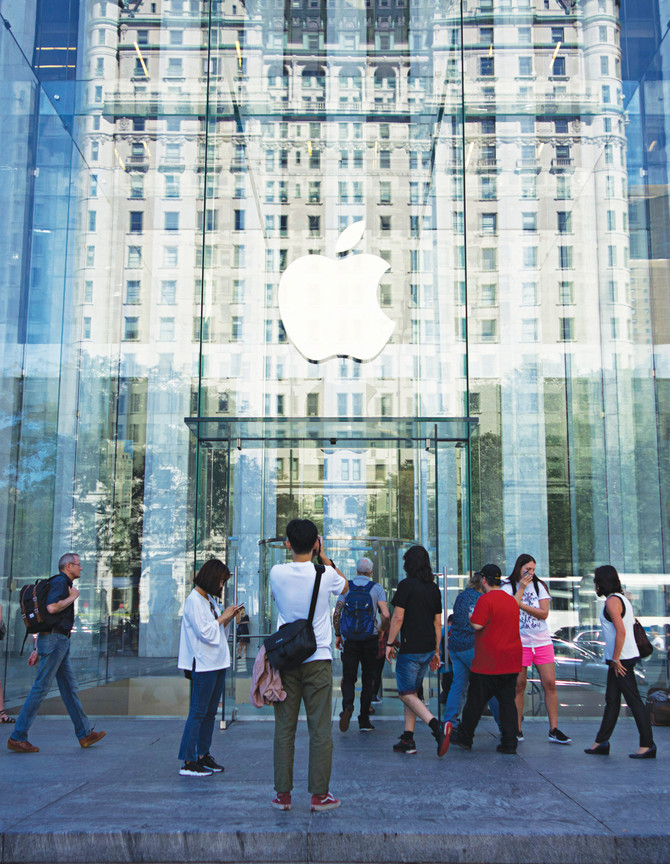

LONDON: Tech giant Apple has raised its profile in Middle East markets where digitally savvy consumers are increasingly willing to pay high prices for the company’s top-end products.
Ramping up the competition against regional heavyweight Samsung, Apple looks set to continue its growth across the Middle East following Thursday’s announcement that it had passed the $1 trillion valuation threshold, becoming the first publicly traded company to reach the milestone.
Apple achieved record results in the region last year, revealing 30 percent growth during the fourth quarter of 2017, driven partly by a double-digit rise in iPhone sales across the Middle East.
In the UAE, Saudi Arabia and Kuwait, the iPhone is rapidly becoming the handset of choice as the company courts the expanding Middle East market amid rising digital penetration across the region.
“In Kuwait, the iPhone dominates; everywhere you go you’ll find an Apple device,” said self-described Apple enthusiast Kuwaiti Nawaf Al-Suwaiyed.
The 32-year-old told Arab News that the region’s large expat population means Android devices also have a strong hold on the Middle East market, but Apple “has the lead with locals.”
Apple launched its first UAE store at Mall of the Emirates in Dubai in 2015 and has since opened two further outlets in the emirate.
Next year, the company plans to increase its penetration in the Saudi market with the launch of its first stores in the Kingdom.
Commenting on the company’s $1 trillion triumph, Al-Suwaiyed said he expected the news but thought it would come a little later in the year, ahead of the next Apple conference in September or October, where they are expected to launch the next generation iPhone, Apple Watch, iPad and the new Apple Air Pod.
Analysts watched Apple’s share value jump by 2.9 percent on Thursday, closing at $207.39, giving it a market capitalization of $1.002 trillion. Apple’s stock market value peaked at $1.006 trillion during its best two-day run since April 2014.
Apple’s stock has climbed by 23 percent this year, compared with a 6 percent gain for the Standard & Poor’s 500 index. This week’s surge comes ahead of the launch of the next generation of iPhone, which is due to be released in September.
Much of Apple’s success is due to the iPhone, which remains the company’s most popular product by a significant margin. While sales have slowed a little in recent years, the addition of new features has encouraged customers to pay higher prices for its top-end models, which are popular among wealthy Gulf shoppers.
In its most recent quarter, Apple fetched an average price of $724 per iPhone — a nearly 20 percent increase from an average of $606 per iPhone at the same time last year, according to Associated Press.
In the UAE, the iPhone dominated smartphone sales last year, with the iPhone 6, 6s and 7 models accounting for the top-three slots in the list of registered devices in 2017 according to the country’s Telecommunications Regulatory Authority (TRA).
At the global level, the company’s net sales topped $229 billion in 2017, up from $215 billion the previous year.
The company also has a strong footing in China, unlike rivals Microsoft and Nokia, which failed to make inroads in the Chinese market, Al-Suwaiyed said.
“China is a big market and they have a good opportunity to expand further there.”
“About 20 years ago they were going to file for bankruptcy and now they’ve hit the $1 trillion mark, it’s amazing,” he said.
In 1997, the Apple’s market value fell below $2 billion, prompting the company to bring back its exiled founder, Steve Jobs, to serve as an interim CEO and restore its fortunes. Jobs turned to rival Microsoft for a $150 million cash injection to pay off the bills and set about bringing its most iconic products into fruition.
He also promoted some of the company’s best talent, bringing in Tim Cook in 1998, who took over as CEO in 2011, a few months before Jobs died of cancer. Under Cook’s stewardship, Apple has continued its meteoric climb, doubling its annual revenue to reach to $229 billion and quadrupling its stock since he took the reins.
In a memo to Apple’s 120,000 employees on Thursday that was seen by Reuters, Cook said that the $1 trillion valuation was “a significant milestone” that gave Apple employees “much to be proud of.” But he said it was “not the most important measure” of the company’s success.
“Financial returns are simply the result of Apple’s innovation, putting our products and customers first, and always staying true to our values,” Cook said in the memo.


