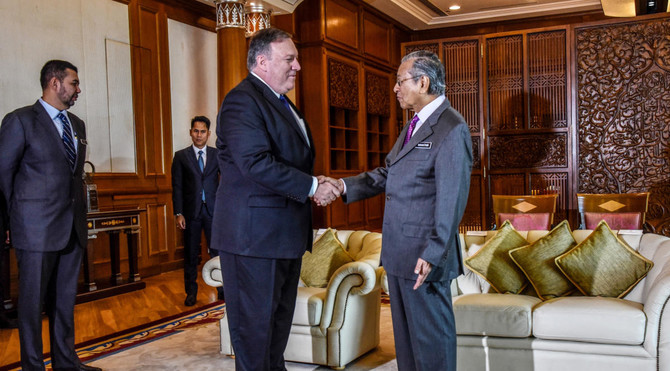
KUALA LUMPUR: US Secretary of State Mike Pompeo ended his two-day visit to Malaysia on Friday after meetings with the Malaysian Prime Minister Mohamad Mahathir to promote Trump’s Indo-Pacific vision and discuss regional issues, including the rise of China.
Pompeo will head to Singapore for ASEAN regional meetings.
The secretary of state’s visit was the first from the US government since a new government under Pakatan Harapan (PH) was formed last May.
The visit is seen as a move by the US government to rekindle its relations with Malaysia under the new leadership.
Professor James Chin, director of the Asia Institute at Tasmania University in Australia, told Arab News that it is normal for the US to visit any new administration. In Malaysia’s case, Mahathir is widely seen as the region’s senior statesman.
Dr. Felix Tan, associate lecturer with SIM Global Education, said that the visit demonstrated the US commitment to the new PH government.
“This will boost the PH’s government in the years ahead,” he said.
Pompeo’s visit has also showcased a more mellow and experienced Mahathir, whose was known for his firebrand leadership during his time as prime minister a few decades ago.
“Dr. M. seems ready to have a cordial relationship with the US, one that is less acrimonious than when he previously served as prime minister,” Dr. Ian Chong, Associate Professor of Political Science at National University of Singapore, said.
“Washington wants to show that it is interested in Malaysia, its process of democratization, and that there is no need to pander to China.”
However, Chin said: “Mahathir is not pro-Trump. He has said many times that he has no idea how to deal with Trump since Trump is so unpredictable.”
The US government had been close to the previous Najib Razak government, currently embroiled in the 1MDB billion-dollar corruption scandal.
Pompeo and Mahathir discussed issues affecting the region, including China’s rise and tension in the South China Sea.
While the Philippines and Vietnam have been vocal on their respective claimed territories in the South China Sea, Malaysia has remained neutral regarding the conflict.
With China’s rise, the US presence is seen as a balancing act in the region that has become a test of power between the two economic giants.
Following on from Obama’s “Pivot to Asia” vision, Trump’s Indo-Pacific vision aims to promote “transparent, private sector-led investment.”
However, US officials claimed the strategy does not compete directly with China’s vast “Belt and Road” initiative.
“Both policies are to contain China and China’s rise,” said Chin, adding that the US wants to ensure Malaysia remains neutral on China and South China Sea.
“The Indo-Pacific vision is far less institutionalized than the Obama administration’s rebalance. It is also more vague and focuses more on major powers rather than the range of actors present in Asia,” Chong said.
“The US is sending the message that it will not abandon its Southeast Asian allies,” said Tan.
“China is a growing superpower and its economic dominance in this region is growing. I don’t think the impact of such visits will be great.”


![]()
![]()

Don’t pander to China, Pompeo tells Malaysia PM
Don’t pander to China, Pompeo tells Malaysia PM
- Mahathir is widely seen as the region’s senior statesman.
- The US government had been close to the previous Najib Razak government.


Latest updates


© 2026 SAUDI RESEARCH & PUBLISHING COMPANY, All Rights Reserved And subject to Terms of Use Agreement.