DHAKA: Dhaka remained largely cut off from the rest of Bangladesh on Friday, with local and long-distance buses staying off the roads after five days of protests by young people demanding safer streets.
The protests, which began Sunday after two college students were struck and killed by a pair of buses, eventually paralyzed the capital of 7 million, with tens of thousands of demonstrators blocking roads.
Students also stopped thousands of private vehicles — including those of top officials and judges — demanding to see if the cars were registered and the drivers licensed. One minister had to abandon his vehicle in the street after protesters found that his paperwork was not in order, according to news reports.
There was no sign of mass protests Friday, the beginning of the country’s weekend, but dozens of people formed a human chain in front of the main press club in Dhaka to call for transportation reform.
“We must bring changes,” said Selina Akter, a mother of two schoolchildren who joined the group.
Corruption is rife in Bangladesh, making it easy for unlicensed drivers and unregistered vehicles to ply the roads. At least 12,000 people die each year in road accidents often blamed on faulty vehicles, reckless driving and lax traffic enforcement.
The two buses involved in the Sunday accident were racing to collect passengers, a common occurrence in the city, which is regularly gridlocked by traffic chaos. One of the bus drivers had fled the scene, though both were later arrested.
Abdur Rahim, a top leader of the Bangladesh Road Transport Workers’ Federation, said that bus operators would stay off the streets until security improves. A handful of buses were attacked during the protests.
“We have invested lot of money to do business, we can’t let people burn our vehicles in the name of protests,” he said. “We need our security too.”
Buses are key to transportation in Bangladesh, where trains are overcrowded and most people cannot afford their own cars.

Bangladesh capital hit by mass protests demanding safe roads
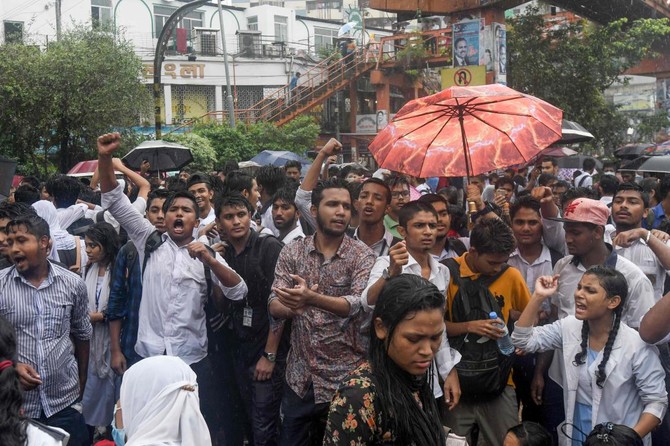
- Dhaka remained largely cut off from the rest of Bangladesh on Friday, with local and long-distance buses staying off the roads after five days of protests by young people demanding safer streets.
- The protests, which began Sunday after two college students were struck and killed by a pair of buses, eventually paralyzed the capital of 7 million.
Modi starts Mideast-Africa tour as India-Oman free-trade pact nears completion
- Oman’s Shoura Council approved the trade deal’s draft last week
- Modi begins trip in Amman, heading to Addis Ababa and Muscat
NEW DELHI: Prime Minister Narendra Modi left New Delhi on Monday for a tour covering Jordan, Oman and Ethiopia, as his government looks to strengthen partnerships with West Asia and Africa and finalize a free-trade deal with Muscat.
Modi’s four-day trip will start in Amman, at the invitation of King Abdullah.
“I am sure this visit will boost bilateral linkages between our nations,” Modi said on social media upon his arrival in Jordan, where he was received by Prime Minister Jafar Hassan.
On Tuesday, he is scheduled to arrive in Addis Ababa for his first state visit to Ethiopia. A day later, he will be in Muscat, where the Shoura Council last week approved the draft Comprehensive Economic Partnership Agreement with India.
“If it is signed during this visit, it will significantly deepen the economic ties between India and Oman. And it will open up a new chapter in the history of India-Oman trade and commercial relationship,” Ministry of External Affairs Secretary Arun Chatterjee told reporters ahead of Modi’s departure.
He said Modi would be accompanied by a high-level delegation for his second visit to Oman, after his last trip in February 2018. It also follows the visit of Oman’s Sultan Haitham bin Tariq to India in December 2023.
Free-trade negotiations between India and Oman began in November 2023, with the first round in New Delhi and the second in Muscat.
When the talks concluded in March 2024, Oman sought revisions on market-access terms and the final signature was postponed.
Announcements of the deal’s possible finalization have been made in the past few months by India’s Commerce and Industry Minister Piyush Goyal and the Omani ambassador to New Delhi, Issa Saleh Al-Shibani.
It would be its second with a GCC country after a 2022 trade deal with the UAE, as India has been trying to reach a similar agreement with the whole bloc.
“The framework is expected to be the same as the UAE’s, that is, a Comprehensive Economic Partnership Agreement. This is significant given that the progress on India-GCC FTA has been slow and non-consequential so far,” said Muddassir Quamar, associate professor at the School of International Studies, Jawaharlal Nehru University.
While Oman is one of Delhi’s smaller GCC trading partners — trailing behind the UAE and Saudi Arabia, with bilateral trade about $10 billion — it remains strategically important, particularly in energy and logistics.
“The FTA is likely to give a boost to India-Oman economic and trade relations, especially of goods and services. (It is) important given India has worked to enhance its trade and economic relations with the Gulf countries that are (among) the most dynamic and fast-expanding global economies,” Quamar told Arab News.
“It is also important because there is immense potential for Indian businesses and industries to partner with their Gulf and Omani partners in contributing to the diversification and economic growth plans.”


