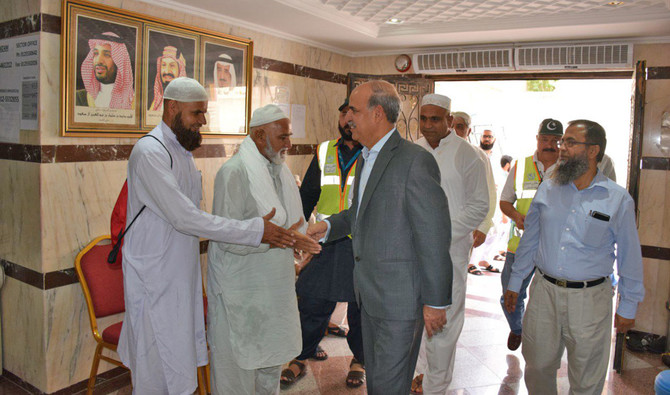
Pakistani envoy visits Makkah to review Hajj arrangements

1 / 2
Pakistan’s ambassador to Saudi Arabia, Khan Hasham bin Saddique also visited the Hajj Mission Hospital, set up especially for Pakistani pilgrims. The hospital has so far treated some 11,000 pilgrims for various ailments, and has distributed more than 100 wheelchairs. (REUTERS)
2 / 2
Pakistan’s ambassador to Saudi Arabia, Khan Hasham bin Saddique also visited the Hajj Mission Hospital, set up especially for Pakistani pilgrims. The hospital has so far treated some 11,000 pilgrims for various ailments, and has distributed more than 100 wheelchairs. (REUTERS)
Updated 03 August 2018
Follow

Pakistani envoy visits Makkah to review Hajj arrangements

  • Ambassador asked Hajj directorate to ensure that best possible facilities are extended to Pakistani pilgrims
  • Around 76,000 Pakistani Hujjaj have arrived in Saudi Arabia, so far

Pakistan’s ambassador to Saudi Arabia, Khan Hasham bin Saddique, on Thursday visited Makkah to review Hajj arrangements for Pakistani pilgrims, 76,000 of whom have arrived in the Kingdom so far.
He also visited the Hajj Mission Hospital, set up especially for Pakistani pilgrims. The hospital has so far treated some 11,000 pilgrims for various ailments, and has distributed more than 100 wheelchairs. 
Patients expressed satisfaction over the hospital’s treatment facilities and the conduct of medical staff.
Saddique also visited accommodation buildings for Pakistani pilgrims. He talked to residents, who expressed satisfaction over the accommodation arrangements and quality of food.


Pakistan PM orders accelerated privatization of power sector to tackle losses

Updated 15 December 2025
Follow

Pakistan PM orders accelerated privatization of power sector to tackle losses

  • Tenders to be issued for privatization of three major electricity distribution firms, PMO says
  • Sharif says Pakistan to develop battery energy storage through public-private partnerships

ISLAMABAD: Pakistan’s prime minister on Monday directed the government to speed up privatization of state-owned power companies and improve electricity infrastructure nationwide, as authorities try to address deep-rooted losses and inefficiencies in the energy sector that have weighed on the economy and public finances.

Pakistan’s electricity system has long struggled with financial distress caused by a combination of factors including theft of power, inefficient collection of bills, high costs of generating electricity and a large burden of unpaid obligations known as “circular debt.” In the first quarter of the current financial year, government-owned distribution companies recorded losses of about Rs171 billion ($611 million) due to poor bill recovery and operational inefficiencies, official documents show. Circular debt in the broader power sector stood at around Rs1.66 trillion ($5.9 billion) in mid-2025, a sharp decline from past peaks but still a major fiscal drain. 

Efforts to contain these losses have been a focus of Pakistan’s economic reform program with the International Monetary Fund, which has urged structural changes in the energy sector as part of financing conditions. Previous government initiatives have included signing a $4.5 billion financing facility with local banks to ease power sector debt and reducing retail electricity tariffs to support economic recovery. 

“Electricity sector privatization and market-based competition is the sustainable solution to the country’s energy problems,” Prime Minister Shehbaz Sharif said at a meeting reviewing the roadmap for power sector reforms, according to a statement from the prime minister’s office.

The meeting reviewed progress on privatization and infrastructure projects. Officials said tenders for modernizing one of Pakistan’s oldest operational hubs, Rohri Railway Station, will be issued soon and that the Ghazi Barotha to Faisalabad transmission line, designed to improve long-distance transmission of electricity, is in the initial approval stages. While not all power-sector decisions were detailed publicly, the government emphasized expanding private sector participation and completing priority projects to strengthen the electricity grid.

In another key development, the prime minister endorsed plans to begin work on a battery energy storage system with participation from private investors to help manage fluctuations in supply and demand, particularly as renewable energy sources such as solar and wind take a growing role in generation. Officials said the concept clearance for the storage system has been approved and feasibility studies are underway.

Government briefing documents also outlined steps toward shifting some electricity plants from imported coal to locally mined Thar coal, where a railway line expansion is underway to support transport of fuel, potentially lowering costs and import dependence in the long term.

State authorities also pledged to address safety by converting unmanned railway crossings to staffed ones and to strengthen food safety inspections at stations, underscoring broader infrastructure and service improvements connected to energy and transport priorities.