
The Galápagos Islands are home to an amazing variety of iconic creatures, from giant tortoises, Galápagos sea lions, Galápagos penguins, and ghost crabs to Darwin’s finches, the blue-footed booby, and hummingbird moths.
But how precisely do these animals manage to survive on — and in the waters around —their desert-like volcanic islands, where fresh water is always scarce, food is often hard to come by, and finding a good mate is a challenge because animal populations are so small?
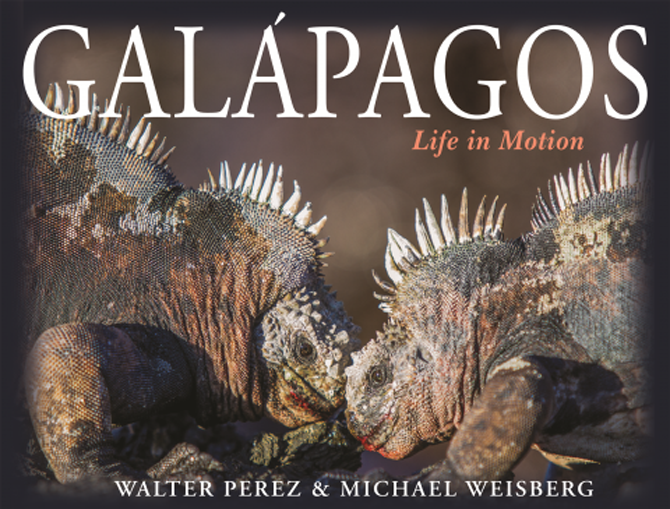
In this stunning large-format book, Galápagos experts Walter Perez and Michael Weisberg present an unprecedented photographic account of the remarkable survival behaviors of these beautiful and unique animals. With more than 200 detailed, close-up photographs, the book captures Galápagos animals in action as they feed, play, fight, court, mate, build nests, give birth, raise their young, and cooperate and clash with other species.
Watch male marine iguanas fight over territory and females; see frigatebirds steal food and nesting materials from other birds; witness the courtship dance of a pair of blue-footed boobies; go underwater to glimpse a Galápagos sea lion pup playing with its mother; and observe a baby Pacific green turtle enter the water for the first time.
These and dozens of other unforgettable scenes are all vividly captured here — including many moments that even experienced Galápagos observers may never be lucky enough to see in person.