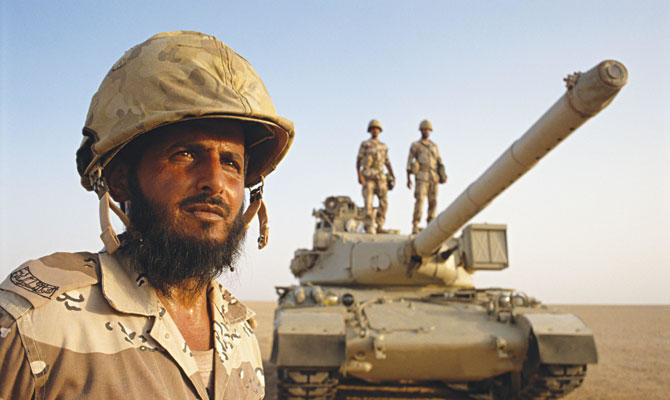

JEDDAH: On this day 28 years ago, Iraq invaded Kuwait. Months later, Saudi Arabia and the United States came to the rescue. Despite their sacrifices and efforts, anti-Saudi and anti-American sentiment is on the rise among many Kuwaitis today — analysts explain why.
Saddam Hussein’s men rapidly overwhelmed the Kuwaiti forces on Aug. 2, 1990. The emir of Kuwait, his family, other government leaders and a large number of Kuwaiti citizens made it to the safety of the Saudi border, where they were offered protection by King Fahd, who said: “Saudi Arabia and Kuwait are one. We live together and we die together.”
The same day, the UN Security Council unanimously denounced the invasion and demanded the immediate withdrawal of Iraqi forces. Four days later, on Aug. 6, 1990, the Security Council imposed a worldwide ban on trade with Iraq. Saddam, meanwhile, amassed nearly 300,000 troops in Kuwait to thwart any attempt to drive out the occupiers.
King Fahd was a resolute leader. He summoned his global allies and began planning for the liberation of Kuwait. He took grave risks. Many Arab countries supported Saddam, including Yemen, led by Ali Abdullah Saleh. The Saudi king severed ties with Yemen and focused on ending the occupation of Kuwait.
The king and his advisers used all their diplomatic skills to marshal the resources of the world for what became Operation Desert Storm.
“That was a golden period in the history of Saudi Arabia,” said Dr. Hamdan Al-Shehri, an international affairs scholar in Riyadh. “The whole world knows how Saudi Arabia stands by its friends, allies and brothers. The Kuwaitis know how Saudi Arabia opened its hearts and borders.”
Against this backdrop, it is sad to hear anti-Saudi and anti-American sentiments from some Kuwaitis, he said, referring to Iranian and Hezbollah sympathizers, along with Muslim Brotherhood members. “They try to overlook the efforts to liberate Kuwait from the clutches of a brutal dictator nearly three decades ago. There are very few of these people and they are in the pay of the Iranians.”
Al-Shehri added that the Muslim Brotherhood has always been critical of Saudi Arabia.
“They have used Saudi Arabia’s differences with Qatar to raise a shrill cry,” he said. “They are upset because Saudi Arabia has exposed the Muslim Brotherhood as being in league with the Iranians. A Kuwaiti man called Nasser Duwailah spits venom against Saudi Arabia on Al Jazeera TV. He is a Muslim Brotherhood sympathizer and his criticism of Saudi Arabia is along predictable lines — he should know the role that Saudi Arabia played in liberating his country.”
Former MP Abdulhameed Dashti, who is also considered to have connections with the Iranians, also regularly criticizes Saudi Arabia. 
“People like him are ungrateful,” said Al-Shehri. “They deny historical facts and only repeat what they are told by the regime in Tehran, which is, of course, inimical to the interests of the Arab and Muslim world.
“Saudi Arabia always stood by its Arab allies. When Bahrain was faced with grave danger from Iran, it was Saudi Arabia that sent its forces to quell the Iranian-inspired insurrection in 2011. When the Iranian-allied Houthis started challenging the Arabs, Saudi Arabia took the lead in neutralizing the Houthi terror machine. How can any fellow Arab blame Saudi Arabia for coming to the aid of Arab countries?”
Saudi columnist Fahad Al-Shoqiran echoes these sentiments. “Saudi Arabia played a pioneering role in Kuwait’s liberation,” he said. “If it was not for Saudi Arabia, Kuwait would not have been liberated.
“The man behind the coalition between Saudi Arabia and the other states was the late King Fahd, thanks to his personal relationships. This is documented in the words of (the then) US President George Bush and other important figures, such as former secretary of state James Baker, during press conferences and interviews. They stressed that had it not been for Saudi Arabia, and particularly King Fahd and his administration, Kuwait’s tragedy would have continued.”
Saudi columnist Abdulrahman Al-Rashed wrote last year that Saudi Arabia viewed its support for Kuwait as honoring its pledges, respecting the principles of the GCC and protecting states from chaos. It was in Riyadh’s interest to defeat Saddam, but the less risky option would have been to find a way to coexist with him, he said.
“It would not have been possible to confront the invasion without Saudi Arabia’s desire and approval,” Al-Rashed wrote. “The Kingdom hosted half a million troops, including 200,000 from the US. King Fahd is a historic figure because he is the one who tolerated threats and managed the confrontation with Saddam.”
The king was keen to preserve the rule of the Al-Sabah family and its unity as a symbol of Kuwait’s legitimacy. He allowed the Kuwaiti government in exile to operate in the city, and helped to revive the symbols of Kuwait by issuing the dinar and publishing daily newspapers, among other things. Kuwaiti military personnel gathered in Saudi Arabia as King Fahd supported the resistance. 
According to Al-Rashed, King Fahd’s most risky decision was inviting US troops to the Kingdom. “This was a huge personal responsibility,” he wrote. “Several high-ranking Saudi royals asked him whether he was sure of his decision, and if he would be able to get them to leave later.”
As troops arrived, Saddam’s supporters protested. Led by Hassan Al-Turabi in Sudan and Rached Al-Ghannouchi in Tunisia, the Muslim Brotherhood launched incitement campaigns,
accusing the Kingdom of apostasy.
During an urgent Arab League session in Cairo, only a slight majority of 12 countries supported the Kuwaiti cause. Despite objections, Egyptian president Hosni Mubarak played a significant role in rejecting attempts to confuse the issue, calling for a vote by a show of hands instead of trying to reach a consensus.
“King Fahd risked his country’s stability, given that the chances of liberating Kuwait were slim, that there might not be a war, or that it would last a long time, like the Iran-Iraq war,” wrote Al-Rashed. “There was the possibility of defeat, of an incomplete victory, of Saddam not entirely leaving Kuwait, or Saudi Arabia not coming out of the war safe.
“King Fahd could have copied (Qatar’s) Sheikh Hamad and bargained with Saddam in exchange for Kuwait, but he did not. He was a brave leader who made a historic decision to stand by Kuwait; we are all proud of this. As such, it is surprising to hear some Kuwaitis supporting Qatar today, instead of condemning its actions that threaten the security and existence of four countries.
“Kuwait has a moral debt to repay, and we expect it to do so.”