

Iran slams Trump talks offer as ‘humiliating’

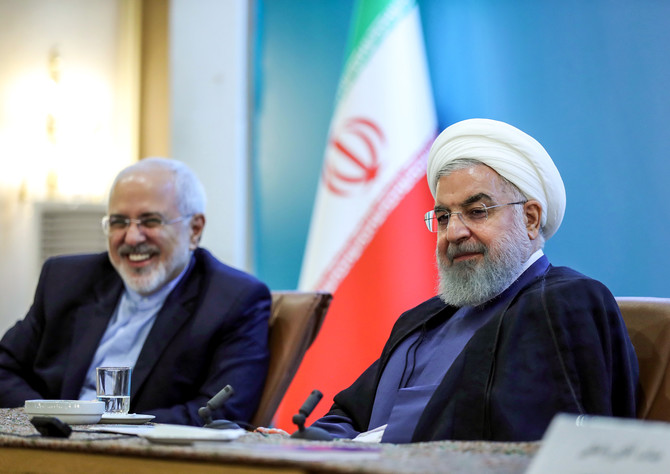
Senior Iranian officials on Tuesday rejected US President Donald Trump's offer of talks without preconditions as worthless and "a humiliation", while resident Hassan Rouhani said Trump's repudiation of the accord reached in 2015 was "illegal." (AFP/Iranian Presidency)
Updated 31 July 2018
Follow

Iran slams Trump talks offer as ‘humiliating’

  • Rouhani said the ball was “in Europe’s court” in terms of maintaining ties with Tehran
  • The US withdrew from the Iran nuclear accord in early May 2018

LONDON: Senior Iranian officials on Tuesday rejected US President Donald Trump's offer of talks without preconditions as worthless and "a humiliation" after he acted to reimpose sanctions on Tehran following his withdrawal from a landmark nuclear deal.
Separately, Iranian President Hassan Rouhani said Trump's repudiation of the accord reached in 2015 was "illegal" and Iran would not easily yield to Washington's renewed campaign to strangle Iran's vital oil exports.
In May, Trump pulled the United States out of the multilateral deal concluded before he took office, denouncing it as one-sided in Iran's favour. On Monday, he declared that he would be willing to meet Rouhani without preconditions to discuss how to improve relations.
Iran's foreign ministry spokesman said Trump's offer to negotiate with Tehran contradicted his actions as Washington has imposed sanctions on Iran and put pressure on other countries to avoid business with the Islamic Republic.
"Sanctions and pressures are the exact opposite of dialogue," Bahram Qasemi was quoted as saying by Fars news agency on Tuesday.
"How can Trump prove to the Iranian nation that his comments of last night reflect a true intention for negotiation and have not been expressed for populist gains?" he added.
The head of the powerful Revolutionary Guards equally dismissed Trump's tentative offer, saying the Islamic Republic was not North Korea.
"Mr Trump! Iran is not North Korea to accept your offer for a meeting," Guards commander Major General Mohammad Ali Jafari was quoted as saying by Fars News agency. "Even US presidents after you will not see that day."
The head of Iran's Strategic Council on Foreign Relations said on Tuesday Tehran saw no value in Trump's offer, made only a week after he warned Iran it risked dire consequences few had ever suffered in history if it made threats against Washington.
"Based on our bad experiences in negotiations with America and based on US officials' violation of their commitments, it is natural that we see no value in his proposal," Kamal Kharrazi was quoted as saying by the semi-official Fars news agency.
“Trump should first make up for his withdrawal from the nuclear deal and show that he respects his predecessors’ commitments and international law,” added Kharrazi, a former foreign minister.
Kharrazi said Trump likes “meeting for the sake of meeting” and was not concerned about its results.
The Strategic Council on Foreign Relations was set up by Iranian Supreme Leader Ayatollah Ali Khamenei to help formulate long-term policies for the Islamic Republic.
Trump's move to force Iran into fresh negotiations has for now reunited Iranian hardliners who opposed the nuclear deal and pragmatists like Rouhani who championed it to end the Islamic Republic's economically crippling stand-off with Western powers.
Ali Motahari, the deputy speaker of Iran's parliament who is seen as part of Iran's moderate camp, said that to negotiate with Trump now "would be a humiliation".
"If Trump had not withdrawn from the nuclear deal and not imposed (new) sanctions on Iran, there would be no problem with negotiations with America," he told state news agency IRNA.
Iran's interior minister chimed in that Tehran did not trust Washington as a negotiating partner. "The United States is not trustworthy. How can we trust this country when it withdraws unilaterally from the nuclear deal?" Abdolreza Rahmani Fazli was quoted as saying by the semi-official Fars news agency.
A senior aide to Rouhani said the only way back to talks was for Washington to return to the nuclear agreement.
"Respecting the Iranian nation's rights, reducing hostilities and returning to the nuclear deal are steps that can be taken to pave the bumpy road of talks between Iran and America," Hamid Aboutalebi tweeted on Tuesday.
Under the 2015 deal, the fruit of Rouhani's efforts to ease Iran's international isolation to help revive its economy, Iran curbed its shadowy nuclear programme and won relief from U.N. and Western sanctions in return.

NUCLEAR PACT IN JEOPARDY
Trump condemned the deal in part because it did not cover Iran's ballistic missile programme and involvement in Middle East conflicts. He reactivated US sanctions, the most all-encompassing measures against Iran, and warned countries to stop importing Iranian oil from Nov. 4 or risk U.S. penalties.
The three major European signatories to the 2015 deal have been searching for ways to salvage it but cautioned Tehran that they may not be able to persuade many major investors not to bolt from business with Iran to avoid US punishment.
Rouhani said during a meeting with Britain's ambassador on Tuesday that after what he called the "illegal" US withdrawal from the nuclear deal, "the ball is in Europe's court now".
He added, "The Islamic Republic has never sought tension in the region and does not want any trouble in global waterways, but it will not easily give up on its rights to export oil.”
Rouhani and some senior military commanders have said Iran could disrupt oil shipments from Gulf states through the Strait of Hormuz if Washington tries to choke off Iranian oil exports.
Reiterating Tehran's official stance, Iranian Navy Commander Rear Admiral Hossein Khanzadi was quoted as saying by Tasnim news agency on Tuesday that the strait would remain open "if Iran's national interests are preserved".
Iran's OPEC governor, Hossein Kazempour Ardebili, told Reuters on Tuesday that Trump was mistaken if he expected Saudi Arabia and other oil producers to compensate for losses of Iranian oil caused by US sanctions.
"It seems President Trump has been taken hostage by Saudi Arabia and a few producers when they claimed they can replace 2.5 million barrels per day of Iranian exports, encouraging him to take action against Iran,” Ardebili said.
"Now they and Russia sell more oil and more expensively. Not even from their incremental production but their stocks."
He said oil prices, which Trump has been pressuring the Organization of the Petroleum Exporting Countries to bring down by raising output, will instead rise unless the United States grants waivers to buyers of Iranian crude.
Iran’s currency plumbed new depths on Monday, dropping past 120,000 rials to the dollar, but Trump's expressed willingness to negotiate with Tehran sparked a minor recovery on Tuesday to 110,000 rials on the unofficial market.
Iranian Vice-President Eshagh Jahangiri said the government and the central bank would unveil a new economic plan by the end of this week to tackle the US sanctions and the rial's fall.
Videos on social media showed hundreds of people rallying in Isfahan in central Iran, and Karaj near Tehran, in protest at high prices caused in part by the rial's devaluation under heightened US pressure.


Palestinians wait at border between Gaza and Egypt as uncertainty clouds reopening of Rafah crossing

Updated 04 February 2026
Follow

Palestinians wait at border between Gaza and Egypt as uncertainty clouds reopening of Rafah crossing

  • At that pace, long waits are facing most of the roughly 20,000 sick and wounded people who Gaza’s Health Ministry has said need treatment abroad
  • Reopening the crossing is considered key as the ceasefire agreement moves into a complicated second phase
  • The bus with about 40 Palestinians that entered Gaza via Rafah on Tuesday arrived at Nasser hospital in Khan Younis early Wednesday morning, where their families welcomed them after spending the entire day waiting

KHAN YOUNIS, Gaza Strip: Palestinians gathered on both sides of Gaza’s border with Egypt on Tuesday hoping to pass through the Rafah crossing, after its reopening the previous day was marred by delays, interrogations and uncertainty over who would be allowed to cross.
On the Egyptian side were Palestinians who fled Gaza earlier in the Israel-Hamas war to seek medical treatment, according to Egypt’s state-run Al-Qahera News television. On the Gaza side, Palestinians in need of medical care that is unavailable in Gaza gathered at a hospital before ambulances moved toward Rafah, hoping for word that they would be allowed to cross the other way.
The office of the North Sinai governor confirmed Tuesday that an unknown number of patients and their companions had crossed from Gaza into Egypt.
The bus with about 40 Palestinians that entered Gaza via Rafah on Tuesday arrived at Nasser hospital in Khan Younis early Wednesday morning, where their families welcomed them after spending the entire day waiting.
Though hailed as a step forward for the fragile ceasefire struck in October, it took more than 10 hours for only about a dozen returnees and a small group of medical evacuees to cross in each direction on the first day Rafah reopened.
Three women who crossed into Gaza on Monday told The Associated Press on Tuesday that Israeli troops blindfolded and handcuffed them, then interrogated and threatened them, holding them for several hours before they were released.
The numbers permitted to cross on Monday fell well short of the 50 people that officials had said would be allowed each way and barely began to address the needs of tens of thousands of Palestinians who are hoping to be evacuated for treatment or to return home.
The import of humanitarian aid or goods through Rafah remains prohibited.
’Not a solution to the crisis’
Evacuation efforts on Tuesday morning converged around a Red Crescent hospital in Khan Younis, where a World Health Organization team arrived and a vehicle carrying patients and their relatives rolled in from another hospital. Then the group of WHO vehicles and Palestinian ambulances headed toward Rafah to await crossing.
As the sick, wounded and displaced waited to cross in both directions, health officials said the small number allowed to exit so far paled beside Gaza’s tremendous needs. Two years of fighting destroyed much of its medical infrastructure and left hospitals struggling to treat trauma injuries, amputations and chronic conditions like cancer.
In Gaza City, Shifa Hospital director Mohamed Abu Selmiya called the pace “crisis management, not a solution to the crisis,” imploring Israel to permit the importing of medical supplies and equipment. He wrote on Facebook: “Denying the evacuation of patients and preventing the entry of medicines is a death sentence for them.”
UN and WHO officials said the trickle of patients allowed out and restrictions on bringing in desperately needed supplies are prolonging a disastrous situation in Gaza.
“Rafah must function as a real humanitarian corridor so we can have a surge in aid deliveries,” said Tom Fletcher, the UN’s top relief official.
Palestinian Red Crescent spokesperson Raed Al-Nims told AP that only 16 patients with chronic conditions or war wounds, accompanied by 40 relatives, were brought from Khan Younis to the Gaza side of Rafah on Tuesday — less than the 45 patients and wounded the Red Crescent was told would be allowed.
After days of anticipation over the reopening, hope lingered that it might mark a meaningful first step. In Khan Younis, Iman Rashwan waited for hours until her mother and sister returned from Egypt, hoping others would soon see their loved ones again.
Waiting on both sides
Officials say the number of crossings could gradually increase if the system works, with Israel and Egypt vetting those allowed in and out. But security concerns and bureaucratic snags quickly tempered expectations raised by officials who for weeks had cast reopening as a major step in the ceasefire deal.
There were delays on Monday over disagreements about luggage allowances. Returnees were carrying more than anticipated with them, requiring additional negotiations, a person familiar with the situation told the AP, speaking on condition of anonymity to discuss the diplomatic matter.
“They didn’t let us cross with anything,” Rotana Al-Regeb said as she returned around midnight Monday to Khan Younis. “They emptied everything before letting us through. We were only allowed to take the clothes on our backs and one bag per person.”
The initial number of Palestinians allowed to cross is mostly symbolic. Israeli and Egyptian officials have said that 50 medical evacuees would depart — along with two caregiver escorts — and 50 Palestinians who left during the war would return.
At that pace, long waits are facing most of the roughly 20,000 sick and wounded people who Gaza’s Health Ministry has said need treatment abroad. About 150 hospitals across Egypt are ready to receive patients, authorities said.
Who and what would be allowed through Rafah was a central concern for both Israel and Egypt.
Israeli Prime Minister Benjamin Netanyahu has said that anyone who wants to leave will eventually be permitted to do so, but Egypt has repeatedly said the Rafah crossing must open in both directions, fearing Israel could use it to push Palestinians out of Gaza.
Reopening the crossing is considered key as the ceasefire agreement moves into a complicated second phase. That calls for installing a new Palestinian committee to govern Gaza, deploying an international security force, disarming Hamas and taking steps to begin rebuilding.
In a meeting Tuesday with US special envoy Steve Witkoff in Jerusalem, Netayanhu repeated Israel’s “uncompromising demand” that Hamas be disarmed before any reconstruction begins, the prime minister’s office said.
A 19-year-old killed in southern Gaza
Nasser Hospital in Khan Younis said Ahmed Abdel-Al, 19, was shot and killed by Israeli troops on Tuesday morning in a part of the southern Gaza City, some distance away from the area under the Israeli military’s control.
Israel’s military said it was not immediately aware of any shootings in the area.
Abdel-Al was the latest of the 529 Palestinians killed by Israeli fire since the Oct. 10 start of the ceasefire, according to Gaza’s Health Ministry. They are among more than 71,800 Palestinians killed since the start of the war, according to the ministry, which does not distinguish between fighters and civilians.
The ministry, part of Gaza’s Hamas-led government, keeps detailed casualty records that are seen as generally reliable by UN agencies and independent experts.