

Tom Cruise’s broken ankle was no setback to the making of this ‘Mission: Impossible’

1 / 3
This image released by Paramount Pictures shows Tom Cruise in a scene from "Mission: Impossible -– Fallout." (Chiabella James/Paramount Pictures and Skydance via AP)
2 / 3
This image released by Paramount Pictures shows, from left, Simon Pegg, Rebecca Ferguson, Tom Cruise and Ving Rhames in a scene from "Mission: Impossible — Fallout." (David James/Paramount Pictures and Skydance via AP)
3 / 3
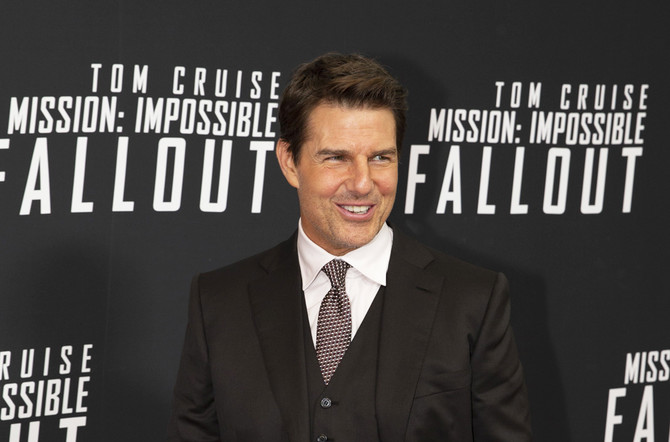
Tom Cruise arrives for a screening of "Mission Impossible — Fallout" at the Smithsonian National Air and Space Museum on July 22, in Washington, DC. (AFP / Alex Edelman)
Updated 30 July 2018
Follow

Tom Cruise’s broken ankle was no setback to the making of this ‘Mission: Impossible’

In previous “Mission: Impossible” movies, action often came first, and story second.

It’s almost ironic then that when writer-director Christopher McQuarrie and Tom Cruise decided to focus on character for the sixth movie, “Fallout,” they’d end up with the most exciting “Mission” ever — wall-to-wall with stunning set pieces in helicopters, trucks, motorcycles. Even a three-man fight in a public restroom is a standout sequence that rivals the very real danger Cruise put himself in (106 times) to do a parachute jump from 25,000 feet in the skies above Abu Dhabi.

McQuarrie, 50, a Hollywood journeyman who won an Oscar 22 years ago for writing “The Usual Suspects,” has been one of Cruise’s go-to guys for a decade, directing “Jack Reacher” and 2015’s “Mission: Impossible — Rogue Nation.”

“We did not set out to make you know the biggest, giant-est, craziest, most outrageous ‘Mission’ ever. I said to Tom I want to make a more emotional movie, a more character-driven movie that’s more about Ethan,” he recently told the Associated Press.

“The things I’m most proud of are the emotional moments. Ilsa (Rebecca Ferguson) following Ethan is the definition of what we call shoe leather. That survived four test screenings. The fact that I cut two giant stunts out that were in the first trailer, and yet that scene stayed? That’s something I’m immensely proud of.”

Despite the emotional side of the film, adrenaline junkies will not be disappointed.

“We come up with big crazy ideas in the middle of the movie, so people are forced to scramble to put them together and it’s always a race against the clock.”

However, with high-octane stunts come the risk of injury and the crew were forced to confront that reality when Cruise broke his ankle on set.

“Tom went right into physical therapy. And I went into the editing room and started to assemble the movie. I was able to make the discoveries I normally wouldn’t have made until well after the film was finished.”


Review: ‘Sorry, Baby’ by Eva Victor

Eva Victor appears in Sorry, Baby by Eva Victor, an official selection of the 2025 Sundance Film Festival. (Supplied)
Updated 27 December 2025
Follow

Review: ‘Sorry, Baby’ by Eva Victor

  • Victor makes a deliberate narrative choice; we never witness the violence of what happens to her character

There is a bravery in “Sorry, Baby” that comes not from what the film shows, but from what it withholds. 

Written, directed by, and starring Eva Victor, it is one of the most talked-about indie films of the year, winning the Waldo Salt Screenwriting Award at Sundance and gathering momentum with nominations, including nods at the Golden Globes and Gotham Awards. 

The film is both incisive and tender in its exploration of trauma, friendship, and the long, winding road toward healing. It follows Agnes, a young professor of literature trying to pick up the pieces after a disturbing incident in grad school. 

Victor makes a deliberate narrative choice; we never witness the violence of what happens to her character. The story centers on Agnes’ perspective in her own words, even as she struggles to name it at various points in the film. 

There is a generosity to Victor’s storytelling and a refusal to reduce the narrative to trauma alone. Instead we witness the breadth of human experience, from heartbreak and loneliness to joy and the sustaining power of friendship. These themes are supported by dialogue and camerawork that incorporates silences and stillness as much as the power of words and movement. 

The film captures the messy, beautiful ways people care for one another. Supporting performances — particularly by “Mickey 17” actor Naomi Ackie who plays the best friend Lydia — and encounters with strangers and a kitten, reinforce the story’s celebration of solidarity and community. 

“Sorry, Baby” reminds us that human resilience is rarely entirely solitary; it is nurtured through acts of care, intimacy and tenderness.

A pivotal scene between Agnes and her friend’s newborn inspires the film’s title. A single, reassuring line gently speaks a pure and simple truth: “I know you’re scared … but you’re OK.” 

It is a reminder that in the end, no matter how dark life gets, it goes on, and so does the human capacity to love.