

Saudi dentist patents dental innovation

1 / 2
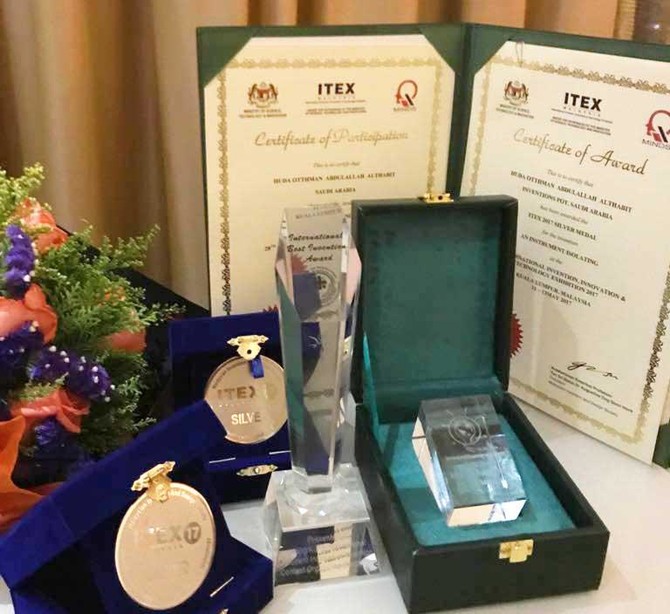
Huda Othman Althabit set up a booth at ITEX2017 in Malaysia to promote her invention.
2 / 2
Updated 28 July 2018
Follow

Saudi dentist patents dental innovation

  • Many side effects can possibly happen in the operating room or even in the dental chair
  • Many of the factories in Saudi Arabia refused to manufacture the invention because they did not believe it would succeed

RIYADH: Huda Othman Althabit is a Saudi pediatric dentist who graduated in 2013 from Riyadh Elm University Dentistry Hospital in Riyadh. She pursued her masters from the same university and is currently studying for the Saudi Board Certification in pediatric dentistry, which she aims to receive by the end of this year.

During her internships and medical practices, Althabit noticed that when she worked in the operating room, she faced numerous obstacles.
“I faced many challenges in protecting the tongue and cheeks during dental treatment, especially in the advanced cases while taking patients under general anesthesia for surgery. Many side effects can possibly happen in the operating room or even in the dental chair. We use lots of sharp instruments and those instruments may injure tissues accidentally, or the patients might swallow some of the dangerous instruments. These possibilities can happen. This was my ultimate motive. I want to help both the dentists and patients have a better experience during operations and treatments,” Althabit said.
Althabit spent time thinking about and working on how to protect the oral cavity of dental patients. “After being stuck in this process, I invented an instrument that can help dentists and patients to equally feel more comfortable. I can work safely in both the upper and lower teeth with complete protection of the tongue by covering it and even the cheek. It gave me an isolation environment. So when I work on the upper teeth, everything else will be isolated and covered, that will lead to no injuries at all, inshallah. It saves time, effort, and reduces danger. My quality of treatment has been also enhanced.”

Althabit’s invention is basically a dental isolator for protecting the tongue and cheek during dental treatment. This invention aims to provide a simple and innovative dental isolator characterized by lightness and easiness to use to achieve two main goals.
The first goal is for the patient, for comforting them and protecting the tongue, checks and other oral tissues from sharp dental instruments, and also avoiding accidental swallowing of dental materials. The second goal is for the dentist, by providing a dry and hygienic dental environment, easily and comfortably treating the upper and lower teeth with less risks and time. It can be also used during dental treatment without the need to replace as it fits both sides of the mouth.
“The instrument consists of a flexible isolating pad with two sides: (A) for the tongue, (B) for the checks (both sides). Each one of them has a saliva-absorbing layer. The two are connected by flexible folding tape. It is also characterized by borders that do not cause any bruises or injuries to the soft tissue,” she said.
Her journey did not stop when she found the idea, it continued with how to get a patent. “I received the patent from the Saudi Patent Office. Everything was online and that helped me a lot because it saves time,” she said.
After the patent, Althabit experienced challenges with how to produce the isolator; she faced many challenges when it came to the factories.
“I consulted lots of people; they made me feel that everything was completely complex and nothing would happen. One of them told me that “you are a researcher, never think of yourself as an inventor because you will never be.” It put me down but later on I saw it as an obstacle that should be overcome. Then I contacted Badir Program for Technology Incubators; they set consultancy meetings and advised me with lots of things including who to consult, where to go and what to do next. I designed the prototype for the invention,” she said.
However, many of the factories in Saudi Arabia refused to manufacture the invention because they did not believe it would succeed.
“They did not want to risk it because they were not sure of the sales. I wanted to take my invention into a really visible level. In the beginning I used very simple materials: Plastic, cotton, and stickers to make my invention, but this was to explain how the invention should work and how it should look like.”
After the difficulties Althabit faced with factories and manufacturing companies, she decided to establish her own small “modern innovation company” five months ago. “My company is specialized in manufacturing inventions and importing medical supplies. I do have a few more inventions, but I am still working on them to get patents. I am planning to invent them all in my company.”
She has had many meetings with dentists and hospitals to experience the invention and later to make it part of the dental operating rooms in their hospitals.
Althabit has also presented her invention at ITEX2017 in Malaysia and won the silver medal in the medical field and a prize from Hong Kong as the best invention (at ITEX many countries participated and each country gives a “best prize” for what they believe it is the best invention).
“I presented my invention also to the American patency and thanks to Allah there was a publication to my invention there and I will continue, inshallah with them,” she said.
“I am doing everything I possibly can to strike the right balance between my studies, my invention and my company. I personally and proudly noticed the developments happening in my country since I registered for Badir online. I felt that my country is welcoming inventions, technology and everything that can lead to developments in all aspects. So never, ever stop,” she said.

Madinah’s culinary identity lends itself to shared cross-cultural connection

Updated 5 sec ago
Follow

Madinah’s culinary identity lends itself to shared cross-cultural connection

  • Madinah earned the title of UNESCO Creative City of Gastronomy in November 2025

RIYADH: In every part of the Arab world, people have long argued about to whom certain traditional dishes belong, each wanting to claim the “correct” recipe and origin as their own, a contention that stands true across the Kingdom’s cities as well — and that might not be such a bad thing.

One of its most historically and religiously significant cities, Madinah, is a perfect example of how culinary diversity actually lends itself to culinary connection between different homes and cultures.

Chef Heba Ramadan, raised in Riyadh but originally from Madinah, spoke to Arab News about the city’s unique culinary character, which earned it the title of UNESCO Creative City of Gastronomy in November 2025.

To Ramadan, Madinah embodies nostalgic childhood memories, family gatherings and joyful moments — especially those centered around food.

As long as you get to the right flavor, it does not matter how you got there.

“Each house has their own way. That’s why I can’t say this way is right or that way is wrong,” she said.

Ramadan added that recipes are not fixed texts or religious doctrines, but are dynamic pieces of social and geographic history that represent changing people, changing times, and the melding of various customs and influences.

If you visit homes across Madinah today, you will find slight variations in the way that families prepare certain dishes.

“For example, Madini rice — everyone knows this dish, but each family makes it differently. Some families don’t put saffron because the grandfather didn’t like saffron, so they grew up cooking it that way.”

Another popular dish is wheat soup: Ramadan said that some people, like her mother, make it using whole milk, others with goat milk, some with no milk at all, and even some who make it with tomato.

“When I searched, I found that people from Makkah make it with tomato, so you see how the dish changes from family to family.” 

In November 2025, Madinah was named a UNESCO Creative City of Gastronomy. (SPA)

A recipe is a living organism; it is affected by factors of its surrounding environment. Personal preference is one example, while others are more complex and drawn out.

Over generations, recipes naturally evolve due to convenience and changing lifestyles.

Busier lives, more demanding careers and increasingly expensive economies mean that people lack the time to recreate recipes from scratch in the exact way they were once done traditionally.

Instead, puff pastries (i.e. convenience) often win against making handmade dough (i.e. time-consuming manual labor).

On the other hand, sometimes adjustments are added on.

Ramadan said that jareesh, a beloved dish across the Kingdom, was originally made without any protein, just buttermilk.

Over time, chicken or other meats were included in the dish to add nutritional value.

“Mothers added protein so the kids would eat better, and that’s how the recipe changed.”

A vital factor to keep in mind is Madinah’s unique position as a historical religious passageway and gathering point for pilgrims.

Historically, pilgrims did not stay for just a few days, but instead for weeks or even months.

“They didn’t just visit — they lived, they stayed and they exchanged experiences,” Ramadan said. 

Wheat soup is a popular dish in Medinah and Hijaz region. (Supplied)

These long stays led to deep cultural exchange as pilgrims arriving from around the world brought their spices, recipes, ingredients and techniques with them.  

Madinah’s food absorbed these influences over time and foreign dishes were adapted into local versions, and vice versa; a process that Ramadan said does not erase authenticity, but defines it.

Kabuli rice, made with orange zest and citrus juice, is believed to have adapted from these exchanges.

At the end of the day, most of us enjoy dishes the way they were made growing up because those flavors were tied to emotional memory.

Perhaps these reasons explain why Ramadan is a little skeptical of UNESCO’s method of defining “official” recipes.

She believes that culinary heritage cannot be standardized without losing its essence, and trying to standardize it by finding the most common factors between recipes or asking the city’s historical families for the correct methods does not paint a true picture of its culinary character.

And considering the close-knit socialization of residents in a small city like Madinah, “everyone knows the families in Madinah and how each family cooks their dishes,” she added.

Ramadan believes the city was chosen because its food is flavor-driven, historically layered and maintained through households rather than institutions.

She suggests UNESCO may have been fascinated by the number of variation within a single culinary identity, yet, all the flavor profiles feel recognizably “Madini.”

For example, “we have different types of rice. Even if it’s white rice, each one has a different flavor.”

Madinah’s traditional dishes were developed based on the local agriculture, seasonal availability of ingredients and circumstantial factors like electricity availability.

Before refrigeration, daily cooking depended on fresh, same-day ingredients, so every dish was directly tied to the land.

Ramadan, who transitioned into cooking to pursue her passion after spending more than a decade in an accounting and finance career, believes that food is meant to be shared, remembered and respected.

She started out in gastronomy by opening her own business before putting it on hold during COVID-19, after which she returned to work as a baker and in hot kitchens.

As her cooking career took off, Ramadan was selected by Diriyah to create traditional dishes for a few of their major events.

Ramadan began representing the Kingdom internationally as a traditional Saudi chef, working with the Saudi Tourism Authority and continuing her work with Diriyah.

Much of Ramadan’s career was defined by the realization that much of Madinah’s food heritage was undocumented and misunderstood.

And although she sees food as dynamic and flexible, Ramadan also strongly believes that it is her job to represent Saudi food globally in a traditional framework, sans any modern fusions or fireworks.

While she respects chefs who experiment with fusion recipes and welcomes any tourists visiting the Kingdom to try both the modern and the traditional, her role adamantly favors cultural representation, not reinterpretation.

Abroad, authenticity is required in both preparation and plating.

Ramadan is admittedly worried about safekeeping these recipes through future generations; as reliance on convenience increases and families spend less time together in the kitchen, she fears that youth are becoming less interested in cooking or trying new foods.

In her opinion, this had led to losing important skills such as smelling food to identify what spices or ingredients are missing.

“This is something you train. It doesn’t come from reading a recipe … you learn by standing next to your mother, your grandmother, and smelling,” she said.

“It’s not written. It’s sensory.”