Blood Moon dazzles star gazers in longest lunar eclipse of 21st century

1 / 21
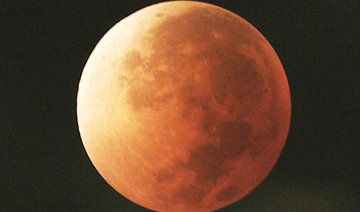
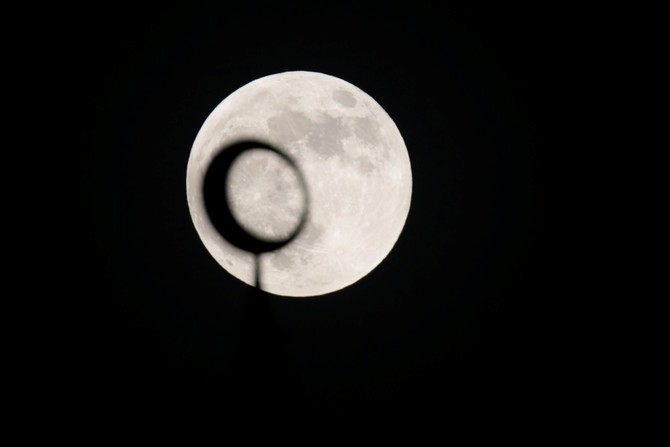
A lunar eclipse of a full "Blood Moon" rises behind the Sheikh Zayed Grand Mosque in Abu Dhabi, United Arab Emirates July 27, 2018. (Reuters)
2 / 21
A lunar eclipse of a full "Blood Moon" rises behind the Sheikh Zayed Grand Mosque in Abu Dhabi, United Arab Emirates July 27, 2018. (Reuters)
3 / 21
A lunar eclipse of a full "Blood Moon" rises behind the Sheikh Zayed Grand Mosque in Abu Dhabi, United Arab Emirates July 27, 2018. (Reuters)
4 / 21
A lunar eclipse of a full "Blood Moon" rises behind the Sheikh Zayed Grand Mosque in Abu Dhabi, United Arab Emirates July 27, 2018. (Reuters)
5 / 21
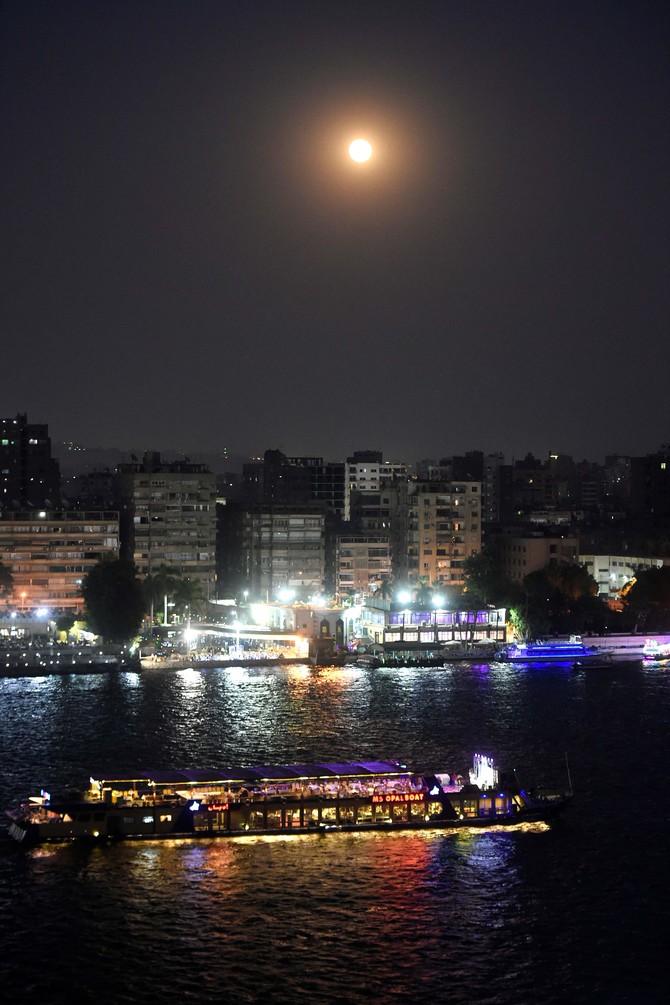
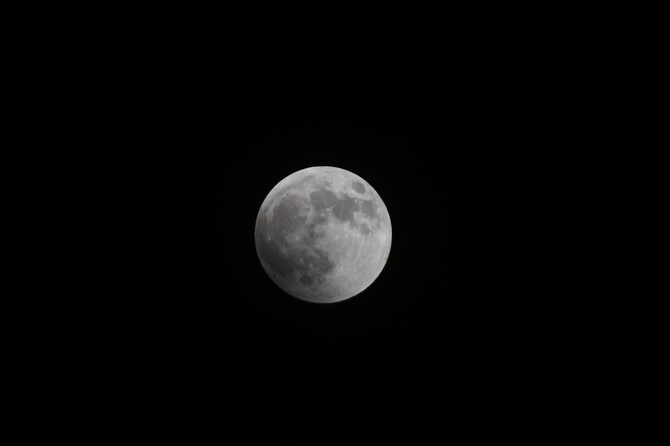
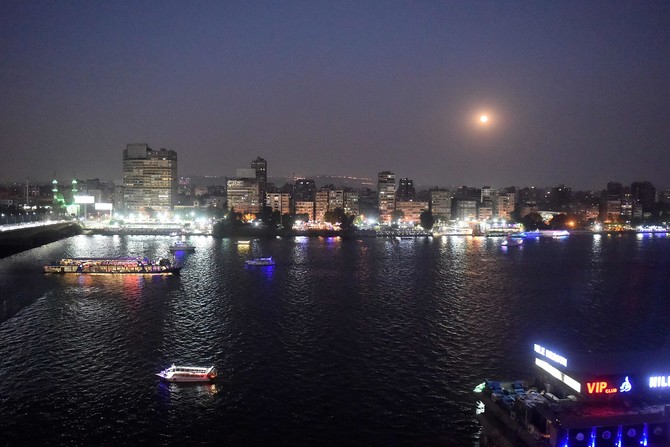
This picture shows the full moon in the sky of the Egyptian capital Cairo on July 27, 2018, prior to the expected total lunar eclipse. (AFP)
6 / 21
This picture shows the full moon in the sky of the Egyptian capital Cairo on July 27, 2018, prior to the expected total lunar eclipse. (AFP)
7 / 21
This picture shows the full moon in the sky of the Egyptian capital Cairo on July 27, 2018, prior to the expected total lunar eclipse. (AFP)
8 / 21
People gather as they wait for the sun to go down and the appearance of the 'Blood moon' in Berlin on July 27, 2018. (AFP)
9 / 21
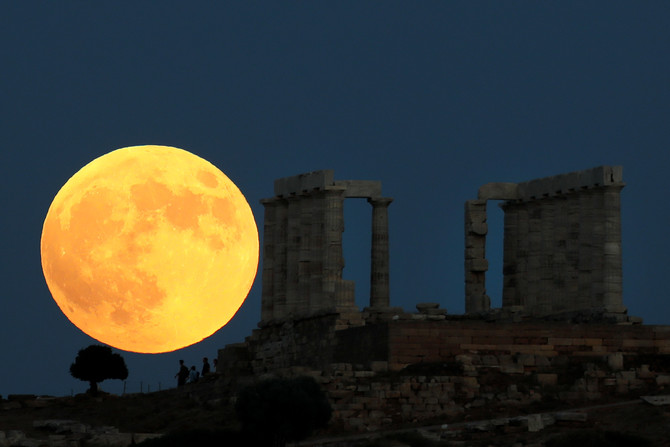
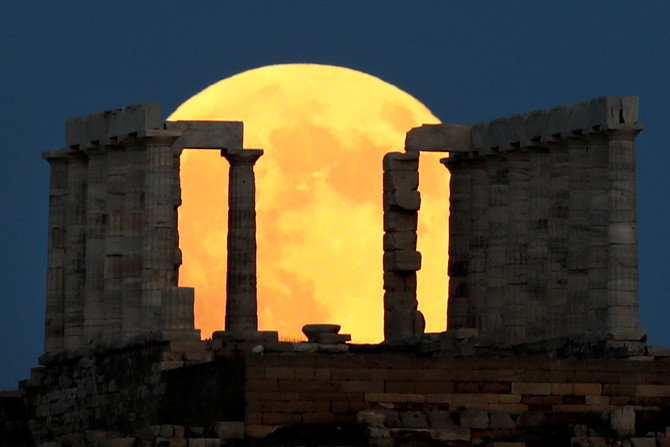
A full moon rises behind the Temple of Poseidon before a lunar eclipse in Cape Sounion, near Athens, Greece, July 27, 2018. (Reuters)
10 / 21
A full moon rises behind the Temple of Poseidon before a lunar eclipse in Cape Sounion, near Athens, Greece, July 27, 2018. (Reuters)
11 / 21
This picture shows the lunar eclipse in the sky of Gaza City on July 27, 2018. (AFP)
12 / 21
A "Super Blue Blood Moon" rises during a lunar eclipse over Cairo, Egypt July 27, 2018. (Reuters)
13 / 21
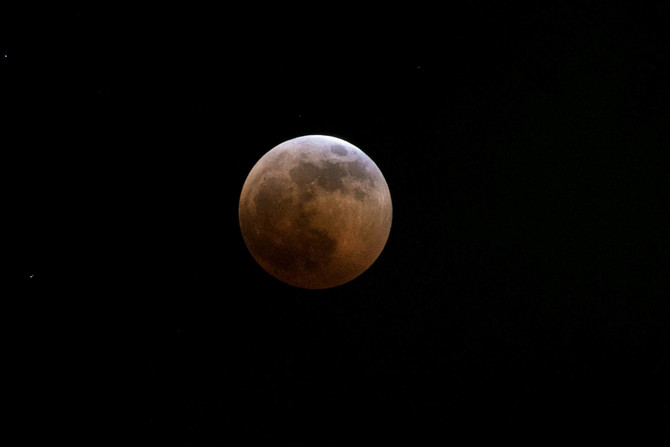
The moon is seen during a full lunar eclipse over Nairobi, Kenya, July 27, 2018. (REUTERS/Baz Ratner)
14 / 21
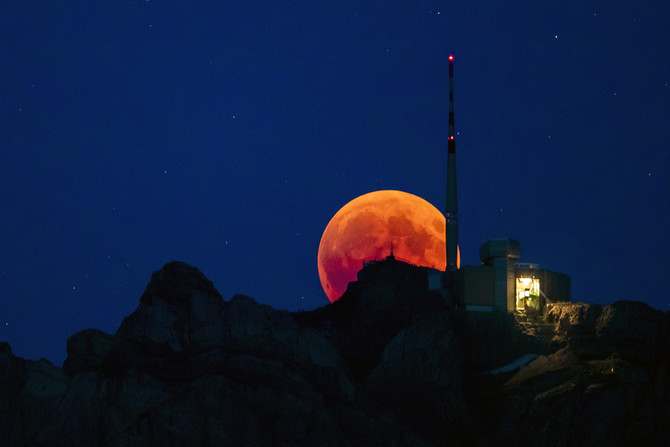
The moon turns red during a total lunar eclipse, behind the Saentis in Luzern, Switzerland, on July 27, 2018. (Christian Merz/Keystone via AP)
15 / 21
The moon turns red during a total lunar eclipse, as seen from Dresden, Germany, on July 27, 2018. (Sebastian Kahnert/dpa via AP)
16 / 21
A total lunar eclipse is seen in Sydney in early July 28, 2018. (AFP / Greg Wood)
17 / 21
People wait for a blood moon to rise in London skyline in Hampstead Heath on a cloudy evening on July 27, 2018. (AFP / Tolga Akmen)
18 / 21
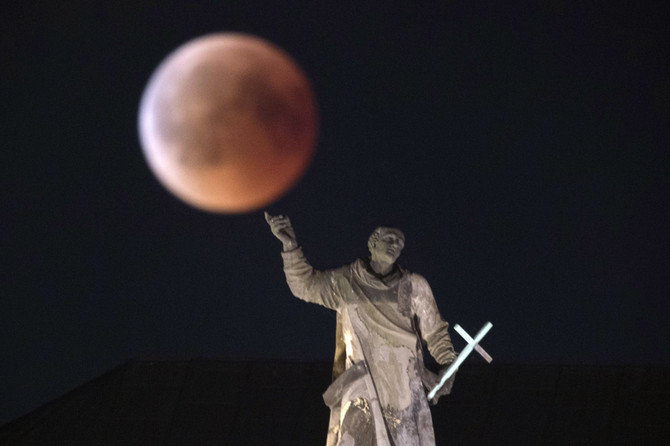
Clouds obscure the view for people sitting on a statue to see the lunar eclipse in Prague, Czech Republic, July 27, 2018. (REUTERS/David W Cerny)
19 / 21
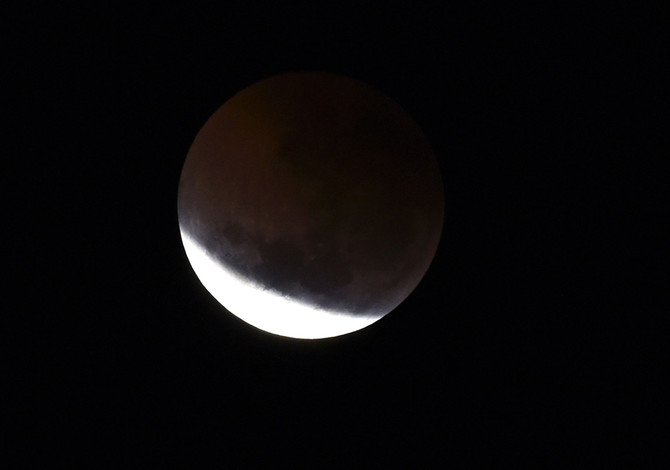
The Moon leaves the shadow of Earth during a full lunar eclipse over Vienna, Austria, on July 27, 2018. (REUTERS/Heinz-Peter Bader)
20 / 21
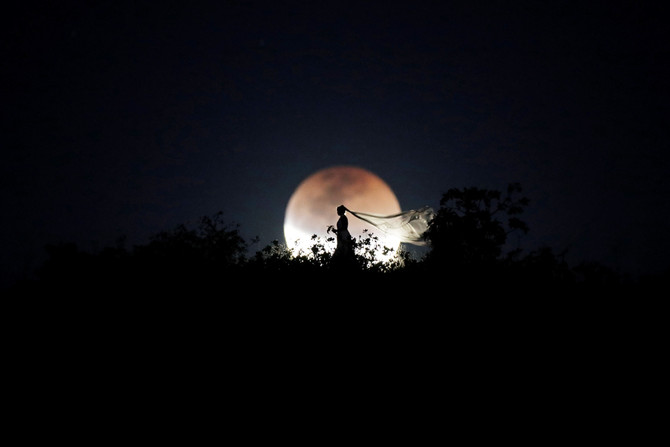
A bride poses for photo during a total lunar eclipse from in Brasilia, Brazil, July 27, 2018. (REUTERS/Ueslei Marcelino)
21 / 21
This picture shows the full moon during a 'blood moon' eclipse behind the ancient Colosseum on July 28, 2018. (AFP / Tiziana Fabi)
Updated 28 July 2018
Follow

Blood Moon dazzles star gazers in longest lunar eclipse of 21st century

  • The total eclipse will last 1 hour, 42 minutes and 57 seconds, though a partial eclipse precedes and follows
  • The next lunar eclipse of such a length is due in 2123

DUBAI/JEDDAH: A blood-red moon dazzled star gazers across much of the world on Friday when it moved into Earth’s shadow for the longest lunar eclipse of the 21st Century.
From the Cape of Good Hope to the Middle East, and from the Kremlin to Sydney Harbor, thousands of people turned their eyes to the stars to watch the moon, which turned dark before shining orange, brown and crimson in the shadow.
The total eclipse lasted 1 hour, 42 minutes and 57 seconds, though a partial eclipse preceded and follows, meaning the moon will spend a total of nearly 4 hours in the Earth’s umbral shadow, according to NASA.
The fullest eclipse was visible from Europe, Russia, Africa, the Middle East, and much of Asia and Australia though clouds blocked out the moon in some places.
The eclipse will not be visible from North America or most of the Pacific.
Reuters charted the eclipse from across the world, capturing a shimmering orange and red moon above Cairo, the Temple of Poseidon in Cape Sounion, near Athens, the Bavarian village of Raisting in Germany, Rio beach in Brazil and Johannesburg.

11:00 p.m. GMT`
In Nairobi, Kenyans watched as the moon darkened.
“This is what life is all about: Magical moments like this,” said Teddy Muthusi as he watched from Uhuru Park in Nairobi. “It’s just beautiful. It’s well worth it.”
On the banks of India’s Ganges, temples were closed ahead of the eclipse. Enthusiasts watched through telescopes at the Marina South Pier in Singapore and at the Al Sadeem Observatory in Al Wathba near Abu Dhabi.

View our photo gallery: Night of the ‘Blood Moon’

Across Africa people turned to the sky, watching the reddish shadow slide up the moon’s surface. In Somalia, some hurried to mosques for special prayers. In South Sudan, some dared to take photos in a war-torn country where using a camera in public is discouraged.
In Ethiopia’s capital, Addis Ababa, people at an open-air restaurant admired a rare clear view during the rainy season, comparing a live NASA webcast to what they saw above. Then clouds rolled in.
“Dem yelebesech chereka,” some murmured — Amharic for “blood moon.”
“The reason that the moon turns red is because atmospheric scattering causes red light to pass through the atmosphere and the composition of the atmosphere can change if volcanic eruptions or forest fires occur,” said Tom Kerss, an astronomer with the Royal Observatory Greenwich.
“And the density of dust increasing in the atmosphere can cause the moon to appear a particularly deep red, and indeed it has the same effect on our sunsets and sunrises.”In a special treat, Mars is also at its closest approach to Earth this week since 2003, making it appear bigger and brighter.
Excited skywatchers on social media shared photos of the bright planet just to the right of the moon.
North America missed out on Friday’s lunar eclipse but can look forward to the next one on Jan. 21, 2019, according to NASA.Hundreds of people in Australia paid to watch the eclipse from the Sydney Observatory before sunrise.
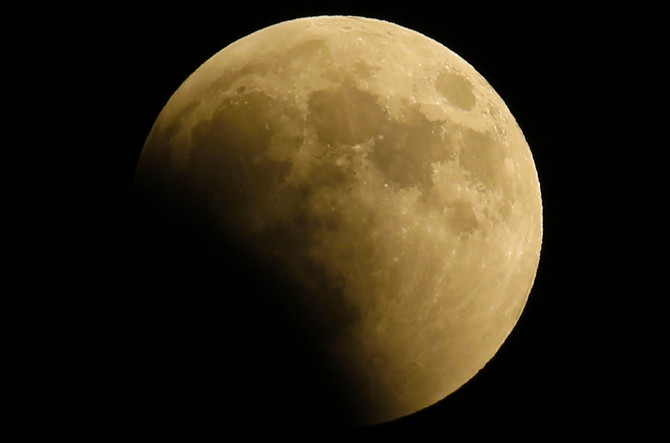
When the moon moved into the conical shadow of the earth, it went from being illuminated by the sun to being dark. Some light, though, still reaches it because it is bent by the Earth’s atmosphere.In a special treat, Mars is in opposition on Friday — meaning the planet and the sun will be on exact opposite sides of the Earth and will shine its best. Mars is also at its closest approach to Earth this week since 2003, making it appear bigger and brighter.

09:35 pm GMT


06:14 pm GMT


The longest “blood moon” eclipse this century began on Friday, coinciding with Mars’ closest approach in 15 years to treat skygazers across the globe to a thrilling celestial spectacle.
Unlike with a solar eclipse, viewers will need no protective eye gear to observe the rare display.
For about half the world, the moon will be partly or fully in Earth’s shadow from 1714 to 2328 GMT — six hours and 14 minutes in all.
The period of complete eclipse — known as “totality,” when the moon appears darkest — will last from 1930 to 2113 GMT.
At the same time, Mars will hover near the moon in the night sky, easily visible with the naked eye.
Amateur astronomers in the southern hemisphere will be best-placed to enjoy the spectacle, especially those in southern Africa, Australia, India and Madagascar, though it will also be partly visible in Europe and South America.

05:50 pm GMT

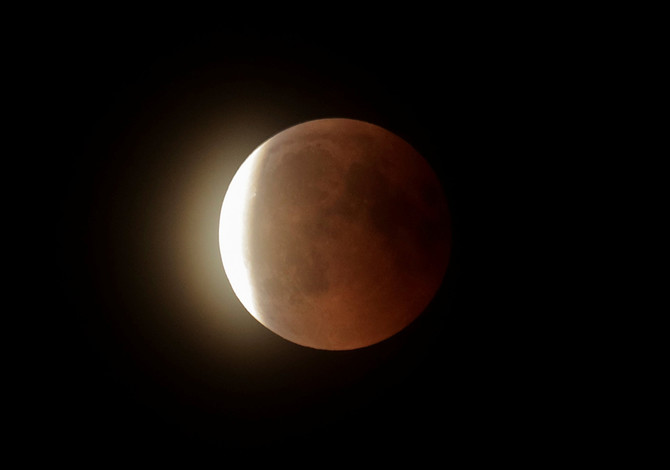
A total lunar eclipse happens when Earth takes position in a straight line between the moon and sun, blotting out the direct sunlight that normally makes our satellite glow whitish-yellow.
The moon travels to a similar position every month, but the tilt of its orbit means it normally passes above or below the Earth’s shadow — so most months we have a full moon without an eclipse.
When the three celestial bodies are perfectly lined up, however, the Earth’s atmosphere scatters blue light from the sun while refracting or bending red light onto the moon, usually giving it a rosy blush.

The long duration of this eclipse is partly due to the fact that the moon will make a near-central passage through Earth’s umbra — the darkest, most central part of the shadow.
Our constant companion will also be at the farthest point on its orbit from Earth, making its movement across the sky slower from our perspective, thus spending longer in the dark.
NASA, meanwhile, has called out social media hoaxers claiming that Mars will appear as big as the moon during the eclipse.
“If that were true, we’d be in big trouble given the gravitational pulls on Earth, Mars, and our moon!” the NASA website states.
Mars will more likely appear as a very bright star.

03:30 pm GMT

Across the world, from the Taj Mahal to the Eiffel Tower, people will turn their eyes to the sky, hoping to see the blood moon, which appears orange, brown or crimson as sunlight is bent through the earth’s atmosphere.
The total eclipse will last 1 hour, 42 minutes and 57 seconds, though a partial eclipse precedes and follows, meaning the moon will spend a total of 3 hours and 54 minutes in the earth’s umbral shadow, according to NASA.
The fullest eclipse, at 2022 GMT, will be visible from Europe, Russia, Africa, the Middle East, much of Asia and Australia.


When the moon moves into the conical shadow of the earth, it goes from being illuminated by the sun to being dark. Some light, though, will still reach it because it is bent by the earth’s atmosphere.
At the same time, Mars will be traveling closer to earth than it has been since 2003, so some observers may be able to see what looks like an orange-red star — and is in fact the red planet.


Trump, sharing leaked texts and AI mock-ups, vows ‘no going back’ on Greenland

Updated 2 sec ago
Follow

Trump, sharing leaked texts and AI mock-ups, vows ‘no going back’ on Greenland

DAVOS, Switzerland/COPENHAGEN: US President Donald Trump on Tuesday vowed there was “no going back” on his goal to control Greenland, refusing to rule out taking the Arctic island by force and rounding on allies as European leaders struggled to ​respond.
Trump’s ambition — spelled out in social media posts and mock-up AI images — to wrest sovereignty over Greenland from fellow NATO member Denmark has threatened to blow apart the alliance that has underpinned Western security for decades.
It has also threatened to reignite a trade war with Europe that rattled markets and companies for months last year, though Trump’s Treasury Secretary Scott Bessent pushed back against what he called “hysteria” over Greenland.
“As I expressed to everyone, very plainly, Greenland is imperative for National and World Security. There can be no going back — On that, everyone agrees!” Trump said after speaking to NATO Secretary General Mark Rutte.
To drive home the message, Trump posted an AI image of himself in Greenland, holding a US flag. Another showed him speaking to leaders next to a map showing Canada and ‌Greenland as part of ‌the United States.
Separately, he leaked messages including from French President Emmanuel Macron, who questioned ‌what ⁠Trump ​was “doing on Greenland.” ‌Trump, who has vowed to impose tariffs on countries who stood in his way, had earlier threatened to hammer French wines and champagnes with a 200 percent tariff.

BESSENT PUSHES BACK AGAINST ‘HYSTERIA’
The European Union has threatened to hit back with trade measures. One option is a package of tariffs on 93 billion euros ($109 billion) of US imports that could automatically kick in on February 6 after a six-month suspension.
Another option is the “Anti-Coercion Instrument” (ACI), which has never yet been used. It could limit access to public tenders, investments or banking activity, or restrict trade in services, the sector in which the US has a surplus with the bloc, including the lucrative digital services provided by US tech giants.
“This is not a ⁠question about the Kingdom of Denmark, it is about the entire transatlantic relationship,” Denmark’s Economy Minister Stephanie Lose told journalists ahead of an EU meeting of economy and finance ministers ‌in Brussels.
“At this point in time, we do not believe that anything should ‍be ruled out. This is a serious situation that, although we ‍would like to de-escalate, there are others who are contributing to escalating it right now, and therefore we will have to ‍keep all options on the table as we move forward.”
Bessent, on the sidelines of the World Economic Forum annual meeting in Davos, Switzerland, said a solution would be found that ensures national security for the United States and Europe.
“It’s been 48 hours. As I said, sit back, relax,” he said. “I am confident that the leaders will not escalate and that this will work out in a manner that ends up in ​a very good place for all.”
Asked about the prospect of a prolonged trade war between the United States and Europe, Bessent replied: “Why are we jumping there? Why are you taking it to the worst case?... Calm down the ⁠hysteria. Take a deep breath.”
However, in her own speech in Davos, European Commission President Ursula von der Leyen said the series of recent geopolitical shocks will force the EU to build a new independent Europe.
“We will only be able to capitalize on this opportunity if we recognize that this change is permanent,” she said.

RUSSIA QUESTIONS DANISH SOVEREIGNTY OVER GREENLAND
Trump will also this week attend the Davos gathering of the global political and business elite. Swiss newspaper NZZ reported that protesters marched in Zurich, Switzerland, late on Monday, carrying a giant banner saying: “TRUMP NOT WELCOME. NO WEF! NO OLIGARCHY! NO IMPERIALIST WARS!“
The foreign minister of Russia, which has been watching with glee as Trump’s drive to acquire Greenland widens splits with Europe, said on Tuesday that Greenland was not “a natural part” of Denmark.
Trump’s renewed tariff threats against European allies have revived talk of the ‘Sell America’ trade that emerged in the aftermath of his sweeping levies last April.
Stock markets bore the brunt on Monday of fears that the trade war could re-escalate, with European equities dropping over 1 percent and US stock futures taking a similar hit that points to weakness ‌following Monday’s US public holiday.
The dollar was on the back foot too, a sign that the world’s No.1 reserve currency was also in the crosshairs of Trump’s threat on Saturday to increase tariffs on Europe.