

California fire ‘tornado’ kills 2 firefighters, thousands flee

1 / 5
A blackened landscape is shown from wildfire damage near Keswick, California, US, July 27, 2018. (REUTERS)
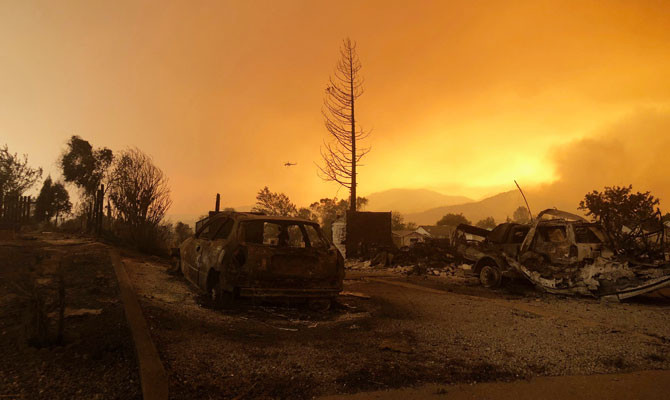
2 / 5
A burned down car sit at a property under a deep orange sky during the Carr fire near Redding, California on July 27, 2018. (AFP)
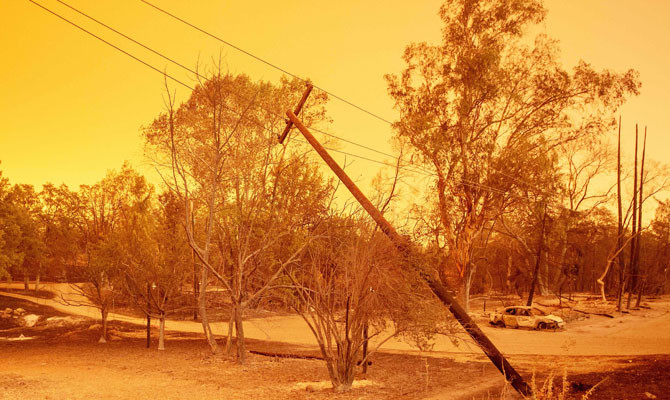
3 / 5
A power pole leans over a burned property as the sky turns a deep orange during the Carr fire near Redding, California on July 27, 2018. (AFP)
4 / 5
A view of cars that were destroyed by the Carr Fire on July 27, 2018 in Redding, California. (AFP)
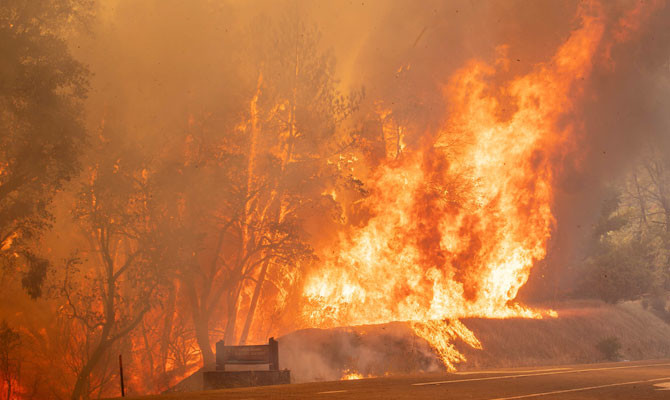
5 / 5
Flames tower above a road during the Carr fire near Redding, California on July 27, 2018. (AFP)
Updated 28 July 2018
Follow

California fire ‘tornado’ kills 2 firefighters, thousands flee

  • Wildfires have blackened an estimated 4.15 million acres (1.68 million hectares) in the United States this year
  • A 32-year-old man was charged with setting the Cranston fire, along with eight other blazes, and faces a potential life sentence

REDDING, California: A fast-growing northern California wildfire killed a second firefighter on Friday after high winds drove it into the city of Redding, prompting mass evacuations, destroying scores of homes and threatening some 5,000 other dwellings and businesses, officials said.
Flames raging in California’s scenic Shasta-Trinity area erupted into a firestorm that jumped across the Sacramento River and swept into the western side of Redding, home to about 90,000 people, forcing residents to flee.
Firefighters and police “went into life-safety mode,” hustling door to door to usher civilians out of harm’s way, said Scott McLean, a spokesman for the California Department of Forestry and Fire Protection (CalFire).
Streets in the Western town were all but deserted, with thick, sickly-brown smoke filling the air, and plumes of smoke rising to the west.
Gale-force winds on Thursday night created a fire “tornado” said CalFire Director Ken Pimlott.
“This fire was whipped up into a whirlwind of activity, uprooting trees, moving vehicles, moving parts of roadways,” Pimlott told a news briefing.
Such highly erratic, storm-like wildfires have grown commonplace in the state, Pimlott said.
“These are extreme conditions, this is how fires are in California,” he said. “We need to take heed and evacuate, evacuate, evacuate.”
California has had its worst start to the fire season in a decade, with 289,727 acres burned through Friday morning, according to National Interagency Fire Center (NIFC) data.
Governor Jerry Brown requested emergency federal assistance to prevent an “imminent catastrophe” as Shasta County tried to find supplies and water for 30,000 evacuated residents and care for horses and cattle rescued from ranches and farms.
CalFire reported 65 structures destroyed by the blaze, but McLean called that tally a “placeholder” figure that would grow significantly, with the number of homes lost likely to run into “the hundreds” as the scope of devastation was fully assessed.

CURTAIN OF SMOKE
The fire had scorched 44,450 acres (18,000 hectares) by Friday and was just 3 percent contained as ground crews, helicopters and airplanes battled the flames for a fifth day.
High temperatures and low humidity were expected for the next seven to ten days, said Pimlott.
“This fire is a long way from done,” he said.
The blaze was one of nearly 90 large fires burning nationally, most of them in the West. One of those prompted the closure of much of California’s Yosemite National Park.
Wildfires have blackened an estimated 4.15 million acres (1.68 million hectares) in the United States this year. That was well above average for the same period over the past 10 years but down from 5.27 million acres (2.13 million hectares) in the first seven months of 2017, NIFC reported.
The blaze in Redding, about 150 miles (240 km) north of Sacramento, on Thursday killed a bulldozer operator working with fire teams to clear brush around the fire. A member of the Redding Fire Department was also reported killed on Friday. A Redding hospital said it had treated eight people, including three firefighters.

THOUSANDS OF BUILDINGS IMPERILED
Rob Wright, 61, and his wife stayed to fight off flames with a high-powered water hose.
“We were fortunate enough that the wind changed hours ago, and it is pushing the fire back,” said Wright on Friday. “We are just waiting it out ... crossing our fingers and hoping for the best.”
Video and images posted on social media showed flames engulfing structures, as an orange glow lit up the sky.
A Red Cross employee told local ABC affiliate KRCR-TV some 500 people took shelter in an evacuation center at Shasta College. Motels were filled to capacity and livestock owners were told to take their animals to the town’s rodeo ground.
The Carr Fire, the name given to the Redding blaze,was one of three fierce blazes threatening large populated areas.
Cal Fire said the Cranston Fire, about 110 miles (177 km) east of Los Angeles had blackened 12,300 acres and was 16 percent contained. The Ferguson Fire near Yosemite, which has charred 46,675 acres, was 29 percent contained.
A 32-year-old man was charged with setting the Cranston fire, along with eight other blazes, and faces a potential life sentence if convicted of the charges.


Thousands rally against immigration enforcement in subzero Minnesota temperatures

Updated 8 sec ago
Follow

Thousands rally against immigration enforcement in subzero Minnesota temperatures

  • Protesters have gathered daily in the Twin Cities since Jan. 7, when 37-year-old mother of three Renee Good was fatally shot by an Immigration and Customs Enforcement officer

MINNEAPOLIS: Police arrested about 100 clergy demonstrating against immigration enforcement at Minnesota’s largest airport Friday, and thousands gathered in downtown Minneapolis despite Arctic temperatures to protest the Trump administration’s crackdown.
The protests are part of a broader movement against President Donald Trump’s increased immigration enforcement across the state, with labor unions, progressive organizations and clergy urging Minnesotans to stay away from work, school and even shops. The faith leaders gathered at the airport to protest deportation flights and urge airlines to call for an end to to what the Department of Homeland Security has called its largest-ever immigration enforcement operation.
The clergy were issued misdemeanor citations of trespassing and failure to comply with a peace officer and were then released, said Jeff Lea, a Metropolitan Airports Commission spokesman. They were arrested outside the main terminal at the Minneapolis-St. Paul International Airport because they went beyond the reach of their permit for demonstrating and disrupted airline operations, he said.
Rev. Mariah Furness Tollgaard of Hamline Church in St. Paul said police ordered them to leave but she and others decided to stay and be arrested to show support for migrants, including members of her congregation who are afraid to leave their homes. She planned to go back to her church after her brief detention to hold a prayer vigil.
“We cannot abide living under this federal occupation of Minnesota,” Tollgaard said.
Protesters demand ICE leave Minnesota
The Rev. Elizabeth Barish Browne traveled from Cheyenne, Wyoming, to participate in the rally in downtown Minneapolis, where the high temperature was minus 9 degrees Fahrenheit (minus 23 degrees Celsius) despite a bright sun.
“What’s happening here is clearly immoral,” the Unitarian Universalist minister said. “It’s definitely chilly, but the kind of ice that’s dangerous to us is not the weather.”
Protesters have gathered daily in the Twin Cities since Jan. 7, when 37-year-old mother of three Renee Good was fatally shot by an Immigration and Customs Enforcement officer. Federal law enforcement officers have repeatedly squared off with community members and activists who track their movements.
Sam Nelson said he skipped work so he could join the march. He said he’s a former student of the Minneapolis high school where federal agents detained someone after class earlier this month. That arrest led to altercations between federal officers and bystanders.
“It’s my community,” Nelson said. “Like everyone else, I don’t want ICE on our streets.”
Organizers said Friday morning that more than 700 businesses statewide have closed in solidarity with the movement, from a bookstore in tiny Grand Marais near the Canadian border to the landmark Guthrie Theater in downtown Minneapolis.
“We’re achieving something historic,” said Kate Havelin of Indivisible Twin Cities, one of the more than 100 participating groups.
Detention of a 2-year-old and a 5-year-old
A 2-year-old was reunited with her mother Friday, a day after she was detained with her father outside of their home in South Minneapolis, lawyer Irina Vaynerman told The Associated Press.
Vaynerman said they had quickly challenged the family’s detention in federal court. The petition states that the child, a citizen of Ecuador, was brought to the US as a newborn. The child and her father, Elvis Tipan Echeverria, both have a pending asylum application and neither are subject to final orders of removal.
A US district judge on Thursday had barred the government from transferring the toddler out of state, but she and her father were on a commercial flight to Texas about 20 minutes later, according to court filings. They were flown back Friday.
Agents arrested Tipan Echeverria during a targeted operation, according to a DHS statement said. DHS said the child’s mother was in the area but refused to take the child.
Vaynerman rejected that explanation, saying Tipan Echeverria was “not allowed” to bring his 2-year-old to her mother inside their home.
DHS repeated its allegation Friday that the father of 5-year-old Liam Ramos abandoned him during his arrest by immigration officers in Columbia Heights on Tuesday, leading to the child being detained, too.
Department spokesperson Tricia McLaughlin said Liam was detained because his father, Adrian Alexander Conejo Arias, “fled from the scene.” The two are detained together at the Dilley Detention Center in Texas, which is intended to hold families. McLaughlin said officers tried to get Liam’s mother to take him, but she refused to accept custody.
The family’s attorney Marc Prokosch said he thinks the mother refused to open the door to the ICE officers because she was afraid she would be detained. Columbia Heights district superintendent Zena Stenvik said Liam was “used as bait.”
Prokosch found nothing in state records to suggest Liam’s father has a criminal history.
On Friday, Border Patrol commander Gregory Bovino sought to shift the narrative away from Liam’s detention by attacking the news media for, in his view, insufficient coverage of children who have lost parents to violence by people in the country illegally. After briefly mentioning the 5-year-old during a news conference, he talked about a mother of five who was killed in August 2023.
Details from Good’s autopsy
The Hennepin County Medical Examiner posted an initial autopsy report online for Good that classified her death as a homicide and determined she died from “multiple gunshots wounds.”
A more detailed independent autopsy commissioned by Good’s family said one bullet pierced the left side her head and exited on the right side. This autopsy, released Wednesday through the Romanucci & Blandin law firm, said bullets also struck her in the arm and breast, although those injuries weren’t immediately life-threatening.
Antonio Romanucci, an attorney for the family, said in a statement that the family is still awaiting the full report from the medical examiner and “hope that they communicate with Renee’s family and share their report before releasing any further information to the public.”
A spokesperson for the firm said there were no funeral plans to share yet.