


KARACHI: The Judge of Anti-Terrorism Court in Karachi on Saturday signed release orders of Rao Ahmed Khan, a police officer popularly known as Rao Anwar, after which jail police were removed of his residence being declared as sub-jail earlier in May.
Anwar, under whom more than 400 people are believed to have been killed in fake encounters, was granted bail in two cases lodged against him in Sachal Police station of the Pakistani metropolis, including the murder of Naqeeb Mehsud, an aspiring model, who was killed in a fake encounter on Jan. 13 this year.
The Mehsud family has been boycotting proceeding after they filed a petition for change of judge in Sindh high court following his bail in a fake encounter case on July 10. “We don’t have trust in the judge after she granted bail,” Muhammad Khan, father of Naqeeb Mehsud, told Arab News in a previous interview.
Amid the boycott, Anwar got second bail in Sindh Arms Act 2013 and Explosive Substance Act on Friday, July 20, 2018.
In April, a joint investigation team’s report, a copy of which was made available to Arab News, had declared Rao Anwar the prime suspect in this case.
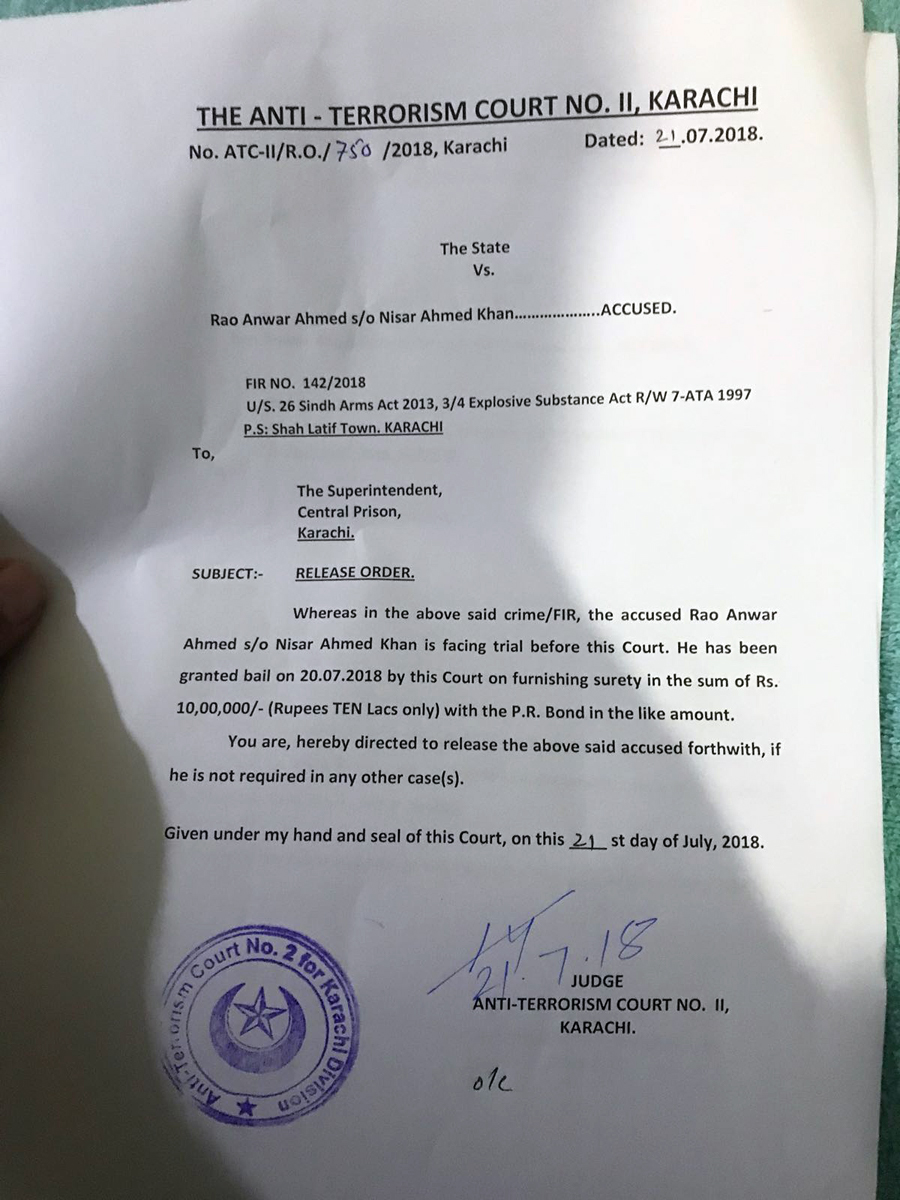
Copy of release order of Rao Anwar, who was granted bails in Naqeeb Mehsud murder and illegal arms case on July 10 and 20, respectively.
“The statement of former SSP Rao Anwar and witnesses recorded under Section 161 of the Pakistan Penal Code, location of Call Detail Record (CDR), CDs of interviews of Rao Anwar with media and investigation till this day prove that Rao Anwar is central character and leader of the team which picked up Naqeebullah, Mohammed Ishaq, Mohammed Sabir and Nazar Jan, declared them terrorists and then killed them in a fake police encounter,” reads the report.
“In light of this evidence, former SSP Rao Anwar and the absconding policemen are found guilty,” reads the JIT report.
The JIT report had rejected claims by Rao Anwar that he did not appear before the JIT which he considers biased. “The JIT held several meetings on the given dates and places and interrogated former SSP Raj Anwar Ahmed Khan on two occasions.”
According to the report, the JIT members also took Anwar to the spot of the encounter at 17:50 on March 31, 2018. “The JIT held several meetings and in a few of these, former SSP Rao Anwar Ahmed was interrogated, after which the report was compiled. Rao was asked to present proofs in his defense, which he failed to produce.”
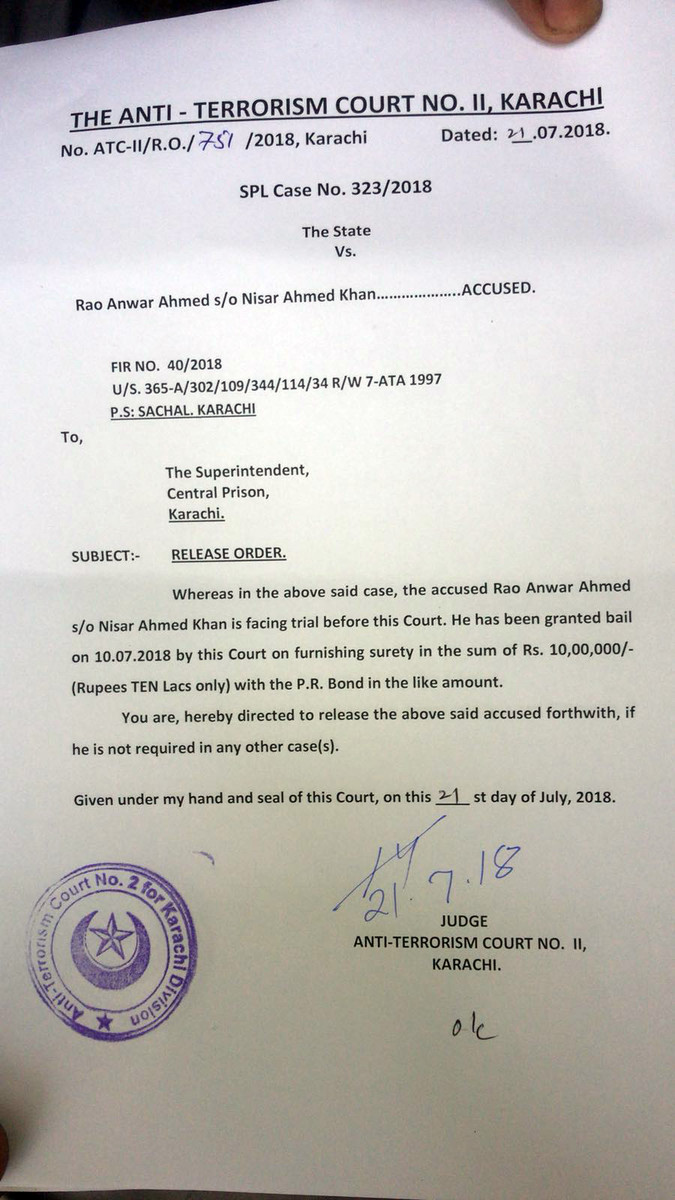
Copy of release order of Rao Anwar, who was granted bails in Naqeeb Mehsud murder and illegal arms case on July 10 and 20, respectively.
Anwar alleged that the slain Pashtun model was an active member of banned terrorist groups such as Tehreek-e-Taliban Pakistan (TTP), Al-Qaeda, and Lashkar-e-Jhangvi (LeJ). However, the evidence subsequently began to pile up against the police team involved in the killing.
As pressure mounted on Anwar, he decided to go underground and made a botched attempt to fly out of Pakistan. However, he, in a surprise move in March, came to the court which handed him over to the Sindh police.
Anwar’s lawyer told the chief justice that his client had “surrendered” and wanted protective bail. However, the Supreme Court turned down the request and ordered the law enforcement authorities to jail him. Anwar, however, later got his plea for declaration of his house as sub-jail approved.


