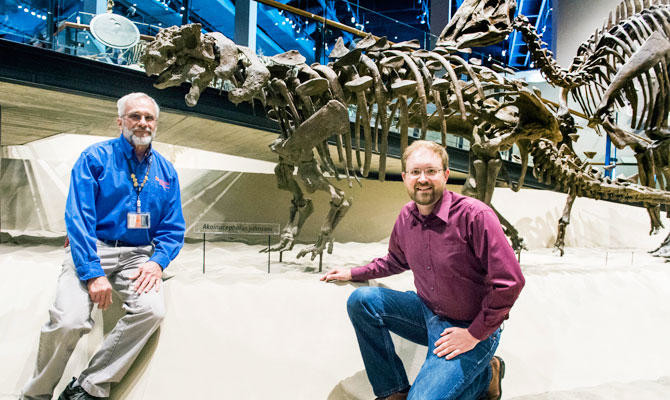
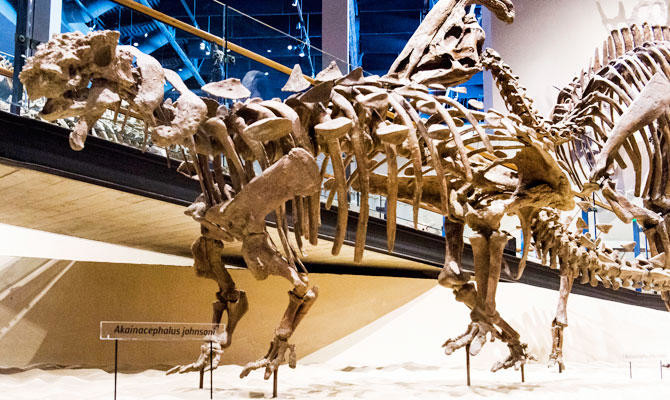
SALT LAKE CITY: A dinosaur that was covered in bony armor from its spiky head to its clubbed tail has been unveiled at a museum in Utah.
The species of ankylosaur was a squat plant-eater that roamed southern Utah on four legs about 76 million years ago, during the late Cretaceous Period. At that time, the desert state was hot and humid, covered with slow-moving streams and rivers as well as large conifer trees, paleontologist Randall Irmis said.
It was about as long as a large alligator and stood at a height that would have been about waist-high for a tall human. It likely used its distinctive clubbed tail and armor for protection, though they could also have been used for display.
The fossil unveiled Thursday at the Natural History Museum of Utah was first discovered in 2008 in the Grand Staircase-Escalante National Monument, a rich dinosaur repository in southern Utah.
The fossil was discovered on the Kaiparowits Formation, a thick layer of sandstone that also has vast coal reserves inside a sprawling national monument that was one of two President Donald Trump ordered downsized last year. The spot where the fossil was found remains within Grand Staircase-Escalante boundaries, though areas that are now outside the boundaries also have fossil potential, Irmis said.
Researchers were expecting it to have smooth bony armor on its skull like other North American ankylosaurs, but were surprised to find evidence that it instead had spiky armor on its head and snout, similar to fossils found in Asia.
Paleontologists believe the animals migrated to North America several times over the eons when lowered sea levels allowed them to cross a land bridge.
The species was dubbed Akainacephalus johnsoni to recognize Randy Johnson, a retired chemist and museum volunteer who spent hundreds of hours painstakingly freeing the skull from rock and debris.
Along with a complete skull, the fossil also includes the distinctive tail club, large parts of its spinal vertebral column and parts of its body armor, including two neck rings and spiked armor plates, the museum said in a statement.

As it hit the pitch, Catan leapt into action and started performing rudimentary CPR, pumping the bird’s ribcage.
“When I started the chest compressions, it began moving its legs. The more it moved, the more I kept going,” he said.
When it started breathing, he carried it off the pitch to medical staff, who took care of it.
By that evening, videos had gone viral on social media and Catan said his phone began ringing nonstop.
“We’d lost the match, so I wasn’t in a good mood. Then overnight the messages started coming in. We were shocked by how fast it spread,” he said.
“It’s been in the press in Brazil, Italy, America...”
Since the Istanbul match, Catan has received animal rights organization PETA’s “Hero to Animals award.”
Originally from the northern Turkish city of Tokat where he lives with his two cats, Catan had dreamed of playing football since childhood.
The story ended sadly, however, as the bird later died, according to a commentator who witnessed the incident.
Yurdum Spor is considering adding a seagull to its logo in tribute.
Armored dinosaur with spiky head unveiled at Utah museum
- Paleontologists believe the animals migrated to North America several times over the eons when lowered sea levels allowed them to cross a land bridge
- The fossil was discovered on the Kaiparowits Formation, a thick layer of sandstone that also has vast coal reserves inside a sprawling national monument
Turkish footballer hailed as hero after saving stunned seagull
- Gani Catan, captain of amateur club Yurdum Spor, raced across the pitch Sunday after a ball knocked the low-flying bird to the ground
- “I acted on instinct, or maybe I once saw someone do this on a dog or a cat,” he said
ISTANBUL: A Turkish amateur footballer has gone viral for saving a seagull’s life with CPR after it was struck down during an Istanbul match.
Gani Catan, a 32-year-old accountant and captain of amateur club Yurdum Spor, raced across the pitch Sunday after a ball knocked the low-flying bird to the ground.
“I acted on instinct, or maybe I once saw someone do this on a dog or a cat,” he told AFP a few days later as he watched the club’s youth teams train.
As it hit the pitch, Catan leapt into action and started performing rudimentary CPR, pumping the bird’s ribcage.
“When I started the chest compressions, it began moving its legs. The more it moved, the more I kept going,” he said.
When it started breathing, he carried it off the pitch to medical staff, who took care of it.
By that evening, videos had gone viral on social media and Catan said his phone began ringing nonstop.
“We’d lost the match, so I wasn’t in a good mood. Then overnight the messages started coming in. We were shocked by how fast it spread,” he said.
“It’s been in the press in Brazil, Italy, America...”
Since the Istanbul match, Catan has received animal rights organization PETA’s “Hero to Animals award.”
Originally from the northern Turkish city of Tokat where he lives with his two cats, Catan had dreamed of playing football since childhood.
The story ended sadly, however, as the bird later died, according to a commentator who witnessed the incident.
Yurdum Spor is considering adding a seagull to its logo in tribute.
© 2026 SAUDI RESEARCH & PUBLISHING COMPANY, All Rights Reserved And subject to Terms of Use Agreement.