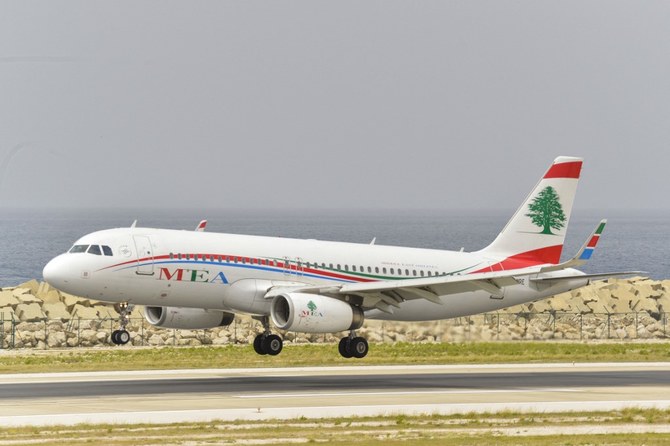
Airline boss threatens to draft in hunters to shoot seagulls around Beirut airport

El-Hout argued at the time that “preserving passengers’ safety is the priority” and “while the environmental committee objected, I had to choose: Either the seagulls flew, or the MEA flew.” (AFP/File)
Short Url
Updated 03 January 2023
Follow

Airline boss threatens to draft in hunters to shoot seagulls around Beirut airport

  • Controversial move adopted in 2017 after gulls from nearby landfill site caused danger to aviation

LONDON: The chairman of Middle East Airlines on Tuesday threatened to draft in hunters to shoot seagulls posing a threat to flight safety at Beirut airport if the Lebanese government failed to address the issue.

Mohamad El-Hout, head of Lebanon’s national carrier, said he was giving the state a choice between “the intervention of security forces or permitting the MEA to bring in hunters.”

Beirut–Rafic Hariri International Airport has seen a steady proliferation of the birds drawn to the nearby Costa Brava landfill site.

Since the waste tip was opened in 2016, the number of seagulls soaring around the city airport has increased dramatically, raising plane accident concerns over birds being sucked into aircraft engines.

El-Hout called on Lebanon’s interior minister to act, otherwise he would have to resort to the solution used in 2017 when the airline recruited 125 hunters and gave them the ammunition to kill more than 10,000 seagulls.

The then Transport Minister Youssef Fenianos failed to deliver on a promise to deal with the problem after local media reported a MEA flight encountering a flock of birds as it landed on the airport’s west runway.

Fenianos had suggested installing extra devices around the airport to emit bird of prey calls to scare off the gulls, a solution welcomed by environmental groups.

Activists and environmental groups have long protested against the landfill and called on authorities to close the site to solve the bird issue altogether and avoid an “extermination campaign.”

On the seagull problem, You Stink activist Lucien Bourjeily, said: “We call for eliminating the main reason behind this crisis, which is the Costa Brava landfill.”

Seagulls are a globally protected species and addressing their proliferation requires tackling the issue of the Costa Brava landfill, which was originally opened as an interim solution after the closure of the main landfill receiving waste from Beirut.

El-Hout argued at the time that “preserving passengers’ safety is the priority” and “while the environmental committee objected, I had to choose: Either the seagulls flew, or the MEA flew.”

MEA recently hit the headlines after a series of unusual incidents. On Saturday, stray bullets fired during new year celebrations in Lebanon’s capital hit two of the airline’s planes parked at the airport. In a similar incident in November, a stray bullet hit an MEA plane as it landed in Beirut. No casualties were recorded.

And in August, an MEA plane flying from Madrid to Beirut was for several minutes flanked by two NATO military jets after the pilot Abed El-Hout, son of the company’s chairman, failed to respond to routine radio calls.


Cambodia takes back looted historic artifacts handled by British art dealer

Updated 28 February 2026
Follow

Cambodia takes back looted historic artifacts handled by British art dealer

  • The objects were returned under a 2020 agreement between the Ministry of Culture and Fine Arts and the family of the late Douglas Latchford, a British art collector and dealer who allegedly had the items smuggled out of Cambodia

PHNOM PENH, Cambodia: Cambodian officials on Friday received more than six dozen historic artifacts described as part of the country’s cultural heritage that had been looted during decades of war and instability.
At a ceremony attended by Deputy Prime Minister Hun Many, the 74 items were unveiled at the National Museum in Phnom Penh after their repatriation from the United Kingdom.
The objects were returned under a 2020 agreement between the Ministry of Culture and Fine Arts and the family of the late Douglas Latchford, a British art collector and dealer who allegedly had the items smuggled out of Cambodia.
“This substantial restitution represents one of the most important returns of Khmer cultural heritage in recent years, following major repatriations in 2021 and 2023 from the same collection,” the Culture Ministry said in a statement. “It marks a significant step forward in Cambodia’s continued efforts to recover, preserve, and restore its ancestral legacy for future generations.”
The artifacts were described as dating from the pre-Angkorian period through the height of the Angkor Empire, including “monumental sandstone sculptures, refined bronze works, and significant ritual objects.” The Angkor Empire, which extended from the ninth to the 15th century, is best known for the Angkor Wat archaeological site, the nation’s biggest tourist attraction.
Latchford was a prominent antiquities dealer who allegedly orchestrated an operation to sell looted Cambodian sculptures on the international market.
From 1970 to the 1980s, during Cambodia’s civil wars and the communist Khmer Rouge ‘s brutal reign, organized looting networks sent artifacts to Latchford, who then sold them to Western collectors, dealers, and institutions. These pieces were often physically damaged, having been pried off temple walls or other structures by the looters.
Latchford was indicted in a New York federal court in 2019 on charges including wire fraud and conspiracy. He died in 2020, aged 88, before he could be extradited to face charges.
Cambodia, like neighboring Thailand, has benefited from a trend in recent decades involving the repatriation of art and archaeological treasures. These include ancient Asian artworks as well as pieces lost or stolen during turmoil in places such as Syria, Iraq and Nazi-occupied Europe. New York’s Metropolitan Museum of Art is one of the prominent institutions that has been returning illegally smuggled art, including to Cambodia.
“The ancient artifacts created and preserved by our ancestors are now being returned to Cambodia, bringing warmth and joy, following the country’s return to peace,” said Hun Many, who is the younger brother of Prime Minister Hun Manet.