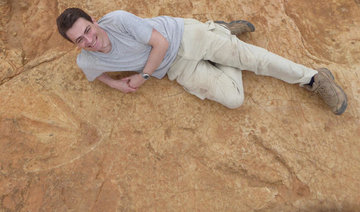
WASHINGTON: Scientists have unearthed in a Sahara Desert oasis in Egypt fossils of a long-necked, four-legged, school bus-sized dinosaur that lived roughly 80 million years ago, a discovery that sheds light on a mysterious time period in the history of dinosaurs in Africa.
Researchers said on Monday the plant-eating Cretaceous Period dinosaur, named Mansourasaurus shahinae, was nearly 33 feet (10 meters) long and weighed 5.5 tons (5,000 kg) and was a member of a group called titanosaurs that included Earth’s largest-ever land animals. Like many titanosaurs, Mansourasaurus boasted bony plates called osteoderms embedded in its skin.
Mansourasaurus, which lived near the shore of the ancient ocean that preceded the Mediterranean Sea, is one of the very few dinosaurs known from the last 15 million years of the Mesozoic Era, or age of dinosaurs, on mainland Africa. Madagascar had a separate geologic history.
Its remains, found at the Dakhla Oasis in central Egypt, are the most complete of any mainland African land vertebrate during an even larger time span, the roughly 30 million years before the dinosaur mass extinction 66 million years ago, said paleontologist Hesham Sallam of Egypt’s Mansoura University, who led the study published in the journal Nature Ecology and Evolution.
The scientists recovered parts of its skull, lower jaw, neck and back vertebrae, ribs, shoulder and forelimb, back foot and osteoderms.
A lot of Africa is covered in grasslands, savannas and rain forests that obscure underlying rock where fossils may be found, said postdoctoral researcher Eric Gorscak of the Field Museum in Chicago, who was formerly at Ohio University.
While as massive as a bull African elephant, Mansourasaurus was modestly sized next to titanosaur cousins such as South America’s Argentinosaurus, Dreadnoughtus and Patagotitan and Africa’s Paralititan, some exceeding 100 feet (30 meters) long.
“Mansourasaurus, though a big animal by today’s standards, was a pipsqueak compared to some other titanosaurs,” said paleontologist Matt Lamanna of the Carnegie Museum of Natural History in Pittsburgh.
The researchers determined Mansourasaurus was more closely related to European and Asian titanosaurs than to those from elsewhere in Africa and other Southern Hemisphere land masses including South America formerly joined in a super-continent called Gondwana.
“This, in turn, demonstrates for the first time that at least some dinosaurs could move between North Africa and southern Europe at the end of the Mesozoic, and runs counter to long-standing hypotheses that have argued that Africa’s dinosaur faunas were isolated from others during this time,” Lamanna said.

Fossil of school bus-sized dinosaur dug up in Egyptian desert
In southeast Pakistan, Ramadan brings Hindus and Muslims closer
MITHI: Partab Shivani, a Hindu in Muslim-majority Pakistan, has fasted on and off during Ramadan for years, but this time is different as he practices abstinence for the entire holy month.
Every year, he and his friends in the southeastern city of Mithi arrange iftar, when Muslims break their daily fast, to foster peace and solidarity between the two religions.
“I believe we need to promote interfaith harmony. First, we are humans — religions came later,” Shivani, a 48-year-old social activist, told AFP, adding that he also reads the teachings of the Buddha.
“His message is about peace and ending war. Peace can spread through solidarity and by standing with one another. Distance only widens the gap between people,” he added.
Ninety-six percent of Pakistan’s 240 million people are Muslim. Just two percent are Hindu, most of them living in rural areas of Sindh province where Mithi is located.
In Mithi itself, most of the 60,000 inhabitants are Hindu.
Many of the city’s Hindus also observe Ramadan and iftar has become a social gathering where people from both faiths happily participate.
“This has been a wonderful tradition of ours for a very long time,” said Mir Muhammad Buledi, a 51-year-old Muslim friend who attended Shivani’s iftar gathering.
“It is a beautiful example of harmony between the two communities.”
Like brothers
Discrimination against minorities runs deep in Pakistan.
Following the end of British rule in South Asia in 1947, the subcontinent was partitioned into mainly Hindu India and Muslim-majority Pakistan.
That triggered widespread religious bloodshed in which hundreds of thousands were killed and millions displaced.
According to the Human Rights Commission of Pakistan, freedom of religion or belief is under constant threat, with religiously motivated violence and discrimination increasing yearly.
State authorities, often using religious unrest for political gain, have failed to address the crisis, the independent non-profit says.
But such tensions are absent in Mithi.
“I am a Hindu but I keep all the fasts during this month,” said Sushil Malani, a local politician. “I feel happy standing with my Muslim brothers.
“We celebrate Eid together as well. This tradition in the region is very old.”
Restaurants and tea stalls are closed across Pakistan during Ramadan.
Ramesh Kumar, a 52-year-old Hindu man who sells sweets and savoury items outside a Muslim shrine, keeps his push cart covered and closed until iftar.
“There is no discrimination among us if someone is Muslim or Hindu. I have been seeing this since my childhood that we all live together like brothers,” he said.
Muslim shrine, Hindu caretaker
Locals say Mithi’s peaceful religious coexistence can be traced to its remote location, emerging from the sand dunes of the Tharparkar desert, which borders the modern Indian state of Rajasthan.
Cows — considered sacred in Hinduism — roam freely in Mithi city, as they do in neighboring India.
At two Sufi Muslim shrines in the middle of the city, Hindu families arrange meals, bringing fruit, meals and juices for their Muslim neighbors to break their fasts.
“We respect Muslims,” said Mohan Lal Malhi, a Hindu caretaker of one of the shrines.
Mohan said his parents and elders taught him to respect people regardless of religion or color, and the traditions pass from one generation to the next.
Local residents said both communities consider their social relationships more important than their religious identity.
“You will see a (Sikh) gurdwara, a mosque, and a shrine standing side by side here,” Mohan said. “The atmosphere of this area teaches humanity.”


