ALEXANDRIA, Egypt: Egyptian archaeologists on Thursday dashed local hopes that a newly discovered ancient sarcophagus might contain the remains of Alexander the Great, finding instead the mummies of what appeared to be a family of three.
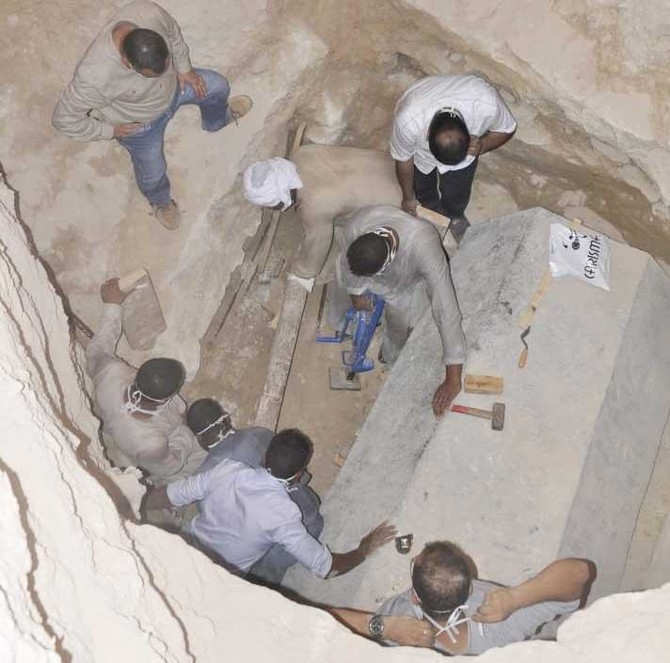
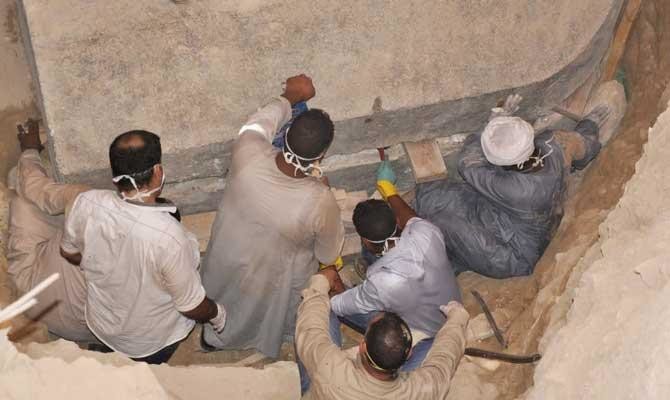
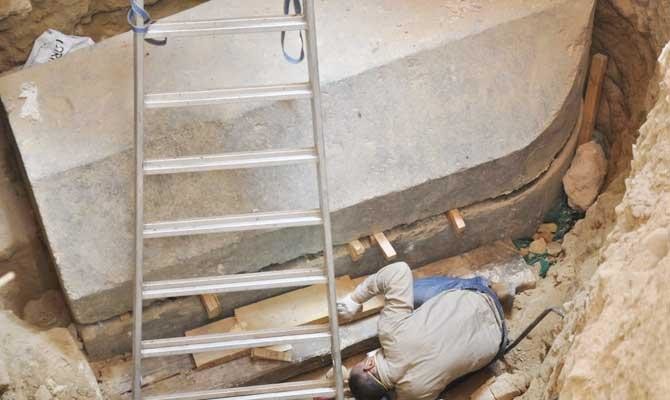
Workmen inadvertently unearthed the approximately 2,000-year-old black granite sealed sarcophagus this month during the construction of an apartment building in the historic Mediterranean port city of Alexandria.
The 30-ton coffin is the largest yet found in Alexandria, prompting a swirl of theories in local and international media that it may be the resting place of the ancient Greek ruler who in 331 BC founded the city that still bears his name.
Egypt’s antiquities ministry had vigorously dismissed the chances of finding Alexander’s remains inside the 30-ton sarcophagus and on Thursday its skepticism was vindicated.
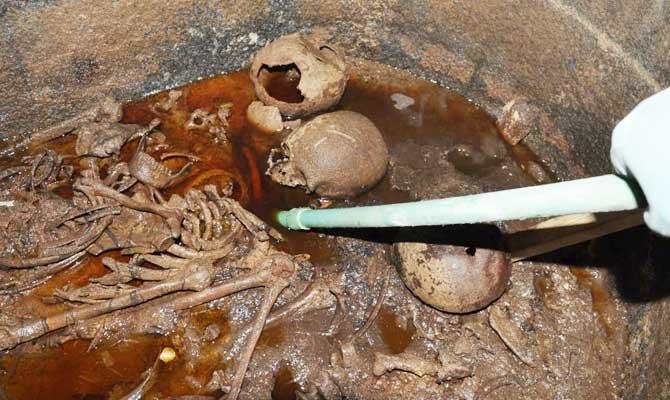
“We found the bones of three people, in what looks like a family burial... Unfortunately the mummies inside were not in the best condition and only the bones remain,” Mostafa Waziri, secretary-general of the Supreme Council of Antiquities, told reporters at the site.
Waziri said some of the remains had disintegrated because sewage water from a nearby building had leaked into the sarcophagus through a small crack in one of the sides.
The location of the remains of Alexander the Great, who died in 323 BC in Babylon, remains a mystery.
The sarcophagus in Alexandria is the latest of a series of interesting archaeological finds this year in Egypt that include a 4,400-year-old tomb in Giza and an ancient necropolis in Minya, south of Cairo.
The unmarked tomb in Alexandria did not likely belong to any other notable ruler in the Ptolemaic period (332 BC-30 BC) associated with Alexander the Great, or the subsequent Roman era, Waziri said.
The prospect of opening the long-sealed sarcophagus had stirred fears in Egyptian media that it could unleash a 1,000-year curse.
“We’ve opened it and, thank God, the world has not fallen into darkness, said Waziri.
“I was the first to put my whole head inside the sarcophagus... and here I stand before you ... I am fine.”


Mystery Egypt sarcophagus found not to house Alexander the Great’s remains

Mystery Egypt sarcophagus found not to house Alexander the Great’s remains

- The unmarked tomb in Alexandria did not likely belong to any other notable ruler in the Ptolemaic period (332 BC-30 BC) associated with Alexander the Great, or the subsequent Roman era
- The location of the remains of Alexander the Great, who died in 323 BC in Babylon, remains a mystery


Lina Gazzaz traces growth, memory and resilience at Art Basel Qatar
- The Saudi artist presents ‘Tracing Lines of Growth’ at the fair’s inaugural edition
DUBAI: Saudi artist Lina Gazzaz will present a major solo exhibition via Hafez Gallery at the inaugural edition of Art Basel Qatar, which runs Feb. 3 to 7. “Tracing Lines of Growth” is a body of work that transmutes botanical fragments into meditations on resilience, memory and becoming.
Hafez Gallery, which was founded in Jeddah, frames the show as part of its mission to elevate underrepresented regional practices within global conversations. Gazzaz’s biography reinforces that reach. Based in Jeddah and trained in the United States, she works across sculpture, installation, painting and video, and has exhibited in Saudi Arabia, the US, Lebanon, the UK, Germany, the UAEand Brazil. Her experimental practice bridges organic material and conceptual inquiry to probe ecological kinship, cultural memory and temporal rhythm.

“Tracing Lines of Growth” is a collection rooted in long-term inquiry. “I started to think about it in 2014,” Gazzaz told Arab News, describing a project that has evolved from her initial simple line drawings through research, experimentation and material interrogation.
What began as tracing the lines of Royal Palm crown shafts became an extended engagement with the palm’s physiology, its cultural significance and its symbolic afterlives. During the COVID-19 pandemic, she went deeper into that exploration, translating weathered crown shafts into “lyrical instruments of time.”
Each fragment of “Tracing Lines of Growth” is treated as a cache of human and ecological narratives. Gazzaz describes a feeling of working with materials that “have witnessed civilization,”attributing to them a deep collective memory.
Hafez Gallery’s presentation text frames the palm as a cipher — its vascular routes once pulsing with sap transformed into calligraphic marks that summon the bodies of ouds, desert dunes and scripted traces rooted in Qur’anic and biblical lore.

“Today, the palm has evolved into a symbol of the land and its people. Throughout the Arabian Peninsula, it is still one of the few agricultural exports; and plays an integral role in the livelihood of agrarian communities,” said Gazzaz.
The sculptures’ rippling ribs and vaulted folds, stitched with red thread, evoke what the artist hears and sees in the wood. “Each individual line represents a story, and it’s narrating humanity’s story,” she said.
The works’ stitching is described in the gallery’s materials as “meticulous.” It emphasizes linear pathways and punctuates the sculptures with the “suggestion of life’s energy moving through the dormant material.”
“(I used) fine red thread — the color of life and energy — to narrate the longevity of growth, embodying themes of balance, fragility, music, transformation and movement. The collection is about the continuous existence in different forms and interaction; within the concept of time,” Gazzaz explained.
Hand-stitching, in Gazzaz’s practice, highlights her insistence on care and repair, and the human labor that converts cast-off organic forms into carriers of narratives.
Gazzaz describes her practice as a marriage between rigorous research and intuitive making. “I am a search-based artist... Sometimes I cannot stop searching,” she said. “During the search and finding more and more, and diving more and more, the subconscious starts to collaborate with you too, because of your intention. After all the research, I go with the flow. I don’t plan... I go with the flow, and I listen to it.”
The artist is far from done with this particular project. “I am now beginning to explore the piece with glass,” she noted.
Art Basel Qatar’s curatorial theme for its inaugural year is “Becoming.” For Gazzaz, ‘becoming’ is evident in the material and conceptual transformations she stages: discarded palm fragments reconstituted into scores of lived time, stitched lines reactivated as narratives.
“It’s about balance. It’s about fragility. It’s about resilience,” she said.


