NEW YORK: Astronomers are still finding moons at Jupiter, 400 years after Galileo used his spyglass to spot the first ones.
The latest discovery of a dozen small moons brings the total to 79, the most of any planet in our solar system.
Scientists were looking for objects on the fringes of the solar system last year when they pointed their telescopes close to Jupiter’s backyard, according to Scott Sheppard of the Carnegie Institute for Science in Washington. They saw a new group of objects moving around the giant gas planet but didn’t know whether they were moons or asteroids passing near Jupiter.
“There was no eureka moment,” said Sheppard, who led the team of astronomers. “It took a year to figure out what these objects were.”
They all turned out to be moons of Jupiter. The confirmation of 10 was announced Tuesday. Two were confirmed earlier.
The moons had not been spotted before because they are tiny. They are about one to two kilometers (miles) across, said astronomer Gareth Williams of the International Astronomical Union’s Minor Planet Center.
And he thinks Jupiter might have even more moons just as small waiting to be found.
“We just haven’t observed them enough,” said Williams, who helped confirm the moons’ orbits.
The team is calling one of the new moons an ‘oddball’ because of its unusual orbit. Sheppard’s girlfriend came up with a name for it: Valetudo, the great-granddaughter of the Roman god Jupiter.
Valetudo is in Jupiter’s distant, outer swarm of moons that circles in the opposite direction of the planet’s rotation. Yet it’s orbiting in the same direction as the planet, against the swarm’s traffic.
“This moon is going down the highway the wrong way,” Sheppard said.
Scientists believe moons like Valetudo and its siblings appeared soon after Jupiter formed. The planet must have acted like a vacuum, sucking up all the material that was around it. Some of that debris was captured as moons.
“What astonishes me about these moons is that they’re the remnants of what the planet formed from,” he said.
Telescopes in Chile, Hawaii and Arizona were used for the latest discovery and confirmation.
Galileo detected Jupiter’s four largest moons, Io, Europa, Ganymede and Callisto in 1610. The latest count of 79 known planets includes eight that have not been seen for several years. Saturn is next with 61, followed by Uranus with 27 and Neptune with 14. Mars has two, Earth has one and Mercury and Venus have none.


Jupiter’s moon count reaches 79, including tiny ‘oddball’

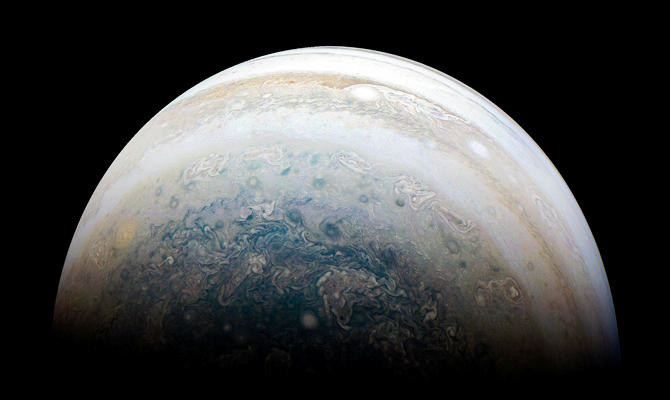
Jupiter’s moon count reaches 79, including tiny ‘oddball’
- The most interesting of the new moons is Valetudo (pronounced val-eh-TOO-doh), named after the ancient Roman god Jupiter's great-granddaughter, the goddess of health and hygiene
- upiter's 79 known moons are the most of any planet in the solar system, followed by the 62 identified around the giant ringed gas planet Saturn


Apple to update EU browser options, make more apps deletable
- iPhone maker came under pressure from regulators to make changes after the EU’s sweeping Digital Markets Act took effect on March 7
- Apple users will be able to select a default browser directly from the choice screen after going through a mandatory list of options
STOCKHOLM: Apple will change how users choose browser options in the European Union, add a dedicated section for changing default apps, and make more apps deletable, the company said on Thursday.
The iPhone maker came under pressure from regulators to make changes after the EU’s sweeping Digital Markets Act took effect on March 7, forcing big tech companies to offer mobile users the ability to select from a list of available web browsers on a “choice screen.”
The new rules require mobile software makers to show the choice screen where users can select a browser, search engine and virtual assistant as they set up their phones, which earlier came with preferred options from Apple and Google.
In an update later this year, Apple users will be able to select a default browser directly from the choice screen after going through a mandatory list of options.
A randomly ordered list of 12 browsers per EU country will be shown to the user with short descriptions, and the chosen one will be automatically downloaded, Apple said. The choice screen will also be available on iPads through an update later this year.
Apple released a previous update in response to the new rules in March, but browser companies criticized the design of its choice screen, and the Commission opened an investigation on March 25 saying it suspected that the measures fell short of effective compliance.
The company said it has been in dialogue with the European Commission and believes the new changes will address regulators’ concerns.
It also plans to introduce a dedicated area for default apps where a user will be able to set defaults for messaging, phone calls, spam filters, password managers and keyboards.
Users will also be able to delete certain Apple-made apps such as App Store, Messages, Camera, Photos and Safari. Only Settings and Phone apps would not be deletable.