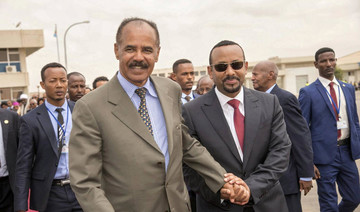
ADDIS ABABA: Official rivals just weeks ago, the leaders of Ethiopia and Eritrea embraced warmly to the roar of a crowd of thousands Sunday at a concert celebrating the end of a long state of war.
A visibly moved Eritrean President Isaias Afwerki, clasping his hands over his heart, addressed the crowd in Ethiopia’s official language, Amharic, on his first visit to the country in 22 years.
“Hate, discrimination and conspiracy is now over,” the 72-year-old Isaias said to cheers and people chanting his name. “Our focus from now on should be on developing and growing together. We are ready to move forward with you as one. No one can steal the love we have regained now. Now is the time to make up for the lost times.”
The Eritrean leader repeatedly praised the “able leadership” of Ethiopia’s reformist new Prime Minister Abiy Ahmed, who in his own speech thanked Isaias for his “courageous gesture” in accepting the offer of peace.
The concert highlighted the end of hostilities between the arch-foes in East Africa, who fought a bloody border war from 1998 to 2000 that killed tens of thousands and left families separated. The antagonism ended last month when Abiy announced that Ethiopia was fully accepting a peace deal originally signed in 2000 and Eritrea swiftly responded.
“The reconciliation we are forging now is an example to people across Africa and beyond,” the 42-year-old Abiy said.
Jubilant Ethiopians, some of whom have compared the dramatic developments to the fall of the Berlin Wall, found themselves putting aside the World Cup final to watch live coverage of the concert.
Isaias arrived in Ethiopia on Saturday, reciprocating the Ethiopian leader’s trip to Eritrea last weekend that led to the restoration of diplomatic, telephone and transport ties. He was greeted by Abiy in a red-carpet welcome, with people dancing at the airport and thousands of residents of the capital, Addis Ababa, lining the streets to see Isaias’ motorcade.
Some chanted songs criticizing the Tigray Peoples Liberation Front, which used to be Ethiopian ruling coalition’s strongest political party and was hostile to Eritrea until Abiy came to power at the beginning of April and introduced a breathtaking series of political and economic reforms.
“Nothing can stop the ongoing reforms in Ethiopia,” Abiy told the crowd Sunday. “But we need to protect the democratic rights we are regaining now.”
The embrace of the peace deal, which hands key disputed border areas to Eritrea, was the boldest of the changes as Ethiopia moves away from years of anti-government protests that demanded wider freedoms in Africa’s second most populous country with more than 100 million people.
Now attention shifts to Eritrea, one of the world’s most reclusive nations, which has been ruled by Isaias since it gained independence from Ethiopia in 1993. The state of war with Ethiopia kept the country of 5 million in a constant state of military readiness with a system of compulsory conscription that sent thousands of people fleeing the country toward Europe and elsewhere.
Eritrea also has faced years of UN sanctions over alleged support to extremists, which the government has denied, and Abiy already has called for them to be lifted.
The sight of the Eritrean leader speaking Amharic to reach out to Ethiopians surprised even his longtime acquaintances. “I have known him for more than 40 yrs. Never heard him speak Amharic,” the Eritrean ambassador to Kenya and Tanzania, Beyene Russom, said on Twitter, describing the crowd’s shouts of joy.
The United States and others have praised the end of the state of war between the two countries as a welcome development for the strategic Horn of Africa region and beyond.
Ethiopia’s leader has been quick to promote economic development as a shared goal of the new friendship, giving Isaias a tour of an industrial park and pursuing deals for his landlocked nation to use Eritrea’s ports on the Red Sea along one of the world’s busiest shipping lanes.
The Eritrean leader’s visit to Ethiopia continues Monday as Isaias is expected to re-open his country’s embassy.
___
Follow Africa news at https://twitter.com/AP_Africa


![]()

Eritrean, Ethiopian leaders call new peace example to Africa
Eritrean, Ethiopian leaders call new peace example to Africa
- The concert highlighted the end of hostilities between the arch-foes in East Africa
- The antagonism ended last month when Ethiopia accepted a peace deal and Eritrea swiftly responded
Latest updates


© 2026 SAUDI RESEARCH & PUBLISHING COMPANY, All Rights Reserved And subject to Terms of Use Agreement.