

Political climate of Karachi soars as Imran, Bilawal prepare for faceoff in polls

1 / 2
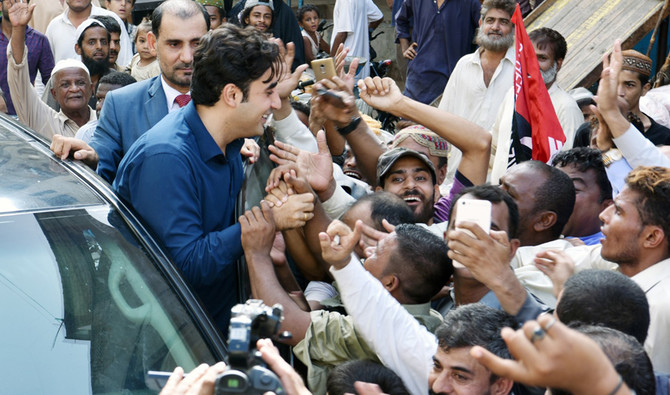
Chairman Pakistan People’s Party, Bilawal Bhutto Zardari, submitted nomination form here at City Courts, Karachi here on Thursday, June 8, 2018 (Photo by Omar R. Quraishi)
2 / 2
Chairman Pakistan People’s Party, Bilawal Bhutto Zardari, shaking hand with workers and supporters after submitted nomination form here at City Courts, Karachi here on Thursday, June 8, 2018 (Photo by Omar R. Quraishi)
Updated 09 June 2018
Follow

Political climate of Karachi soars as Imran, Bilawal prepare for faceoff in polls

  • Imran Khan submitted nomination form to contest election from NA-243, a constituency where Muttahida Qaumi Movement (MQM) won the last two general elections.
  • Bilawal is contesting from two National Assembly seats – NA-246 of Karachi’s Lyari area and NA-200 of Larkana – which his party has been wining since 1970s.

KARACHI: Political climate of Karachi, which had become cold due to split within major political party of the city – The Muttahida Qaumi Movement (MQM) – has soared up after chiefs of the Pakistan People’s Party (PPP) and Pakistan Tehreek-e-Insaf (PTI) chose this important metropolis as battleground for contesting 2018 general elections.

Election commission of Pakistan (ECP) has fixed July 25, 2018, as the date for general elections on the national and provincial assemblies in the country. According to ECP, the aspirant candidates can submit their nomination papers till June 11, 2018.

A day earlier, Bilawal submitted his nomination papers to contest elections from two National Assembly seats – NA-246 of Karachi’s Lyari area and NA-200 of Larkana – which his party has been wining since 1970s.

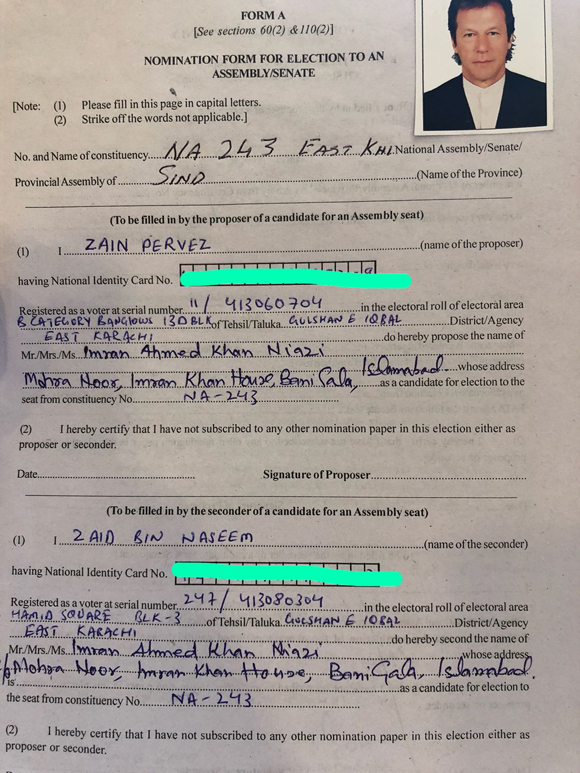
PTI Chief Imran Khan submitted his nomination form for NA-243 of the city.

Zia Ur Rehman, a Karachi-based political commentator, says Karachi is very a important city for major political parties which is why heads of major political parties have been contesting polls from the metropolis.

“First, Karachi is electorally highly symbolic at national level. Second, Participation of Bilawal and Imran will boost the electoral campaigns of their parties’ candidates contesting from various parts of the city,” Rehman opines.

Experts believe that PPP has played safe by fielding its chief on a seat which the party has been wining since its inception whereas PTI has taken a risk to choose NA-243 where the party could only emerge as a runner-up and that too when its popularity was at the peak in 2013.

“Lyari is a safe constituency for PPP as the party has been winning this seat for the past several decades by drawing support from its Baloch and Katchi ethnic electorate and this is the reason why the PPP has chosen Lyari for its young chairperson.”

PTI has chosen Gulshan-e-Iqbal, a constituency that houses upper-middle and middle-class population of the city. Khan’s participation from the area will help the party's other candidates to muster votes from Mohajir and upper-middle class neighborhoods of the city.

According to the new delimitation, NA-243 now comprises areas of former NA-251 and NA-252, which as per the results on ECP’s official website, were among the city’s seats where PTI had not only secured second position but Imran Khan’s party had also got good number of votes, upsetting the Muttahida Qaumi Movement (MQM) Chief Altaf Hussain.

Faisal Subzwari, former provincial minister and senior MQM leader sees PTI’s decision to pitch Khan from a known MQM stronghold as an unwise move.

“No doubt PTI had been runner up from these constituencies in 2013 but it was a wave in favor of PTI, which it has badly failed to retain,” the MQM-P leader says, adding despite split within the MQM-Pakistan, his party is in strong position to win the said seat.

Head of the PTI’s central media cell, Iftikhar Durrani, admits that the split within MQM shaped PTI’s decision to choose this constituency. “However, that’s not the only reason. Our election management cell has worked it out scientifically. We have conducted several surveys after which we took this decision. We are sure that Imran Khan will win with huge margin.”

Durrani says Khan will not only win this seat but it will give boast to party’s election campaign in Karachi over a large number of seats.

On Bilawal’s choice of constituency, MQM-P’s Subzwari says PPP has played safe by fielding Bilawal from Lyari but it will be really hard for it to retain the previous margin as the party has lost turf over the last several years. “In past local gangers would muster support for the party. Gangs have been eliminated,” he says.

President PPP Karachi division and former minister, Saeed Ghani, says it was his party’s decision to field Bilawal as a candidate from Lyari. “This seat belongs to Bhuttos and the people have never reposed their trust in anyone else. Bilawal will not only retain the previous winning margins but he will win with biggest margins.”

With both PPP and PTI dreaming great results for their leaders, the political climate of Karachi rises for the big day.

Pakistan Army’s logistics firm to run national shipping corporation, confirm officials

Updated 4 sec ago
Follow

Pakistan Army’s logistics firm to run national shipping corporation, confirm officials

  • Government to transfer 30 percent shares in Pakistan National Shipping Corporation, management control to NLC firm, say officials
  • Officials say the move will increase PNSC’s shipping fleet from 10 to 54, save $6 billion Islamabad pays in foreign freight annually

KARACHI: The government has decided to transfer the state-run Pakistan National Shipping Corporation’s (PNSC) management to the military-run National Logistics Corporation (NLC), officials confirmed on Thursday, saying the move is expected to save $6 billion that Islamabad currently pays in foreign freight annually. 

A week earlier, Prime Minister Shehbaz Sharif’s government sold 75 percent of its shareholding in the national flag carrier Pakistan International Airlines (PIA) to a business consortium led by Arif Habib Group for Rs135 billion ($482 million).

The government’s current drive to privatize state-owned enterprises (SOEs) is a key requirement of the International Monetary Fund’s (IMF) $7 billion loan program. The global lender wants Islamabad to privatize its loss-making state assets to save valuable revenue. 

PNSC reported a 34 percent decline in its profit, which reduced to Rs3.71 billion ($13.2 million) in the July-September quarter this year. Its revenues from shipping business fell by 2 percent to Rs9.32 billion ($33 million) in the same period, according to the company’s filing to the Pakistan Stock Exchange (PSX) seen by Arab News. The PNSC’s profits remained almost stagnant at Rs20 billion ($73 million) in FY25 while its shipping income shrank 18 percent to Rs33.7 billion ($120.3 million).

“We received a letter about one month ago in which the government asked us to sort out things before Dec. 30,” a PNSC official told Arab News on condition of anonymity as he was not authorized to speak to media. “The management control will go to the NLC.”

An NLC official confirmed the same. 

“Yes, this is happening,” an NLC official told Arab News on condition of anonymity. He said details will be shared in due course.

Muhammad Arshad, a spokesman at Pakistan’s Maritime Affairs Ministry, and PNSC Spokesperson Muhammad Farooq Nizami both declined to comment on the matter.

“We can’t say anything about this development until we get an official notification,” Nizami told Arab News. 

Officials said that as per the PNSC Revitalization and Improvement Plan, the government would sell about 30 percent of its PNSC shareholding to NLC, which would then have a controlling share in the corporation’s management.

As of Jun. 30, the government holds 87.56 percent shares in PNSC, whose 198.1 million shares are listed on the PSX with a market capital of Rs109 billion ($389 million). 

The NLC will be required to increase the PNSC’s shipping fleet, which currently comprises only 10 ships, to 54 over the next five years, the shipping company’s official said.

This would help Pakistan’s government save about $6 billion in freight costs as the PNSC’s current 10 ships are only able to handle 11 percent of the country’s commercial cargo, he added.

“As a result, Pakistan has to pay approximately $6 billion annually in foreign exchange to foreign shipping companies as freight charges,” he said. 

Among other objectives, the military-led company is also expected to rid PNSC of its aging fleet, as many vessels are nearing the end of their operational life and won’t be able to sail profitably beyond 2030.

“This initiative will ensure 100 percent replacement of all old PNSC vessels along with the induction of new ships,” the PNSC official said. 

News reports of the transfer of management have led to a rise in the PNSC’s shares at the PSX, which gained by around 21 percent in the last two trading sessions. The stocks traded at Rs548.89 ($1.9) per share on Thursday morning, taking its year-to-date gains to 17 percent.

Pakistan’s government has been cautious in spending its $16 billion foreign exchange reserves as it aims to keep its current account balance in check. 

Pakistan’s current account reported a $812 million deficit in the July-November period from a $503 million surplus last year, according to data shared by the central bank. 

The PNSC official said the increase in the company’s shipping fleet will enhance its share in global maritime freight from $162 million to $1.79 billion. 

“Despite significant growth potential in the shipping industry, the absence of private operators is hindering market dynamism and efficiency,” he said. 

“World-class financial and legal advisers will be appointed for institutional restructuring, transforming PNSC into a modern, agile, and professionally managed organization.”