Deadly Algerian migrant expulsions resume in desert, UN says

1 / 2
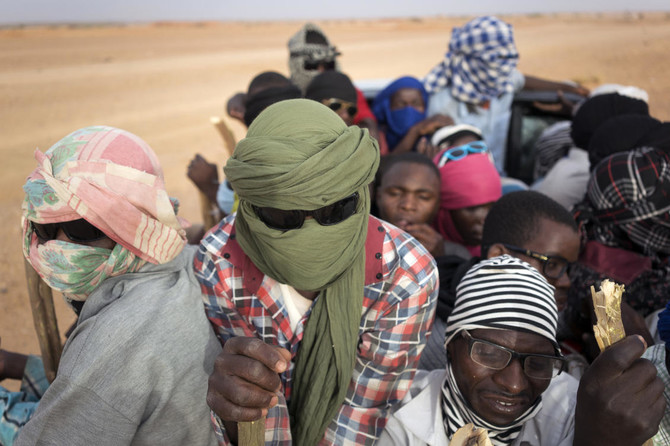
In this Monday, June 4, 2018 file photo, Nigeriens and third-country migrants head towards Libya from Agadez, Niger. (AP/Jerome Delay)
2 / 2
In this Monday, June 4, 2018 file photo, Nigeriens and third-country migrants head towards Libya from Agadez, Niger. Algeria's deadly expulsions of migrants into the Sahara Desert have nearly ground to a halt after widespread condemnation and the abrupt firing of two of its top security officials. (AP/Jerome Delay)
Updated 14 July 2018
Follow

Deadly Algerian migrant expulsions resume in desert, UN says

  • UN says Algeria’s government has resumed expelling migrants into the Sahara Desert to die
  • IOM has found many migrants as they stumble through the desert

PARIS: Algeria's government has resumed expelling migrants into the Sahara Desert to die, leaving 391 people to wander through some of the world's most hostile terrain in the middle of summer, a U.N. migration official said Saturday.
The migrants, from 16 different countries, were abandoned at the border with Niger, according to a tweet from Giuseppe Loprete , the head of the U.N.'s International Organization for Migration in Niger.
The Associated Press reported last month that Algeria has left more than 13,000 migrants in the desert of Niger and Mali since May 2017, forcing them to walk or die under searing heat,
For several weeks after the AP report came out, the expulsions appeared to have been suspended. IOM in Mali said the normally secretive Algerian government seemed to be trying to make an effort to communicate the movement of the migrants. An aid worker with contacts inside Algeria said the government instead was rounding up migrants to jail in detention centers.
IOM has been forced to find the migrants as they stumble through the desert, and many told the AP some of their companions died along the way.
Algeria has an agreement with Niger's government to deport its citizens by convoy directly to the city of Agadez. But migrants from other countries who have been rounded up in repeated sweeps are trucked to around 15 kilometers (nine miles) from the nearest water and ordered to march through some of the world's most hostile terrain, where summer temperatures reach well above 40 C (104 F).
The African Union, many of whose member governments count citizens among the expelled migrants, has demanded that Algeria stop abandoning people to die in the desert. The United Nations has also condemned the practice.
Algeria's opaque government, however, has refused to acknowledge it. Soon after the AP report and a Human Rights Watch report came out detailing the desert expulsions, Algeria asked local journalists to observe the mass detention of migrants, claiming it was proof of their humane treatment. But journalists weren't permitted to travel beyond the detention centers where they are held before expulsion.


First responders enter devastated Aleppo neighborhood after days of deadly fighting

Updated 12 January 2026
Follow

First responders enter devastated Aleppo neighborhood after days of deadly fighting

  • The US-backed SDF, which have played a key role in combating the Daesh group in large swaths of eastern Syria, are the largest force yet to be absorbed into Syria’s national army

ALEPPO, Syria: First responders on Sunday entered a contested neighborhood in Syria’ s northern city of Aleppo after days of deadly clashes between government forces and Kurdish-led forces. Syrian state media said the military was deployed in large numbers.
The clashes broke out Tuesday in the predominantly Kurdish neighborhoods of Sheikh Maqsoud, Achrafieh and Bani Zaid after the government and the Syrian Democratic Forces, the main Kurdish-led force in the country, failed to make progress on how to merge the SDF into the national army. Security forces captured Achrafieh and Bani Zaid.
The fighting between the two sides was the most intense since the fall of then-President Bashar Assad to insurgents in December 2024. At least 23 people were killed in five days of clashes and more than 140,000 were displaced amid shelling and drone strikes.
The US-backed SDF, which have played a key role in combating the Daesh group in large swaths of eastern Syria, are the largest force yet to be absorbed into Syria’s national army. Some of the factions that make up the army, however, were previously Turkish-backed insurgent groups that have a long history of clashing with Kurdish forces.
The Kurdish fighters have now evacuated from the Sheikh Maqsoud neighborhood to northeastern Syria, which is under the control of the SDF. However, they said in a statement they will continue to fight now that the wounded and civilians have been evacuated, in what they called a “partial ceasefire.”
The neighborhood appeared calm Sunday. The United Nations said it was trying to dispatch more convoys to the neighborhoods with food, fuel, blankets and other urgent supplies.
Government security forces brought journalists to tour the devastated area, showing them the damaged Khalid Al-Fajer Hospital and a military position belonging to the SDF’s security forces that government forces had targeted.
The SDF statement accused the government of targeting the hospital “dozens of times” before patients were evacuated. Damascus accused the Kurdish-led group of using the hospital and other civilian facilities as military positions.
On one street, Syrian Red Crescent first responders spoke to a resident surrounded by charred cars and badly damaged residential buildings.
Some residents told The Associated Press that SDF forces did not allow their cars through checkpoints to leave.
“We lived a night of horror. I still cannot believe that I am right here standing on my own two feet,” said Ahmad Shaikho. “So far the situation has been calm. There hasn’t been any gunfire.”
Syrian Civil Defense first responders have been disarming improvised mines that they say were left by the Kurdish forces as booby traps.
Residents who fled are not being allowed back into the neighborhood until all the mines are cleared. Some were reminded of the displacement during Syria’s long civil war.
“I want to go back to my home, I beg you,” said Hoda Alnasiri.