

Rein in Hezbollah, Yemeni foreign minister tells Lebanon

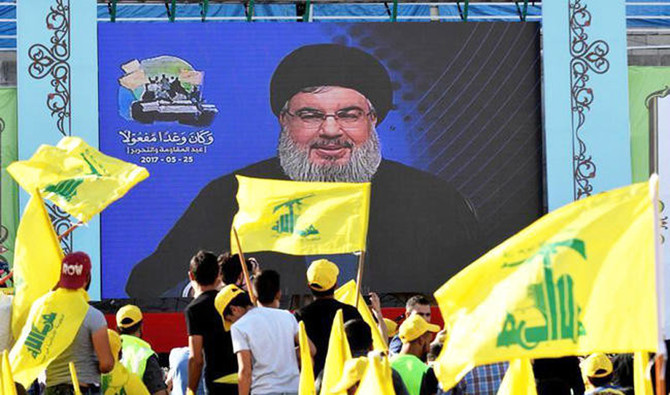
Al-Yamani said that Hezbollah’s support for the Houthis was evident. (Reuters/File)
Updated 12 July 2018
Follow

Rein in Hezbollah, Yemeni foreign minister tells Lebanon

  • The Arab coalition said on Monday that it had evidence of Hezbollah’s involvement in training Houthi militias
  • The Lebanese Foreign Ministry did not comment on the Yemeni demand

BEIRUT: Yemen’s foreign minister has called on Lebanon’s caretaker government to “rein in” Hezbollah and its aggressive tactics in support of the Iranian-backed Houthi militia.

“The Republic of Yemen reserves the right to present the matter to the Arab League, the Organization of the Islamic Conference and the Security Council,” Khalid Hussein Al-Yamani said in a letter to Lebanese Foreign Minister Gebran Bassil. The contents of the letter were aired by Sky News. 

Al-Yamani said that Hezbollah’s support for the Houthis was evident in a recent televised address by its Secretary-General Hassan Nasrallah, who called on the Houthis to fight the Yemeni government forces, and expressed “his party’s ambition to fight in Yemen against the internationally recognized legitimate authority.”

The foreign minister described the address as “blatant interference in the internal affairs of my country, which would seriously damage Yemen’s national security and fuel the flames of war.”

“The Yemeni government condemns Hezbollah’s statements and practices, including participation in training, planning and incitement and supporting the coup movements,” he said.

The Arab coalition said on Monday that it had evidence of Hezbollah’s involvement in training Houthi militias.

The Lebanese Foreign Ministry did not comment on the Yemeni demand.

However, Mustafa Alloush, of the Future Movement, told Arab News: “The meaning of this message is that Hezbollah’s damage to Lebanon continues. 

“The Lebanese government will not respond to this message, not because it supports Hezbollah but because it is unable to restrain the party,” he said.

The situation in Yemen was the focus of a recent meeting between UAE Ambassador to Lebanon Hamad Said Al-Shamsi and the UN Coordinator in Lebanon, Bernell Dahler Cardel.

Al-Yamani said that talks focused on “the integrated humanitarian plan that is being implemented to ensure easy access and provision of aid, as well as the protection of unarmed civilians through close coordination between the legitimate forces and international humanitarian organizations.”

He highlighted support for the efforts of UN Special Envoy Martin Griffiths, confirming that Houthi militias should withdraw from territories they occupied illegally as a prerequisite for accelerating peace negotiations.


Israeli Druze leader says Syrian community ‘besieged’ months after clashes

Updated 12 sec ago
Follow

Israeli Druze leader says Syrian community ‘besieged’ months after clashes

  • “They aren’t allowed to bring in any humanitarian aid, including the aid we’re trying to deliver,” Sheikh Mowafaq Tarif told AFP
  • Clashes erupted last July in southern Syria between Druze fighters and Sunni Bedouin tribes

JULIS, Israel: Seven months after deadly clashes between Syria’s Druze minority and government-backed forces, the spiritual leader of Druze in neighboring Israel said members of the community across the border remained in peril.
“They’re still besieged — completely encircled. They aren’t allowed to bring in any humanitarian aid, including the aid we’re trying to deliver,” Sheikh Mowafaq Tarif told AFP in an interview this week.
The cleric spoke in Julis, a quiet Druze village in northern Israel, where the community has set up an “emergency room” to coordinate aid efforts for Druze in Syria.
Israeli and Druze flags hang on the walls of the room, alongside posters in Hebrew and Arabic calling for an end to the killing of Syrian Druze.
The Druze are followers of an esoteric religion that split from Shiite Islam centuries ago. Its adherents are spread across parts of Syria, Israel, Lebanon and the Israeli-occupied Golan Heights.
Clashes erupted last July in southern Syria between Druze fighters and Sunni Bedouin tribes.
The Syrian authorities said their forces intervened to stop the clashes, but witnesses and monitors accused them of siding with the Bedouin.
Israel bombed Syria during the violence, saying it was acting to defend the minority group.
The Syrian Observatory for Human Rights said the fighting left more than 2,000 people dead, including 789 Druze civilians who were “summarily executed by defense and interior ministry personnel.”
The UN Office for the Coordination of Humanitarian Affairs estimated that some 187,000 people were displaced by the violence.
- ‘Why not let them return?’ -

“There are still more than 120,000 people displaced from their homes,” Sheikh Tarif said.
“Thirty?eight villages have been captured, and residents aren’t allowed to return. There are more than 300 captives, including children and women.”
AFP was unable to verify those claims.
Although a ceasefire was reached in July, access to Sweida remains difficult.
Residents accuse the government of imposing a blockade on the province, which Damascus denies. Several aid convoys have entered since then.
“Why not let them return to their villages? We’re in the depths of winter and that is a mountainous area. It’s very cold,” Tarif said.
With Syria’s government and Kurdish-led forces agreeing last month to integrate Kurdish fighters and civil institutions into state structures, Sweida is the last major area outside Damascus’s control.
Tarif said the community did not need government security forces in the region.
“The Druze have forces capable of defending themselves and maintaining order,” he said, referring to Syrian government forces as jihadists and “Islamic State members.”
Many in Syria remain wary of Sharaa, given that the jihadist group he once led started out as an Al-Qaeda affiliate and many of its former members are in his government.
Israel’s leaders have repeatedly referenced Sharaa’s jihadist past in calling for the West not to legitimize him.
Nevertheless, Israel and Syria, which have no official diplomatic ties, have held several rounds of direct talks in recent months.
Following negotiations in January, and under US pressure, both sides agreed to set up an intelligence?sharing mechanism as they moved toward a security agreement.
One issue under discussion is the possibility of Syrian Druze working in Israel.
Sheikh Tarif confirmed “that is something we have heard” and added that he wished any Syrian could come to work as a daily laborer “because the (economic) situation in Syria is very difficult.”
He also called for Druze across the Middle East to be able to visit their religious sites in neighboring countries, “just as our Christian and Muslim brothers visit their holy places” in states with which they may not have diplomatic relations.
“The Druze also deserve to access and pray at our holy sites in Syria and Lebanon and for them to come visit our holy places” in Israel, he said.