

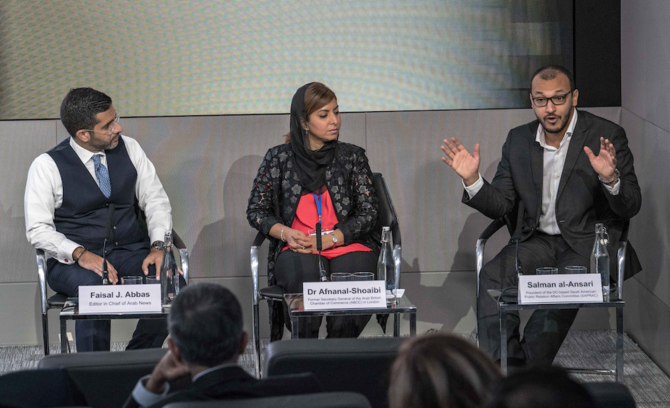

LONDON: Saudi Arabia’s Vision 2030 will bring tangible opportunities — but better communication of the reforms, quicker processes, and a “one-stop-shop” for businesses looking to enter the Kingdom are needed to attract long-term investors, an Arab News-moderated panel heard Wednesday.
Greater transparency and clarity when it comes to the judiciary and the rule of law was one of the key areas highlighted at the event at the 12th BMG Economic Forum at the London Stock Exchange Group.
During a panel on “Brand KSA: Tackling Investors Perception of the Kingdom of Saudi Arabia,” moderator Faisal J. Abbas, editor in chief of Arab News, the official media partner of the event, questioned panelists on the gap between what Vision 2030 aims to achieve and the reality on the ground, as well as investors’ common misconceptions and stereotypes about the Kingdom.
Dr. Afnan Al-Shuaibi, former Secretary General of the Arab-British Chamber of Commerce (ABCC) in London, responded to some media reports that questions whether Saudi Arabia is doing too much, too soon.
“People think we are going too fast, I don’t think we are — it’s because before we were too slow,” she said. “Right now the Kingdom of Saudi Arabia is not a place for people who are slow. You are either in or your are out.”
Praising the move by the Kingdom to lift the ban on women driving, Al-Shuaibi spoke how she recently traveled to Saudi Arabia to obtain her driving licence — and spoke how easy the online processes were to secure the documentation allowing her behind the wheel.
This, she highlighted, is a demonstration of the forward-thinking nature and digitalization of the Kingdom and how the country is evolving in line with the Vision 2030 reforms.
That being said, there is room for further improvement before Saudi Arabia determines its ambitious goals for the future.
Abbas asked the audience for a show of hands of those who felt there was enough information in the public sphere about investing in the Kingdom.
Addressing the overwhelming majority who felt that more information is needed, Al-Shuaibi said the problem is a combination of many factors.
“I think there are good efforts, but not efforts combined,” she said.
“The problems with any investor or anyone wishing to do business in Saudi Arabia (is) they don’t know where to start. Do they start with the commercial office or the embassy? Do they start with organizations dealing with business, whether it is the Chamber of Commerce, whether it is a business council? It is not really clear where to get the accurate information from.
“I think there has to be a one-stop shop that offers that.”
Al-Shuaibi said the one stereotype about Saudi Arabia that needs to be challenges is that it is an “easy cash-in-cash-out” pace to invest.
That is not the case any more, she said.
“Saudi Arabia is looking for partners, it not looking for people to make a quick business deal. We need long and sustainable relationships with investors.”
Fellow panelist Salman Al-Ansari, president of the Washington-based Saudi American Public Relation Affairs Committee (SAPRAC), said Vision 2030 needs to be put into context before addressing what needs to be done in order for the country to be more approachable to foreign investment.
“Look at Saudi Vision as like a chair with four legs; the first is economic diversification, the second is government, the third is accountability and the fourth is investing in human capital. It’s absolutely true that we have not been doing enough to tell the people outside and also inside Saudi Arabia about these four pillars and what they mean for the future of the Saudi economy. It still needs a lot of work.”
Al-Ansari said while there are a lot of regulations helping investors come to Saudi, there is still a long way to go and said implementing new controls to reduce restrictions on foreign investments is “10 times more important than PR campaigns encouraging investment into Saudi Arabia.”
“It is all about perception; most of the companies that do business in Saudi Arabia — they have regional hubs mostly in Dubai, and what they do they go and visit Saudi Arabia and get the deal signed and go back,” he said. “Saudi Arabia wants to get rid of this business model. It has enough geography and resources to be the hub.”
The panelists also discussed how foreign investors coming into the Kingdom need to understand that the idea of “quick and easy cash” no longer exists and the uncertainty surrounding the potential fallout of Brexit may be a deterrent for Saudi investors into the United Kingdom.
Abbas also raised the question on the ease of doing business to members of the audience, who raised the the challenges of dealing with the judicial system and the transparency of its operations and processes and the difficulties of issuing visas to international business visitors.
Al-Ansari said there was “doubt there are some ambiguity” and clarity was needed.
Al-Shuaibi said that, while there is criticism toward some of Saudi Arabia’s policies and approaches, the time is now for investors to turn to the Kingdom for business opportunities.
“There is a great potential now in Saudi Arabia and I think it is very important that our partners, whether it here in the UK, or in Washington, or anywhere else, this is the time for people to join in what is happening in Saudi Arabia,” she said.
“All the negativities that have been discussed — although I prefer to call them challenges — I want to say, look where we were and now look where we are. Because of the vision from the leadership, we are following a path that has been very well instructed and I think the golden objective is very clear.
“So I hope each and every one who has attended this forum can be part of it because the end result can be amazing.”
Al-Ansari concluded by saying: “There is no doubt that Saudi Arabia is heading towards a bright, bright future. We want to accelerate that and attract foreign investors who can contribute to the Saudi vision.”


