

London Stock Exchange chairman hails Saudi Arabia’s ‘forward-thinking leadership’ at BMG forum

Chairman of London Stock Exchange Group (LSEG), Donald Brydon, at the 12th BMG Economic Forum in London. (AN/ Ziyad Alarfaj)
Updated 16 July 2018
Follow

London Stock Exchange chairman hails Saudi Arabia’s ‘forward-thinking leadership’ at BMG forum

  • Donald Brydon praised Saudi Arabia for investing in human capital and the nurture of small and medium-sized enterprises in the Kingdom
  • The high-level forum will discuss investment opportunities in Kingdom

LONDON: The chairman of the London Stock Exchange Group has urged Saudi Arabia to press on with its Vision 2030 reforms, saying the UK was a “natural partner” in the Kingdom’s economic diversification strategy.

Speaking at the opening of the annual BMG Economic Forum, held in conjunction with Arab News, LSE chairman Donald Brydon said London would would provide “a gateway and a bridge” for international capital for such privatizations.

“The Kingdom’s time for privatizations is now, and the UK is the natural partner to ensure the successful delivery of these,” Brydon told attendees of the forum held at the bourse’s London headquarters.

“London is especially well placed to provide the Kingdom a gateway and a bridge to global investors and attracting foreign direct investment to London’s internationally oriented investor base.

“We can draw on our experiences to support the Kingdom as it takes its rightful place as a global investment power hub and to help deepen liquidity in the Saudi capital market.”

The privatization of key state assets is a central part of Saudi Arabia’s Vision 2030 strategy, unveiled in 2016, as part of a strategy to reduce its dependence on oil revenues.

“Privatizing selected government services will improve quality of services and reduce government’s spending while taking into account citizens’ interest,” the Vision 2030 program stated, and “will also help the government to refocus its efforts on its legislative and organizational roles.”

“Moreover, the program will attract foreign direct investments and improve the balance of payments,” it added.
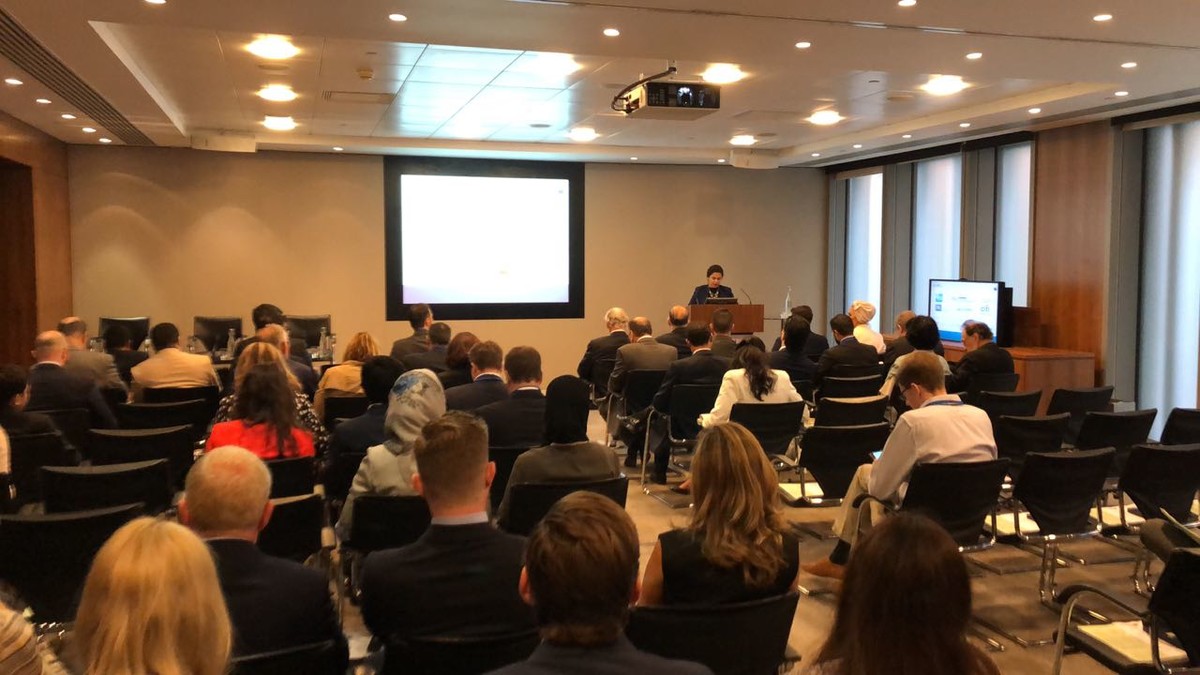


An audience of government officials, regulators, and industry chiefs at the 12th BMG Economic Forum at London Stock Exchange on Wednesday, July 11, 2018. (AN/ Ziyad Alarfaj)

Brydon hailed Saudi Arabia’s “forward-thinking leadership” as he addressed government officials and industry chiefs at the forum in London. He praised Saudi Arabia for investing in human capital and the nurture of small and medium-sized enterprises (SMEs) in the Kingdom.

“The London Stock Exchange is committed to being a strategic partner with the Kingdom to help deliver the Saudi Vision 2030 and beyond,” Brydon said.

Brydon said that Saudi Arabia’s privatization program differed significantly from early attempts by Gulf states in the 1990s to open key areas of the economy to the private sector.

Such moves, he said, ultimately proved unsuccessful, due to limited political buy-in and the failure to provide agreements on terms and conditions for private investors, together with concerns over the loss of control of key industries.

“The good news is that Vision 2030 addresses these concerns and puts in place the framework for successful privatizations,” he said.

Central to the Saudi government’s reform program is the mooted sale of around 5 percent in Saudi Aramco, the world’s largest oil company, which may raise as much as $100 billion.
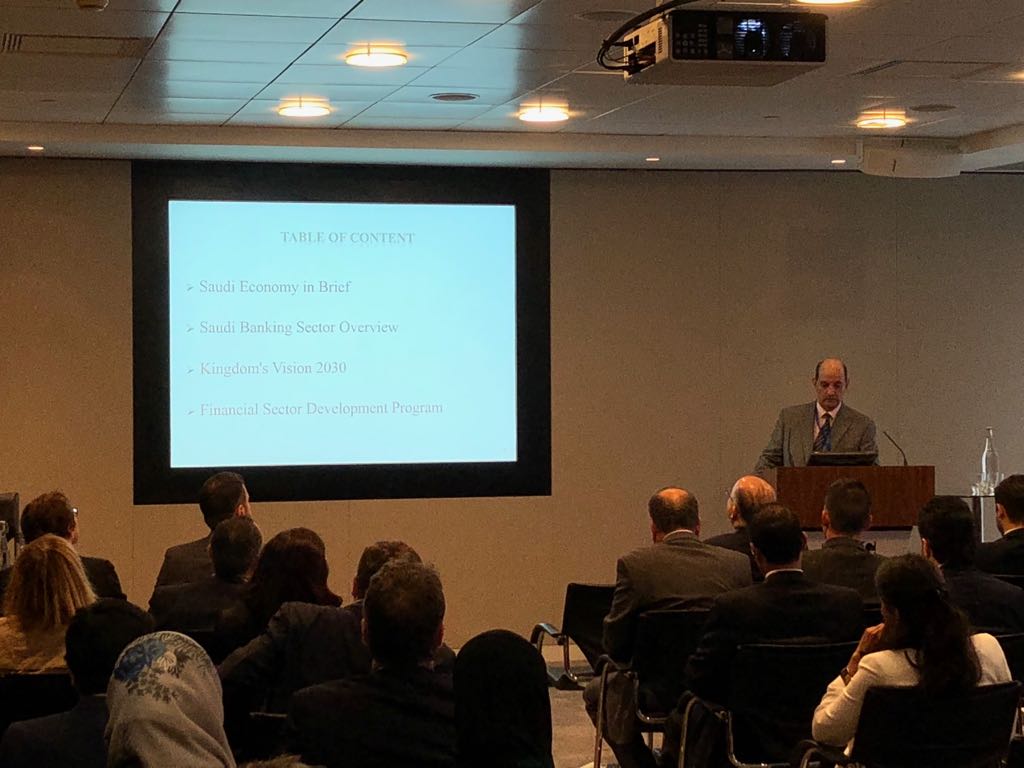


 Talat Hafiz, Secretary General of the Media and Banking Awareness Committee - Saudi Banks, led the first panel of the 12th BMG Economic Forum, under the theme 'Business and Financial Environments in Saudi Arabia’ on Wednesday, July 11, 2018. (AN/ Ziyad Alarfaj)

The London Stock Exchange is among the international exchanges vying for part of the listing, alongside bourses in New York and elsewhere.

Originally intended for 2018, the IPO now appears unlikely to happen until 2019 at the earliest. Officials at Aramco and the Saudi stock exchange (Tadawul) have so far declined to say whether the listing will occur on both Tadawul and an international exchange, or whether all shares will be listed domestically.

Brydon noted that the London Stock Exchange had raised nearly $400 billion from international privatizations since 1984, with around $290 billion of that figure raised from non-UK privatizations. 

He praised the “far-reaching and world-leading” stock market reforms introduced by Tadawul in the past years, which have prompted index providers MSCI and FTSE Russell to upgrade Saudi stocks to emerging market status this year.

These upgrades, due to be implemented next year, are forecast to attract as much as $50 billion worth of passive and active money into Saudi stocks.

The BMG Economic Forum addressed wider investment opportunities in Saudi Arabia and the Kingdom’s vision for the future.

“This is a new era for Saudi Arabia. An era of great opportunities coupled with great challenges,” said the chairman and CEO of BMG Financial Group, Basil M.K. Al-Ghalayini, as he officially opened the forum.

“Through this forum today, I am sure we can highlight these opportunities and learn how to manage these challenges,” Al-Ghalayini added.

Government officials, regulators, and industry chiefs gathered on the iconic atrium balcony at the London Stock Exchange as the daily 60-second countdown officially marked the start of Wednesday’s trading — and served as a precursor to the forum.

Al-Ghalayini and Dr. Robert Barnes, CEO of Turquoise and global head of primary markets at the London Stock Exchange Group, stepped forward and completed the daily ritual of placing a bespoke engraved glass tablet onto the podium, setting off the 8 a.m. bell.

Talat Hafiz, secretary general of the Media and Banking Awareness Committee at Saudi Banks, led the first panel of the forum, under the theme “Business and Financial Environments in Saudi Arabia.”

“Saudi Arabia is a one-stop shop for investments; we are the heart of the Arab world and an investment powerhouse,” said Hafiz.

Hussain Shobokshi, businessman and consultant and columnist, said: “Our biggest commodity used to be oil. Now, I believe our biggest commodity is youth.”

Using space science to protect Saudi Arabia’s environment

Updated 9 sec ago
Follow

Using space science to protect Saudi Arabia’s environment

  • Kingdom is harnessing satellite technology to forecast disasters, boost agriculture

RIYADH: Learning space science has delivered significant environmental benefits worldwide, helping many countries better understand and manage climate challenges. 

Saudi Arabia is now taking steps not only to explore the galaxy but also to invest in future generations who can apply space science to pressing environmental issues at home.

Last November, the Space Academy, part of the Saudi Space Agency, launched a series of seminars designed to enhance knowledge and develop skills in space science and technology, with a particular focus on Earth observation.

Running for nearly a month, the program formed part of a broader strategy to nurture national talent, raise scientific awareness, and build data capabilities that support innovation and research across the Kingdom.

Developing space sector can eventually help reduce some of the critical climate issues such as drought and air pollution. (AFP)

As efforts to strengthen the sector continue, important questions remain: How can space science translate into tangible environmental benefits? And how large is the global space economy?

In an interview with Arab News, Fahad Alhussain, co-founder of SeedFord, highlighted the scale of the opportunity and its environmental impact.

“To be frank, the slogan that we always use in space is that ‘saving the Earth from the space.’ It is all about this,” Alhusain told Arab News.

“You can recall a lot of related environmental issues like global warming, related to forests, related to the damage that happens to the environment. Without space, it would be almost impossible to see the magnitude of these damages.”

According to Alhussain, satellites have transformed how experts observe environmental changes on Earth, offering a comprehensive view that was previously impossible.

“By collecting data and using satellites… You can better analyze and measure so many things that help the environment,” said Fahad Alhussain. (Supplied)

He said that “the transformation of technology allows even the non-optical ways of measuring, assessing, and discovering what is going on in the environment … you can even anticipate fire before it happens in the forest.”

“You can detect the ice-melt down, you can get huge amount of information and can see it through the weather maps…there is a huge section in the economy for the environment,” Alhussain commented.

A 2022 report by Ryan Brukardt, a senior partner at McKinsey & Company, published by McKinsey Quarterly, found that more than 160 satellites currently monitor Earth to assess the impacts of global warming and detect activities such as illegal logging.

Brukardt cited NASA as an example of how advanced satellite tools are used to track environmental changes, including shifts in ocean conditions, cloud cover, and precipitation patterns. He also noted that satellite data can help governments determine when immediate action is needed, particularly in response to wildfires.

FASTFACT

Did You Know?

  • Satellites collect massive amounts of data, and AI is used to help interpret this information more efficiently and predict future outcomes.
  • The global space economy surpassed $600 billion in 2024 and is projected to exceed $1 trillion by 2030.
  • Saudi Arabia has established three key entities: the Supreme Space Council, the Saudi Space Agency, and the Communications, Space, and Technology Commission.

Beyond disaster response, satellites offer vital insights for agriculture. According to Brukardt’s report, scientists can use space-based data to monitor crop development and anticipate threats to harvests, such as drought or insect infestations.

These wide-ranging applications explain the rapid growth of the global space economy. 

According to World Economic Forum research, the sector is projected to reach $1.8 trillion by 2035, nearly tripling from $630 billion in 2023.

A deeper understanding of space and its applications offers Saudi Arabia, and the world, better tools to anticipate climate challenges, protect ecosystems, and safeguard biodiversity. (Supplied)

For Saudi Arabia, expanding space science capabilities could help address the country’s arid conditions by monitoring desertification and identifying sources of air pollution. Early detection of droughts, heatwaves, and crop stress could support more effective environmental planning and response.

Space-based data could also play a critical role in tracking environmental changes in the Red Sea and surrounding coastal ecosystems, strengthening marine conservation efforts and supporting the Sustainable Development Agenda.

As Alhussain emphasized, advancing knowledge in space science and satellite technology enables experts to measure environmental damage accurately and predict disasters before they occur, allowing for more effective responses.

By investing in space science education and research, the Kingdom can build national expertise, strengthen environmental protection policies, enhance food and water security, and contribute to global efforts to combat climate change—while also benefiting from the rapidly expanding space economy.

Ultimately, a deeper understanding of space and its applications offers Saudi Arabia, and the world, better tools to anticipate climate challenges, protect ecosystems, and safeguard biodiversity.

“By collecting data and using satellites, you can better analyze and measure so many things that help the environment,” said Alhussain.
“There will be patterns where you can warn people, scientists and decision makers to do something about it.”