Pakistani authorities arrest son-in-law of ousted premier Sharif

1 / 3
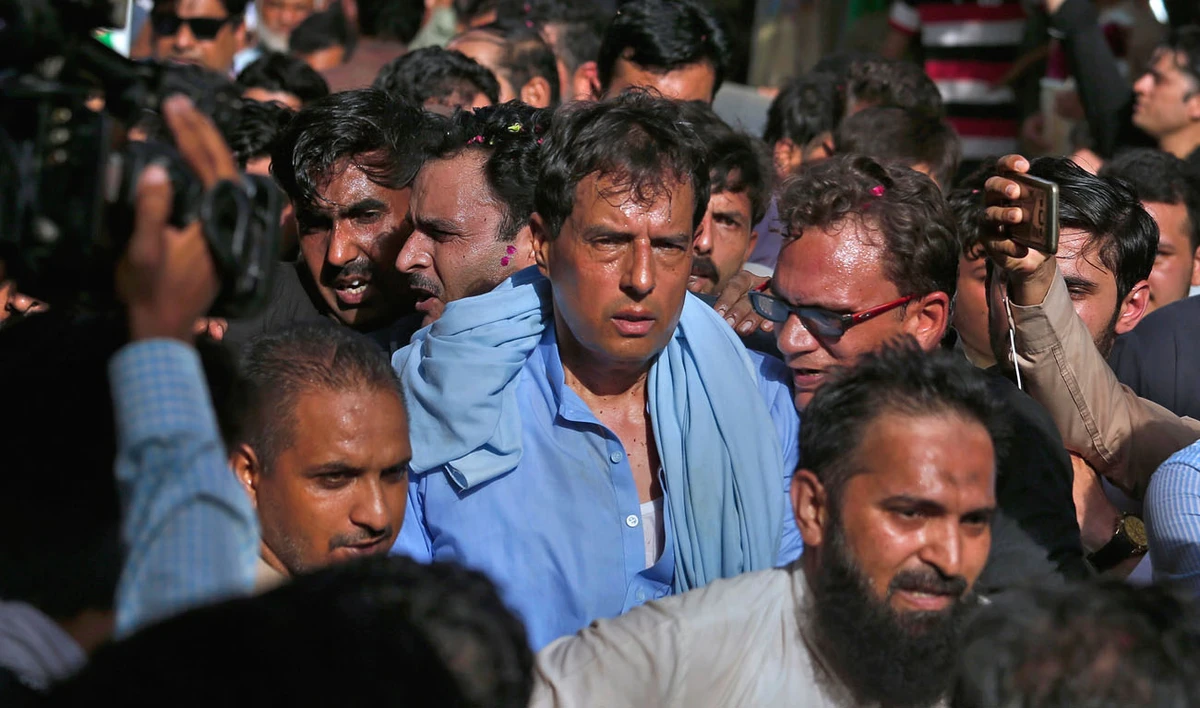
Mohammad Safdar, center, son-in-law of former prime minister Nawaz Sharif leads a rally in Rawalpindi, Pakistan, Sunday, on July 8, 2018. (ANJUM NAVEED/AP)
2 / 3
Pakistani authorities arrested Captain (Retd) Muhammad Safdar Awan in Rawalpindi on Sunday, July 8, 2018. (Photo courtesy: PML-N media wing)
3 / 3
Captain (Retd) Muhammad Safdar Awan waving hands to party supporters in Rawalpindi on July 8, 2018. (Photo courtesy: PML-N media wing)
Updated 09 July 2018
Follow

Pakistani authorities arrest son-in-law of ousted premier Sharif

  • Mohammad Safdar went into hiding after an anti-graft court convicted him last Friday
  • Safdar dramatically appeared with hundreds of supporters, marching down the city’s streets Sunday for hours with the crowd growing

KARACHI: Pakistani authorities on Sunday arrested the son-in-law of ousted Prime Minister Nawaz Sharif, who was on Friday sentenced in absentia to 10 years in prison over a corruption ruling linked to his family’s purchase of luxury flats in London.
Sharif’s daughter Maryam, seen as his chosen political heir, was sentenced to seven years in prison and her husband Muhammad Safdar was given a one-year jail term in a ruling many see as a blow to the Pakistan Muslim League-Nawaz (PML-N) party before the July 25 election.
Pakistan’s anti-corruption National Accountability Bureau (NAB) said in a statement that Muhammad Safdar handed himself in. Earlier in the day Safdar and supporters had driven around the garrison city of Rawalpindi holding impromptu rallies, local television showed.
“After continued raids of National Accountability Bureau (NAB) at his houses in Abbottabad, Mansehra and Haripur, Captain Safdar decided to surrender before NAB,” NAB said,
NAB also requested media not to air Safdar’s live speeches, saying they are against the law and the code of conduct of the country’s media regulator.
After the verdict on Friday, Safdar said “justice has been massacred” and railed against the judiciary.
Sharif was jailed as the family could not explain how the obtained funds to purchase four luxury flats in London’s exclusive Hyde Park area. Maryam was given a prison term for allegedly providing a forged trust deed, for which Safdar was a witness.
Sharif and his daughter would return to Pakistan on July 13 from London where they are tending to the veteran leader’s wife, Kulsoom, who is being treated for cancer and is in a coma after suffering a heart attack last month.
“We will reach Lahore on July 13,” Maryam told reporters.
Sharif and Maryam will face arrest on arrival in Pakistan just before the election, in which his party is in a tight race with opposition figure Imran Khan’s party.
Both Sharif and Maryam deny wrongdoing and plan to appeal the NAB decision.
Sharif had denounced the court proceedings against him as politically motivated and a judicial witch-hunt, often suggesting the military was to blame.
Pakistan’s military, which has ruled the nuclear-armed country for almost half its history, denies involvement in civilian politics.
Sharif was ousted by the Supreme Court in July 2017 and barred from politics for being “dishonest” by failing to report a monthly income of 10,000 Emirati dirhams ($2,723) from a company owned by his son. He denies drawing the monthly salary.

India, Arab League target $500bn in trade by 2030

Updated 01 February 2026
Follow

India, Arab League target $500bn in trade by 2030

  • It was the first such gathering of India–Arab FMs since the forum’s inauguration in 2016
  • India and Arab states agree to link their startup ecosystems, cooperate in the space sector

NEW DELHI: India and the Arab League have committed to doubling bilateral trade to $500 billion by 2030, as their top diplomats met in New Delhi for the India–Arab Foreign Ministers’ Meeting. 

The foreign ministers’ forum is the highest mechanism guiding India’s partnership with the Arab world. It was established in March 2002, with an agreement to institutionalize dialogue between India and the League of Arab States, a regional bloc of 22 Arab countries from the Middle East and North Africa.

The New Delhi meeting on Saturday was the first gathering in a decade, following the inaugural forum in Bahrain in 2016.

India’s Foreign Minister S. Jaishankar said in his opening remarks that the forum was taking place amid a transformation in the global order.

“Nowhere is this more apparent than in West Asia or the Middle East, where the landscape itself has undergone a dramatic change in the last year,” he said. “This obviously impacts all of us, and India as a proximate region. To a considerable degree, its implications are relevant for India’s relationship with Arab nations as well.”

Jaishankar and his UAE counterpart co-chaired the talks, which aimed at producing a cooperation agenda for 2026-28.

“It currently covers energy, environment, agriculture, tourism, human resource development, culture and education, amongst others,” Jaishankar said.

“India looks forward to more contemporary dimensions of cooperation being included, such as digital, space, start-ups, innovation, etc.”

According to the “executive program” released by India’s Ministry of External Affairs, the roadmap agreed by India and the League outlined their planned collaboration, which included the target “to double trade between India and LAS to US$500 billion by 2030, from the current trade of US$240 billion.”

Under the roadmap, they also agreed to link their startup ecosystems by facilitating market access, joint projects, and investment opportunities — especially health tech, fintech, agritech, and green technologies — and strengthen cooperation in space with the establishment of an India–Arab Space Cooperation Working Group, of which the first meeting is scheduled for next year.

Over the past few years, there has been a growing momentum in Indo-Arab relations focused on economic, business, trade and investment ties between the regions that have some of the world’s youngest demographics, resulting in a “commonality of circumstances, visions and goals,” according to Muddassir Quamar, associate professor at the School of International Studies, Jawaharlal Nehru University.

“The focus of the summit meeting was on capitalizing on the economic opportunities … including in the field of energy security, sustainability, renewables, food and water security, environmental security, trade, investments, entrepreneurship, start-ups, technological innovations, educational cooperation, cultural cooperation, youth engagement, etc.,” Quamar told Arab News.

“A number of critical decisions have been taken for furthering future cooperation in this regard. In terms of opportunities, there is immense potential.”