JEDDAH: Times have changed since the introduction of the Internet in the 1990s: Now, more than ever, people are exposed to the world via a laptop or mobile screen.
But behind these screens lurk dangers — unknown and disturbing features of the Internet that can’t always be detected — and children are the most vulnerable.
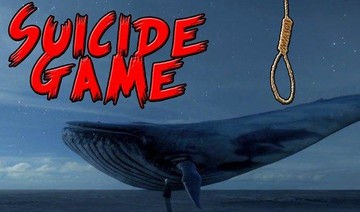
For the past two years, the term “Blue Whale game” has been popping up increasingly on social media. The game can’t be found on app stores and is not commercially available.
Named after the beaching of blue whales, a natural phenomenon by which the great mammals end their lives, the game implies the same — a death to end the game.
The game made its first appearance in 2016 and has many other names as well: “A Sea of Whales”, “Wake Me Up at 4:20 a.m.” and “A Silent House.”
A former Russian psychology student, Philipp Budeikin, 21, was reported to have been expelled from university after claiming he invented the game to “cleanse society” and rid it of “biological waste.” In other words, prey on the weak and vulnerable, and those with low self-esteem, and push them to their deaths.
Last year, a game “administrator” was sentenced to three years’ jail in Russia after he pleaded guilty to inciting 16 teenage girls to kill themselves.
The game consists of 50 daily challenges for precisely 50 days, asking people to show proof of their commitment or risk exposure and become a pariah in society. It is a game where teenagers are brainwashed and forced to commit horrendous acts, including self-harm.
The challenges, which vary from cutting one’s lip to carving the shape of a blue whale on one’s arm, encourage participants to gradually succumb to the administrator’s requests, ending in tragedy, as has been reported worldwide. An estimated 130 victims have killed themselves as part of the game’s final challenge.
This year has brought a rise in self-inflicted deaths in the region, sounding alarm bells. In early April, the 18-year-old son of a former Egyptian MP, Hamdy Al-Fakhrany, is believed to have been a victim of the suicide-linked game. A few weeks later, a 17-year-old girl from the Egyptian city of Sohag set fire to her family home, killing her mother and disabled brother in a suspected challenge issued by the game.
As many as 10 teenagers this year are suspected to have killed themselves in Egypt. Two Dubai-based teens were found dead in April after their social media accounts showed them discussing their suicides. India, the US, the UK, Brazil and Bangladesh have also reported suspicious deaths related to the Blue Whale game.
On June 30, tragedy struck in Saudi Arabia. Abdul Rahman Al-Ahmari, a 12-year-old in grade 7, died after a self-inflicted injury. Initial reports suggested the injury was prompted by the Blue Whale game. In an interview with Saudi official news channel Al-Ekhbariya, the boy’s father confirmed his son’s death, but said Blue Whale wasn’t involved, but something similar.
“I confirm that it wasn’t the Blue Whale game,” said Abu Sa’ad Al-Ahmari. “It was a gaming platform that held other games. I could see my son playing the game, but I didn’t see a pattern. There was no change in his behavior. He was everything a parent would ask for in a child. He was happy, loving, smart and witty. Everyone loved him.”
Al-Ahmari said he was aware of his child’s addiction to the game, but didn’t notice any change in his behavior. “He was secluding himself and not playing with his friends, although he did still play with his siblings,” Al-Ahmari said.
Small signs, but not enough to cause alarm.
“After his death, I asked them to open the game to see for myself. It was a devastating game. It breaks you. It (the game’s design) makes you believe that you are weak, taken for granted, neglected, alone and raises suspicion about everyone.”
With growing fears over Blue Whale and similar games in the UAE and Egypt, a school administrator at a Jeddah girls’ school said she planned to raise awareness about the games’ dangers.
Calling for parents to be vigilant, child development experts and family therapists were invited to speak to children about the importance of avoiding games that “don’t feel right” and to parents about how to recognize behavior changes in their children.
It’s not clear how children are finding the Blue Whale game since there are no websites or mobile apps available. Egypt’s National Telecom Regulatory Authority announced last month it was banning Blue Whale’s challenges from online sources. The UAE’s Telecommunications Regulatory Authority has also banned the game. However, it still manages to slip through the cracks.
Meanwhile, psychologists have urged parents to keep a close eye on their children’s behavior, checking if there are any markings on their arms or legs, monitoring their sleep patterns, and speaking with school counsellors about their academic progress and behavior in class.