

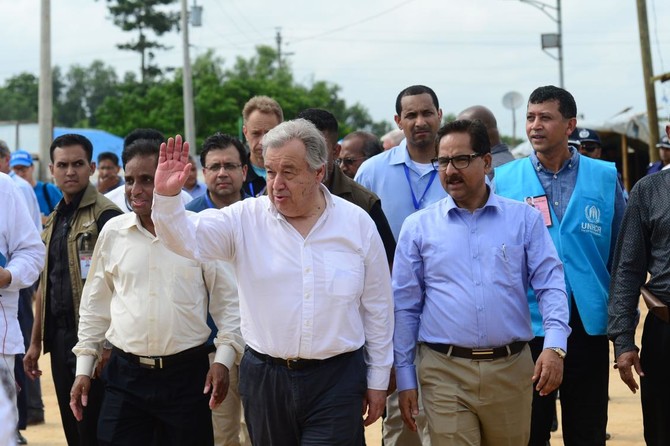


KUTUPALONG REFUGEE CAMP/DHAKA, Bangladesh: UN Secretary General Antonio Guterres on Monday called for more international pressure on Myanmar to create conditions safe for the return of Rohingya Muslims who have fled the country since a military crackdown last August.
“Repatriation should take place when the conditions for them to live with full dignity in their own country are there,” Guterres told a press conference at the Kutupalong Refugee Camp in the southeastern Bangladeshi town of Cox's Bazar.
Guterres and World Bank President Jim Yong Kim arrived in Bangladesh Sunday to assess the needs hundreds of thousands of Rohingya refugees driven from their homes in Myanmar. They met Prime Minister Sheikh Hasina before proceeding to the refugee center.
“It is unbelievable. My heart is broken,” said Guterres while briefing the local media at refugee camp in Ukhiya district.
“I have just heard unimaginable accounts of killing and rape from Rohingya refugees who recently fled Myanmar. They want justice and a safe return home,” he later tweeted after his meeting with some of the refugees.
The United Nations and Myanmar struck an agreement in May that the UN hopes will eventually allow thousands of Rohingya to return safely and by choice.
“This memorandum of understanding is the first step on the way of progressive recognition of the rights of the people,” Guterres said, speaking inside a bamboo shelter at the refugee camp.
“This is the kind of concession that was possible to obtain at the present moment from Myanmar ... Let’s test the sincerity of this concession and then let’s move on in relation to the full rights of the people.”
No one was available from the Myanmar government to comment on Guterres’s statement on Monday.
The visit by Guterres came 10 months after attacks by Muslim militants in Myanmar triggered a military offensive that has forced more than 700,000 Rohingya – a mostly Muslim ethnic minority – to escape to neighboring Bangladesh. The UN has described the crackdown as ethnic cleansing, an allegation Myanmar denies.
The MOU, details of which were reported by Reuters last week, does not offer explicit guarantees of citizenship or freedom of movement — which have been among the key demands of many Rohingya, a long-persecuted group that Myanmar doesn’t consider citizens.
More help sought from donors
The UN chief, accompanied by UN High Commissioner for Refugees Filippo Grandi, urged the international community to generate more funds to deal with the Rohingya refugee crisis.
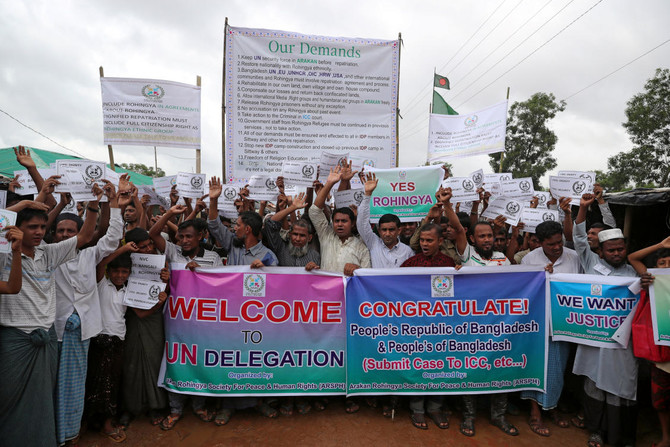
During the visit of the high-powered delegation, a group of Rohingya refugees staged a demonstration, demanding their safe return to Myanmar.
“Include Rohingya in agreements about Rohingya” and “Dignified repatriation must include full citizenship right as Rohingya ethnic group.”
Some Rohingya leaders have said they wouldn’t accept the deal in its current form.
Guterres said the agreement was UN’s effort to try to force the Myanmar government “to pave the way for potential future returns.”
“So it is like that it must be considered. Not as a final agreement on returns,” he said. “We know that Myanmar will probably not accept everything at the same time.”
He and Kim also stressed that while safe and voluntary returns of the Rohingya to Myanmar was the first priority, the immediate need was to support Bangladesh in dealing with the humanitarian disaster.
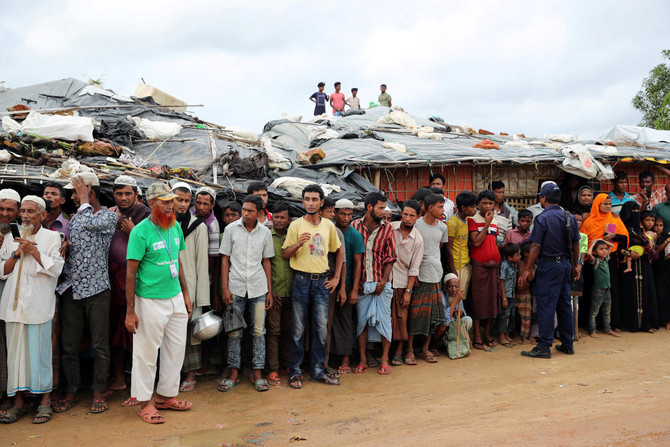
Their visit follows the World Bank’s announcement last week that it would provide $480 million to Bangladesh to help support the refugees, living in congested bamboo-and-plastic shelters built on sandy hills and at risk of deadly monsoon floods and landslides this month.
Kim said on Monday the World Bank would look for ways to bring more development resources to Bangladesh – among the world’s poorest nations – “because of the contribution they’ve made to the world in hosting the Rohingya.”
Rohingya who have arrived in Bangladesh in recent months have reported mass killings, arson and rapes by Myanmar security forces. Guterres and Kim met some of those victims at the camps, whose conditions they said were some of the worst they had ever seen.
“It is probably one of the most tragic stories in relation to the systematic violation of human rights,” Guterres said. “We need to push and will be pushing in the right direction.”
'Concrete solution' urged
This high-profile visit is indeed very significant and Bangladesh can achieve some advantage from this, said veteran Bangladeshi diplomat, Humayun Kabir.
“The UN has talked a lot over the Rohingya issue for the past 10 months. Now the UN chief will have the opportunity to validate everything they have talked about,” said Humayun, former Bangladesh ambassador to the US, told Arab News.
He said the donors’ funding for Rohingyas may also accelerate with the visit of the World Bank Group’s president as most donors prefer to donate through global channels such as the World Bank and the Asian Development Bank.
Talking about a possible stepping up of refugee repatriation after the UN chief’s visit, Humayun said: “Although they can’t play any direct role they still have influence over the situation.”
He suggests that much talk has been done; now it is time to do something concrete to put Myanmar in a situation that compels the country to repatriate the Rohingyas with “dignity and rights.”
Professor Amena Mohsin, international relations teacher at Dhaka University, told Arab News: “We need a concrete solution, not support.” She believes no result can be achieved without the US re-imposing sanctions on Myanmar.
“It’s a crime against humanity and no more a bilateral issue. The world, including China, should mount pressure on Myanmar to accelerate refugee repatriation,” said Mohsin.
She hopes that during the next UN General Assembly session in September, there may come a stronger decision against Myanmar on the country’s gross violation of human rights on the Rohingyas.
(With Reuters and AFP)


