TOKYO: Japanese Emperor Akihito canceled his public duties after suffering dizziness and nausea due to cerebral anemia, a condition caused by insufficient blood flow to the brain, a palace official said on Monday.
Akihito, 84, who has spent much of his nearly three decades on the throne seeking to heal the wounds of war, is set to step down on April 30 next year in the first abdication by a Japanese emperor in nearly two centuries.
The Imperial Household Agency, which manages the imperial family’s affairs, said the emperor was diagnosed with cerebral anemia after complaining of nausea and dizziness.
The emperor will be monitored while he rests at the Imperial Palace in Tokyo, the agency said.
Kyodo news agency said Akihito’s wife, Empress Michiko, will still meet Princess Ayako, daughter of Akihito’s late cousin, Prince Takamado, who was set to call on the imperial couple on Monday following the announcement of her engagement to a 32-year-old commoner.
Akihito, who has had heart surgery and treatment for prostate cancer, said in 2016 that he feared age might make it hard for him to fulfill his duties.
Once considered divine, Japan’s emperor is now defined by the constitution as “a symbol of the state and the unity of the people,” but has no political power.
Akihito and Michiko have spent much of their time trying to address the legacy of World War Two, which was fought in the name of his father Hirohito, and consoling victims of disasters or other woes. He is widely respected by average Japanese.
His heir is the 58-year-old Crown Prince Naruhito.


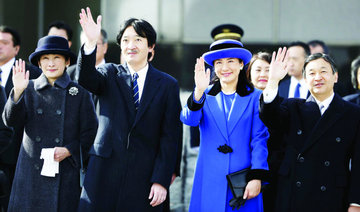
Japanese Emperor Akihito resting due to cerebral anemia

Japanese Emperor Akihito resting due to cerebral anemia
- Akihito, 84, who has spent much of his nearly three decades on the throne seeking to heal the wounds of war, is set to step down on April 30 next year
- The emperor was diagnosed with cerebral anemia after complaining of nausea and dizziness


Trump says he asked Putin not to target Kyiv for 1 week during brutal cold spell
- “I personally asked President Putin not to fire on Kyiv and the cities and towns for a week during this ... extraordinary cold,” Trump said
- Zelensky, for his part, thanked Trump for his effort and welcomed the “possibility” of a pause
KYIV: US President Donald Trump said Thursday that President Vladimir Putin has agreed not to target the Ukrainian capital and other towns for one week as the region experiences frigid temperatures.
There was no immediate confirmation from the Kremlin that Putin has agreed to such a pause.
Russia has been pounding Ukraine’s critical infrastructure, hoping to wear down public resistance to the war while leaving many around the country having to endure the dead of winter without heat.
“I personally asked President Putin not to fire on Kyiv and the cities and towns for a week during this ... extraordinary cold,” Trump said during a Cabinet meeting at the White House, adding that Putin has “agreed to that.”
Kremlin spokesman Dmitry Peskov was asked earlier Thursday whether a mutual halt on strikes on energy facilities was being discussed between Russia and Ukraine, and he refused to comment on the issue.
Ukrainian President Volodymyr Zelensky late Wednesday had warned that Moscow was planning another large-scale barrage despite plans for further US-brokered peace talks at the weekend.
Trump said he was pleased that Putin has agreed to the pause. Kyiv, which has grappled with severe power shortages this winter, is forecast to enter a brutally cold stretch starting Friday that is expected to last into next week. Temperatures in some areas will drop to minus 30 degrees Celsius (minus 22 Fahrenheit), the State Emergency Service warned.
“A lot of people said, ‘Don’t waste the call. You’re not going to get that.’” the Republican US president said of his request of Putin. “And he did it. And we’re very happy that they did it.”
Zelensky, for his part, thanked Trump for his effort and welcomed the “possibility” of a pause in Russian military action on Kyiv and beyond. “Power supply is a foundation of life,” Zelensky said in his social media post.
Trump did not say when the call with Putin took place or when the ceasefire would go into effect. The White House did not immediately respond to a query seeking clarity about the scope and timing of the limited pause in the nearly four-year war.
Russia has sought to deny Ukrainian civilians heat and running water over the course of the war, which began with Russia’s full-scale invasion on Feb. 24, 2022. Ukrainian officials describe the strategy as “weaponizing winter.”
Last year was the deadliest for civilians in Ukraine since 2022 as Russia intensified its aerial barrages behind the front line, according to the UN Human Rights Monitoring Mission in the country.
The war killed 2,514 civilians and injured 12,142 in Ukraine — 31 percent higher than in 2024, it said.


