MAUNGDAW, Myanmar: The transit camp in Myanmar’s Rakhine state stands ready to welcome back 150 Rohingya refugees from Bangladesh every day.
But on most days it lies completely empty, as members of the stateless minority dread returning to a place they were violently driven from by the military, and Myanmar makes little effort to reassure them things will be different this time.
“We have been ready to receive them since January, when we opened,” said Win Khaing, immigration director at Nga Khu Ra, standing in the desolate camp with reporters on Friday as part of a two-day government-chaperoned trip to the area.
The result is a stand-off, as Myanmar immigration officials wait in empty offices shuffling papers and arranging biometric equipment but with little to no work to do except greet visiting delegations and journalists.
Fewer than 200 Rohingya Muslims have been resettled in Myanmar’s northern Rakhine state from the 700,000 who fled a violent army crackdown in August.
Rohingya women say they were raped by security forces, while witnesses described summary executions and a merciless campaign of violence that the UN has said amounts to ethnic cleansing.
Myanmar says it only targeted militants, although the military has admitted one instance of executing captured suspects.
Even the limited number of Rohingya who have returned have all done so under murky circumstances.
In April the government trumpeted the arrival of a Rohingya family of five, but it was later slammed as a PR stunt as it emerged they had come from a buffer area between the two countries that is technically part of Myanmar.
Local authorities nevertheless created a billboard with several large photos of the family near the border, heralding the “photo records of steps of repatriation.”
In recent months, Myanmar says dozens have been repatriated after crossing over from Bangladesh illegally.
It says others who tried to flee to Bangladesh by boat but accidentally washed up back in Myanmar have also been sent to live with relatives after being processed at the transit camp.
Bangladesh does not recognize these as legitimate returnees.
“The repatriation process has not begun,” Bangladesh refugee commissioner Mohammad Abul Kalam said.
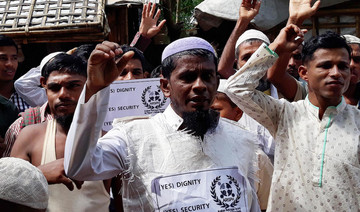
Nine Rohingya purportedly released from prison in May after crossing back over illegally were brought by Myanmar officials to meet journalists on Friday.
But cracks quickly emerged in the story, with some saying they had never even been to Bangladesh and were “repatriated” from prison in Myanmar.
“We were arrested in November last year (in Myanmar) and sentenced to four years imprisonment each under the immigration act,” said Yar Sein, 35, a farmer and father-of-four.
“We were arrested from school and accused of coming from Bangladesh. We haven’t been to Bangladesh.”
The prolonged delays in repatriation have also strained relations with Bangladesh, which plans to send a protest note after a 10-year-old Rohingya boy in the buffer zone was struck by a bullet from the Myanmar side on Thursday.
Myanmar says it fired at people attempting to damage the border fence.
As the two countries blame each other for the delay, Myanmar has embarked on what it says is a massive development project in northern Rakhine, bulldozing Rohingya towns and remaking the entire landscape in the name of reconstruction.
The UN has said conditions in Rakhine are not ripe for a safe, voluntary and dignified repatriation, but signed an agreement with Myanmar to assess conditions on the ground to help refugees make an informed decision.
Myanmar has faced global condemnation for its treatment of the Rohingya, and Amnesty International said this week that several senior military figures should be tried for crimes against humanity.
A US Trafficking in Persons (TIP) report Thursday downgraded Myanmar for failing to protect Rohingya Muslims fleeing the crackdown and leaving them vulnerable to exploitation and trafficking rings.
The Rohingya are loathed by many in Myanmar, where they were stripped of citizenship and branded illegal immigrants from Bangladesh despite calling Rakhine their homeland.
Min Aung Hlaing, the army chief, said last month that Rohingya have nothing to fear as long as they stay in places “designated” for them, raising concerns that they would be placed back into the apartheid-like conditions they escaped.
Ye Htoo, district administrator in Maungdaw — the epicenter of violence in the western state — told reporters Myanmar is “planning to create a good environment for them to stay if they come back.”
Still, he admitted, “there is no one” at the camps.
Local residents have also spoken of not being willing to coexist alongside their former neighbors, whom many associate with a Rohingya militant group that attacked police posts.
Khin Soe, a 30-year-old Buddhist ethnic Rakhine woman from Inn Din village, said they are still afraid.
“If the government really plans to relocate them here again, we are leaving this place.”


Myanmar transit camps sit empty as Rohingya fear return

Myanmar transit camps sit empty as Rohingya fear return
- Fewer than 200 Rohingya Muslims have been resettled in Myanmar’s northern Rakhine state from the 700,000 who fled a violent army crackdown in August
- Even the limited number of Rohingya who have returned have all done so under murky circumstances


Indonesia: Discussions with Board of Peace ‘on hold’ due to Iran war
- Indonesia’s participation on the board has drawn criticism from experts and Muslim groups at home
JAKARTA: Indonesia’s foreign minister said talks on US President Donald Trump’s Gaza “Board of Peace,” of which the Southeast Asian nation is a key troop-contributing member, were on hold due to the Middle East war.
The US and Israeli air war against Iran has killed scores of civilians, thrown global air transport into chaos and sent oil prices surging after the effective closure of the Strait of Hormuz.
“All BoP discussions are on hold as all attention has shifted to the situation in Iran,” Minister Sugiono, who goes by one name, said late on Tuesday in response to a question on calls for Indonesia to exit the peace board in the aftermath of the fresh conflict in the Middle East.
“We will also consult with our friends and colleagues in the Gulf because they are also under attack,” Sugiono told reporters after attending an event alongside President Prabowo Subianto.
Indonesia’s participation on the board has drawn criticism from experts and Muslim groups at home, who say it compromises the world’s largest Muslim-majority nation’s longstanding support for the Palestinian cause.
Indonesia backs a two-state solution.
The Indonesian Ulema Council, a leading clerical body, said on March 1 that Indonesia should leave the board, citing Trump’s attack on Iran as rendering the initiative ineffective.
Meanwhile, Nahdlatul Ulama, Indonesia’s largest Muslim organization, said Jakarta should use its position to press Israel and the United States to halt the violence.
Trump first proposed the board in September when he unveiled a plan to end Israel’s war in Gaza, later expanding its remit to address other global conflicts typically handled by the United Nations.
Sugiono also said Prabowo is willing to be a mediator in the Iran war in a bid “to cool down and de-escalate the situation in the region.”
Indonesia is readying 1,000 troops for potential deployment in Gaza by early April as part of a proposed multinational peacekeeping force, its army said, as part of the UN-mandated International Stabilization Force. It has also been given the deputy commander role of the force.