Top Myanmar military officers should be tried for crimes against humanity -Amnesty

1 / 3
In this file photo taken on March 30, 2018, Myanmar military chief Senior General Min Aung Hlaing, followed by top officials, arrive for the oath taking ceremony of newly appointed Myanmar President Win Myint in the parliament in Naypyidaw. (AFP)
2 / 3
Senior General Min Aung Hlaing (L), Myanmar's commander-in-chief, shakes hands with National League for Democracy (NLD) party leader Aung San Suu Kyi before their meeting in Hlaing's office at Naypyitaw December 2, 2015. (REUTERS)
3 / 3
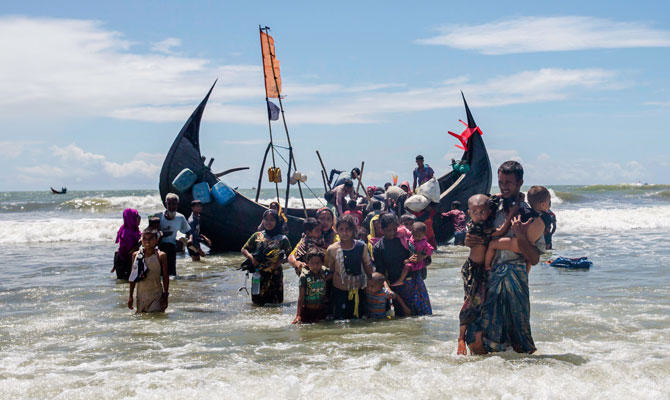
In this Sept. 14, 2017 file photo, a Rohingya man carries two children to shore in Shah Porir Dwip, Bangladesh, after they arrived on a boat from Myanmar. (AP)
Updated 27 June 2018
Follow

Top Myanmar military officers should be tried for crimes against humanity -Amnesty

  • Amnesty, which began its investigation in September, said in its report that the “military-led operations ... amounted to an orchestrated campaign of murder, rape, torture, and destruction aimed at punishing the Rohingya population
  • About 700,000 mostly Muslim Rohingya have fled to Bangladesh from largely Buddhist Myanmar since a military crackdown last August that the United Nations has called a “textbook example of ethnic cleansing

NEW YORK: Senior Myanmar military officials, including the commanders of its defense services and army, should face trial for crimes against humanity over the treatment of Rohingya minorities, Amnesty International said in a report on Tuesday.
Amnesty called for the United Nations Security Council to refer the report’s findings to the International Criminal Court (ICC) and impose a “comprehensive arms embargo” on the Southeast Asian country and financial sanctions against senior officials.
Contacted late on Tuesday, neither the Russian delegation to the United Nations, currently presiding over the UN Security Council, nor the Myanmar Mission to the United Nations were available for comment.
A spokesman for the Myanmar government also was not available for comment.
About 700,000 mostly Muslim Rohingya have fled to Bangladesh from largely Buddhist Myanmar since a military crackdown last August that the United Nations has called a “textbook example of ethnic cleansing.”
A separate Reuters special report https://reut.rs/2yLzrsV on Tuesday gave a comprehensive account of the roles played by two light infantry divisions in the offensive against the Rohingya.
Amnesty, which began its investigation in September, said in its report that the “military-led operations ... amounted to an orchestrated campaign of murder, rape, torture, and destruction aimed at punishing the Rohingya population in northern Rakhine State and at driving them out of the country.”
It named Senior General Min Aung Hlaing, the commander of Myanmar’s Defense Services, and his deputy and commander of the army, Vice Senior General Soe Win, and commanders of specific units that “committed many of the worst atrocities.”
The report also named eight other military members and three members of the Border Guard Police.
Amnesty said these people should face justice “for their command responsibility, their direct responsibility, or both.”
A spokesman for the Myanmar military was not available for comment.
In Myanmar, Rohingya are widely called “Bengali,” which they see as a derogatory term implying they are illegal immigrants from Bangladesh. Despite many Rohingya tracing their roots in Myanmar back generations, they have been denied citizenship.
Amnesty called on Myanmar to halt restrictions on freedom of movement and restore citizenship to the Rohingya.
In February, Reuters reported on the killing of 10 Rohingya men and boys by Rakhine Buddhists and security forces in the village of Inn Din.
Two Reuters journalists were jailed in December in Myanmar while reporting that story and remain in prison in Yangon, facing up to 14 years behind bars for allegedly violating Myanmar’s Official Secrets Act.
Myanmar has rejected most accusations of wrongdoing and has said it launched a legitimate counter-insurgency operation after attacks against its military by Rohingya militants last August.
In Myanmar there is no civilian oversight of military justice. The International Criminal Court, the world’s first permanent war crimes court, does not have automatic jurisdiction over Myanmar because it is not a member state.
However, the ICC has already been asked to consider a separate case dealing with Myanmar allegedly deporting Rohingya to Bangladesh, which is an ICC member state.
The ICC did not immediately respond to requests for comment outside business hours in The Hague.
If the UN Security Council referred Amnesty’s findings to the ICC, it would also grant the court jurisdiction to investigate.


Backlash as Australia kills dingoes after backpacker death

Updated 58 min 43 sec ago
Follow

Backlash as Australia kills dingoes after backpacker death

  • The euthanization program has stirred debate about how to manage the local population of dingoes
  • Wildlife experts said killing the animals was the wrong response and may threaten the island’s dingo population

SYDNEY: Australian authorities have sparked a backlash by killing a group of dingoes linked to the death of a young Canadian woman on an island in the country’s east.
The Queensland government said six animals were put down after 19-year-old backpacker Piper James’s body was found on January 19 at a beach on the World Heritage-listed island of K’gari.
The euthanization program has stirred debate about how to manage the local population of dingoes, a sandy-colored canine believed to have first arrived in Australia 4,000 to 5,000 years ago.
An autopsy conducted on James’ body found evidence “consistent with drowning” but also detected injuries corresponding to dingo bites.
“Pre-mortem dingo bite marks are not likely to have caused immediate death,” said a spokesperson for the Coroners Court of Queensland.
The coroner’s investigation into the cause of death was expected to take several weeks.
In response, the Queensland government said a pack of 10 dingoes involved would be euthanized after rangers had observed some “aggressive behavior.”
Six of the dingoes had already been euthanized, the state’s environment minister, Andrew Powell, told reporters Sunday.
“Obviously, the operation will continue,” he said.
The traditional owners of K’gari, the Butchulla people, said the state’s failure to consult with them before euthanizing the dingoes — or wongari in their language — was “unexpected and disappointing.”
“Once again, it feels as though economic priorities are being placed above the voices of the people and traditional owners, which is frustrating and difficult to accept,” the Butchulla Aboriginal Corporation said in a statement to Australian media this week.
‘You are food’
Wildlife experts said killing the animals was the wrong response and may threaten the island’s dingo population, estimated at just 70-200 animals.
Given their small numbers, killing a pack of 10 animals would harm the population’s genetic diversity, said Mathew Crowther, professor of quantitative conservation biology at the University of Sydney.
“There’s no moral from the dingoes’ point of view. They’re just being wild animals, doing wild things,” Crowther said.
Dingoes tend to lose their fear of people as they interact with tourists, some of whom defy advice against feeding the animals.
“That’s the worst thing you can do to a wild animal,” Crowther said.
“They just relate humans to food, and if you don’t give them food, well, you are food — that’s basically how it is.”
Dingoes are wild, predatory animals and need to be treated with respect, said Bill Bateman, associate professor in the school of molecular and life sciences at Curtin University.
The canines are more likely to attack children or people who are alone, and may be triggered when people turn their backs or run, he said.
“These are important animals, and therefore we need to change the way we deal with them, otherwise we’re just going to keep reacting to these attacks and driving the population of dingoes down,” Bateman said.
Wildlife managers, rangers, Indigenous people and tourism operators need to work together so that humans and dingoes can coexist on the island, he said.
Todd James, the father of Piper, has described on social media how his family’s hearts were “shattered” by her death.
News of the dingoes’ euthanization was “heart-wrenching,” he told Australian media, adding however that he recognized it may be necessary for safety because of the pack’s behavior.